Have you ever received a message like:
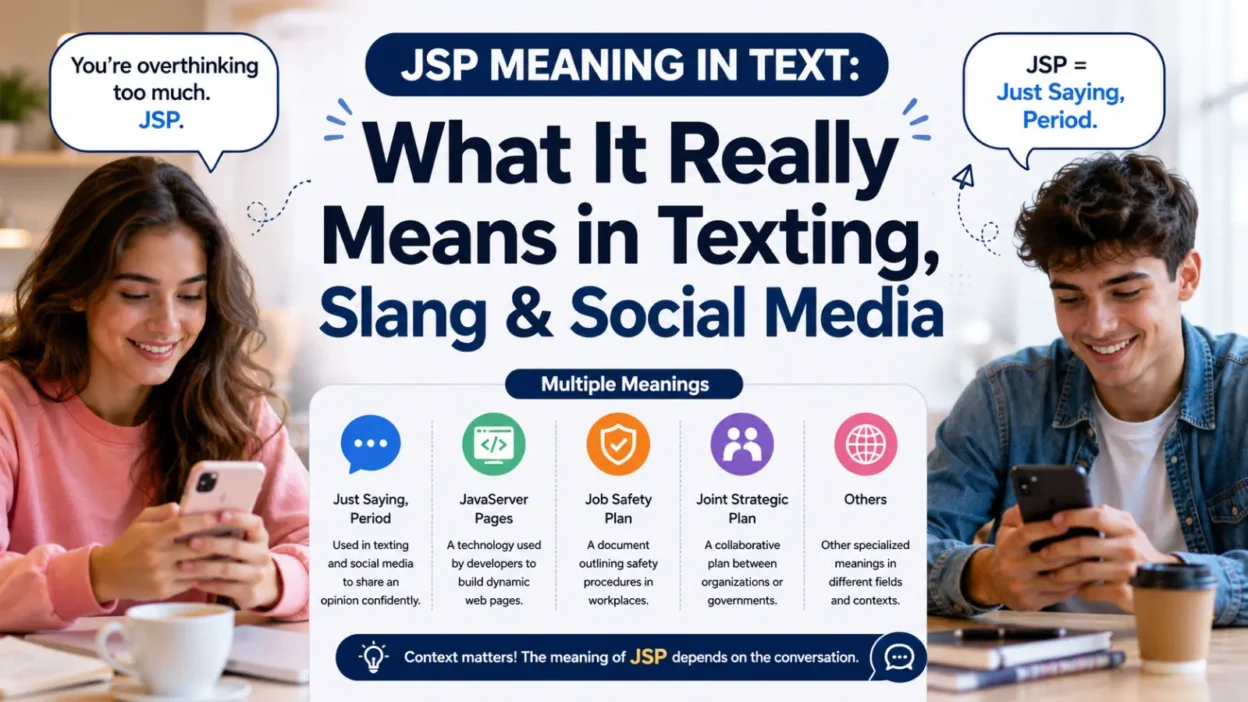
Alex: You’re overthinking it. JSP.
Taylor: Wait… what does JSP mean?
Or maybe you spotted JSP in a programming discussion where someone said:
“This website still uses JSP.”
Same three letters, but two completely different meanings.
That’s exactly why so many people search for JSP meaning in text. Depending on where you see it, JSP can either refer to “Just Saying, Period” in online conversations or “JavaServer Pages” in web development. Context changes everything.
Understanding internet slang today isn’t just about knowing definitions. It’s about recognizing tone, intent, and the community where the phrase is being used. Let’s break down every major meaning of JSP and see how people actually use it in real conversations.
Quick Definition & Meanings
JSP has multiple meanings depending on the conversation.
| Meaning | Used In | Tone |
|---|---|---|
| Just Saying, Period | Texting, Snapchat, Instagram, TikTok, WhatsApp | Opinionated, casual, confident |
| JavaServer Pages | Programming, coding, software development | Technical |
| Job Safety Plan | Construction, workplace safety | Professional |
| Joint Strategic Plan | Business and government | Formal |
| Japan Socialist Party | Politics and history | Informational |
For everyday texting and social media, Just Saying, Period is by far the most common slang meaning.
JSP = Just Saying, Period
This version emphasizes that the speaker has already made their point and doesn’t want to continue debating.
Example
“I think you deserve better. JSP.”
The phrase adds confidence while softening the statement slightly.
JSP = JavaServer Pages
Among developers, JSP refers to a server-side technology used for building dynamic web pages using Java.
Example
“The client still runs its website on JSP.”
Here, it has absolutely nothing to do with texting slang.
JSP = Job Safety Plan
Construction companies and industrial workplaces often shorten Job Safety Plan to JSP.
Example
“Complete the JSP before starting today’s work.”

JSP = Joint Strategic Plan
Businesses, military organizations, and government departments sometimes use JSP to refer to planning documents.
Example
“The leadership approved the new JSP for next year.”
What Does “Just Saying, Period” Actually Mean?
Unlike simply writing “just saying,” adding “period” makes the opinion sound firmer.
It usually means:
- That’s my opinion.
- I’m finished discussing it.
- Take it or leave it.
- No hard feelings—but I stand by what I said.
It often carries confidence without sounding openly aggressive.
Example
“You should ask for the promotion. JSP.”
The message encourages someone while making it clear the speaker isn’t looking for an argument.

JSP Meaning in Text & Messaging
People use JSP because texting lacks facial expressions and vocal tone.
Instead of writing:
“That’s just my opinion.”
They simply write:
“JSP.”
It saves time while signaling emotional intent.
In Private Chats
Friends often use JSP when giving honest advice.
“You deserve someone who texts back faster. JSP.”
In Group Chats
Someone may end a debate with:
“Pizza is better than burgers. JSP.”
Everyone understands it’s a playful opinion.
During Heated Conversations
Sometimes JSP helps end back-and-forth arguments.
“You ignored every message yesterday. JSP.”
Here, it signals finality.
Origin, Evolution & Social Media Spread
Unlike many internet slang terms that originated from meme culture, Just Saying has existed in spoken English for decades.
The abbreviation JSP emerged naturally as texting became faster and character limits encouraged shortcuts.
Today it appears on:
- TikTok comments
- Snapchat
- Instagram DMs
- Discord
- X (formerly Twitter)
- Facebook Messenger
Internet users continually shorten common expressions, and JSP fits that pattern alongside abbreviations like:
- IMO
- TBH
- FYI
- IDK
- SMH
Its popularity isn’t driven by one viral trend. Instead, it spreads through everyday digital conversations.
Real-Life Conversations
WhatsApp Chat
Emma: He’s still leaving you on read.
Lily: Maybe he’s busy.
Emma: If he wanted to reply, he would. JSP.
The phrase communicates honest advice without adding extra explanation.
Instagram DM
Jake: That outfit looks expensive.
Chris: Confidence makes everything look expensive. JSP.
Here it feels playful and self-assured.
TikTok Comments
Comment 1: This movie deserved better reviews.
Comment 2: Best superhero film this year. JSP.
The commenter signals confidence while expecting disagreement.
Emotional Pattern Behind JSP
People often choose JSP because it balances honesty with social protection.
Instead of sounding argumentative, it frames an opinion as personal rather than absolute.
That subtle difference keeps conversations lighter.
Psychological & Emotional Dynamics
Using JSP can communicate several emotional signals:
- Confidence
- Self-awareness
- Mild stubbornness
- Honest advice
- Emotional boundaries
- Friendly teasing
Internet slang helps people manage relationships.
A short abbreviation can soften criticism, reduce awkwardness, or show confidence without writing a long explanation.
That’s one reason slang evolves so quickly—it makes emotional communication more efficient.
Contextual Usage Guidelines
Social Media
Perfect for opinions, jokes, hot takes, and playful debates.
Example
“This song is underrated. JSP.”
Private Texts
Useful when giving advice or sharing honest feelings.
Example
“You deserve better friends. JSP.”
Close Friends
Works naturally because everyone understands the tone.
Casual Acquaintances
Use carefully since not everyone recognizes the abbreviation.
Professional Environments
Avoid using JSP in business emails or formal reports.
Many professionals will assume you mean JavaServer Pages instead of Just Saying, Period.
When NOT to Use JSP & Common Misconceptions
Avoid JSP when:
- Writing professional emails
- Talking with clients
- Communicating with teachers
- During serious conflicts
- Speaking with people unfamiliar with internet slang
Common Misconceptions
Myth: JSP always means JavaServer Pages.
Reality: In programming, yes. In texting, usually not.
Myth: JSP is rude.
Reality: Not inherently. Tone determines whether it sounds helpful, sarcastic, or dismissive.
Myth: Everyone knows what JSP means.
Reality: It’s less common than abbreviations like LOL or BRB, so some readers may misunderstand it.
Semantic Comparison Table
| Expression | Primary Meaning | Tone | Best Usage Context |
|---|---|---|---|
| JSP | Just Saying, Period | Confident | Honest opinions |
| JS | Just Saying | Casual | Friendly conversations |
| TBH | To Be Honest | Honest, reflective | Giving opinions |
| IMO | In My Opinion | Neutral | Discussions and debates |
| FYI | For Your Information | Informative | Sharing facts |
Although these expressions all introduce opinions, they carry different emotional weight. IMO sounds neutral, TBH suggests honesty, JS softens a point, while JSP signals stronger conviction by adding a sense of finality.
Similar Slang Terms Related to JSP
If you’re learning internet slang, you may also encounter:
- TBH — To Be Honest
- IMO — In My Opinion
- IMHO — In My Humble Opinion
- FR — For Real
- NGL — Not Gonna Lie
- SMH — Shaking My Head
- IDK — I Don’t Know
- FYI — For Your Information
- IYKYK — If You Know, You Know
- JS — Just Saying
These abbreviations often appear in the same conversations because they help express opinions, emotions, or reactions quickly.
Variations, Derivatives & Responding
Common Variations
- JS
- Just saying
- JSP!
- jsp (lowercase)
- Just saying lol
- Just saying 🤷
- JSP 😂
Casual Replies
- Fair enough.
- I get your point.
- Maybe you’re right.
- That’s true.
Funny Replies
- Bold opinion.
- Noted, professor.
- You came prepared.
- I’ll pretend I didn’t hear that.
Mature Replies
- I appreciate your honesty.
- Thanks for sharing your perspective.
- I’ll think about it.
- That’s a fair observation.
Generational & Regional Perspectives
Gen Z
Uses abbreviations naturally and often mixes JSP with emojis, memes, and reaction GIFs.
Millennials
Recognize internet abbreviations but may simply write “just saying” instead.
Older Generations
Many are unfamiliar with JSP and could interpret it as a technical abbreviation.
Global Internet Culture
For non-native English speakers, abbreviations like JSP often appear in TikTok captions, gaming chats, Reddit discussions, YouTube comments, and Discord servers. Many learn these expressions through repeated exposure rather than formal English lessons.
FAQs
What does JSP meaning in text?
Most commonly, it means Just Saying, Period, expressing a firm opinion or concluding a point.
What does JSP mean in programming?
In software development, JSP stands for JavaServer Pages, a Java-based technology for creating dynamic web applications.
Is JSP rude?
Not usually. It depends on tone and context. It can sound confident, playful, or slightly dismissive.
What does JSP mean on TikTok?
On TikTok, it almost always means Just Saying, Period, especially in comments and captions expressing opinions.
How should I reply to JSP?
You can respond with agreement, ask for clarification, or respectfully share a different opinion depending on the conversation.
Does JSP have more than one meaning?
Yes. Besides Just Saying, Period, it can also mean JavaServer Pages, Job Safety Plan, and Joint Strategic Plan, among other specialized uses.
Conclusion
The meaning of JSP in text depends entirely on context. In everyday messaging, it most commonly stands for Just Saying, Period—a concise way to express an opinion while signaling that you’ve said what you wanted to say.
In technical discussions, however, JSP almost always refers to JavaServer Pages, a well-known web development technology. Other professional fields may use it for terms like Job Safety Plan or Joint Strategic Plan.
As with many internet abbreviations, understanding the surrounding conversation is the key. Modern digital communication relies on shared context, subtle tone, and community norms.
Once you recognize those cues, JSP becomes much easier to interpret—and you’ll know exactly when it’s someone ending a debate with confidence or simply talking about Java code.

I am Maxwell Ford, the creator of meaningosho.com, where I explore the origins and clear definitions of everyday words. I built this platform to help readers easily decode complex vocabulary and deepen their understanding of language. Through my articles, I love sharing simple, engaging insights that make learning new words both fun and useful.