You’re chatting with a friend, and they reply:
Alex: “I’m doing pretty well today. HBU?”
If you’ve never seen it before, you might pause and wonder what HBU meaning in text actually is. Is it another Gen Z abbreviation? Is it something from TikTok? Or does it mean something completely different?
The answer is simple, but the way people use HBU can reveal a lot about digital conversations and modern communication. Short abbreviations like HBU save time, keep chats flowing naturally, and make conversations feel more casual.
As texting, social media, gaming, and messaging apps continue to shape how people communicate, HBU has become one of the internet’s most recognizable abbreviations.
If you’re scrolling through Instagram DMs, replying on Snapchat, chatting on WhatsApp, or commenting on TikTok, you’ve probably seen it countless times.
Let’s explore what HBU meaning in text really is, how people use it, and why it remains popular across the internet.
Quick Definition & Meanings
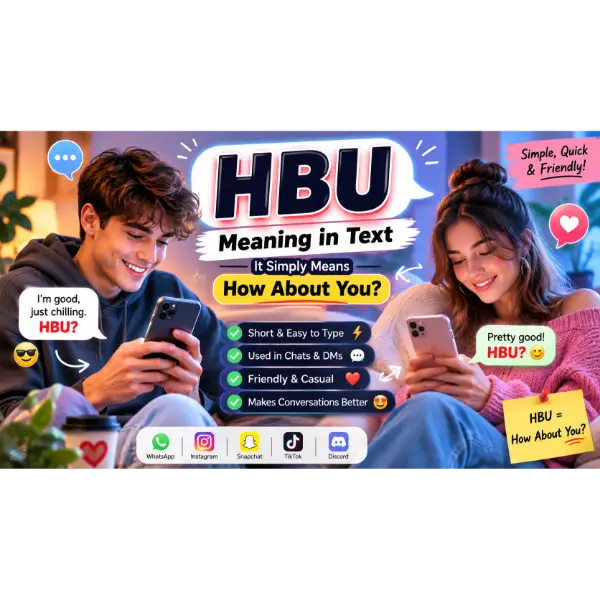
Primary Meaning: How About You?
The most common HBU meaning in text is:
People use it after sharing information about themselves to invite the other person into the conversation.
Example
“I’m staying home tonight. HBU?”
Instead of typing the full sentence, HBU keeps the conversation short and friendly.

HBU as a Friendly Conversation Opener
Sometimes HBU isn’t just asking a question—it’s encouraging the other person to participate.
Example:
“I had a busy day. HBU?”
Here, the speaker wants the conversation to continue naturally.
HBU for Showing Interest
Using HBU often signals that someone genuinely wants to hear your opinion or experience.
Example:
“My favorite movie was amazing. HBU?”
This creates a balanced conversation instead of talking only about yourself.
HBU While Flirting
When texting someone you like, HBU can sound playful and inviting.
Example:
“I’m single right now 😄 HBU?”
The abbreviation keeps the conversation light without sounding too serious.
HBU in Casual Small Talk
Friends often use HBU during everyday conversations.
Example:
“I’m eating pizza. HBU?”
It’s quick, relaxed, and effortless.
HBU in Group Chats
In group conversations, HBU invites multiple people to join.
Example:
“I’m voting for Team Blue. HBU everyone?”
It encourages everyone to respond.
HBU in Gaming Chats
Gamers frequently use HBU while discussing matches, rankings, or strategies.
Example:
“I reached Diamond rank. HBU?”
Other Meanings of HBU
Although How About You? is by far the most common meaning, HBU can occasionally represent different phrases depending on context.
| Meaning | Context |
|---|---|
| How About You? | Texting, social media, messaging |
| Howard University | Education |
| Houston Baptist University (now Houston Christian University) | Education |
| Home Banking Unit | Banking |
| Health Benefits Unit | Workplace or HR |
| Housing Business Unit | Corporate organizations |
In internet conversations, How About You? is almost always the intended meaning.
HBU Meaning in Text & Messaging
Texting rewards speed. Most people don’t want to type long sentences when a short abbreviation communicates the same idea.
HBU helps conversations stay balanced because it shifts attention back to the other person.
Private Messages
People use HBU to keep conversations personal.
Example:
“I’m feeling much better today. HBU?”
Group Chats
HBU invites everyone to share their thoughts.
Example:
“I’m free this weekend. HBU guys?”
Snapchat
Quick replies dominate Snapchat.
Example:
“School was exhausting 😩 HBU?”
Instagram DM
Instagram conversations often stay casual.
Example:
“Love this outfit. HBU?”
Friends and families use HBU naturally.
Example:
“Just finished dinner. HBU?”
Discord
Gaming communities frequently shorten phrases.
Example:
“Finished today’s quest. HBU?”
Origin, Evolution & Social Media Spread
HBU emerged alongside the rise of SMS texting in the early 2000s. When messages had strict character limits, users shortened common phrases to save both space and time.
As smartphones replaced traditional texting, the abbreviation remained popular because it made conversations feel faster and more conversational.
Social platforms accelerated its popularity:
- TikTok
- Snapchat
- Discord
- Facebook Messenger
- X (formerly Twitter)
Gaming communities also helped normalize abbreviations like:
- HBU
- WBU
- WYD
- BRB
- TBH
- IMO
Today, HBU is understood across nearly every major online platform.
Real-Life Conversations
WhatsApp Chat
Emma: I’m finally done with work.
Ryan: Nice! HBU planning anything tonight?
Emma: Probably watching Netflix.
Instagram DM
Alex: Loved your vacation photos!
Sam: Thanks! HBU been traveling lately?
TikTok Comments
User 1: Summer is my favorite season.
User 2: HBU?3: Definitely winter.
Emotional Pattern
People use HBU because it keeps conversations reciprocal. Rather than dominating a discussion, it signals curiosity, politeness, and a willingness to listen. In digital communication, that small gesture helps conversations feel more genuine and less one-sided.
Psychological & Emotional Dynamics
Using HBU often communicates subtle social signals:
- You’re interested in the other person’s thoughts.
- You value balanced conversations.
- You’re approachable and friendly.
- You want to keep the conversation going.
- You’re matching the casual tone of texting culture.
Internet slang isn’t only about saving time. It also creates a sense of belonging. Familiar abbreviations help people feel part of online communities, whether they’re chatting with friends, gaming, or interacting on social media.
Contextual Usage Guidelines
Social Media
HBU feels completely natural on TikTok, Instagram, Snapchat, and X.
Example:
“I love this trend. HBU?”
Private Texts
Perfect for everyday conversations.
Example:
“I’m home now. HBU?”
Close Friends
Friends use HBU constantly because it’s relaxed and informal.
Casual Acquaintances
Still appropriate, especially in friendly conversations.
Professional Settings
Avoid HBU in formal emails or business communication.
Instead write:
“How about you?”
or
“What are your thoughts?”
Professional communication values clarity over internet shorthand.
When NOT to Use It & Common Misconceptions
Avoid HBU when:
- Writing formal emails
- Speaking with clients
- Academic assignments
- Legal documents
- Professional reports
Common Misconceptions
Myth: HBU is Gen Z slang only.
Reality: Millennials, Gen Z, and even many older internet users understand it.
Myth: HBU is rude.
Reality: It’s usually polite because it invites the other person to respond.
HBU Compared with Similar Expressions
| Expression | Primary Meaning | Tone | Best Usage Context |
|---|---|---|---|
| HBU | How About You? | Friendly | Everyday texting |
| WBU | What About You? | Casual | Text conversations |
| And you? | Asking the same question | Neutral | Formal and informal |
| Your turn | Share your opinion | Playful | Group chats |
| What do you think? | Requesting an opinion | Direct | Discussions |
Although HBU and WBU are nearly interchangeable, HBU often sounds slightly warmer because it naturally follows personal updates. Meanwhile, “What do you think?” asks specifically for an opinion rather than a general response.
Variations, Related Expressions & How to Respond
Similar Meanings
- WBU (What About You?)
- And you?
- Your turn
- What about yourself?
- What do you think?
Common Internet Variations
- hbu
- Hbu
- HBU??
- hbu lol
- hbu 😂
- hbu tho
Casual Replies
- Pretty good!
- Same here.
- Not much.
- Doing great!
Funny Replies
- Still surviving 😂
- Powered entirely by coffee.
- Existing… barely.
- Waiting for the weekend!
Mature Replies
- I’ve been busy but doing well.
- Things are improving.
- Thanks for asking. I’m doing okay.
Generational & Regional Perspectives
Gen Z
Uses HBU naturally across TikTok, Snapchat, Discord, and Instagram without thinking twice.
Millennials
Frequently use HBU in texting, WhatsApp, Facebook Messenger, and workplace chats with friends.
Older Generations
Some recognize the abbreviation, while others may prefer typing “How about you?” in full.
Around the World
Even non-native English speakers encounter HBU through social media, online games, streaming communities, and international group chats. Because English dominates much of internet culture, abbreviations like HBU have become globally recognizable.
Frequently Asked Questions
What does HBU mean in text?
HBU usually means “How About You?” It’s a casual way to ask someone the same question after sharing your own answer.
What does HBU mean on TikTok?
On TikTok, HBU almost always means “How About You?” in comments, captions, and direct messages.
Is HBU rude?
No. It’s generally considered friendly and polite because it invites the other person to join the conversation.
Is HBU the same as WBU?
They’re very similar. HBU means How About You?, while WBU means What About You? Most people use them interchangeably.
How should I reply to HBU?
Answer the question naturally.
Example:
“I’m doing well, thanks!”
or
Not much, just relaxing.”
Can I use HBU in professional emails?
It’s better not to. Write the full phrase “How about you?” in formal or professional communication.
Conclusion
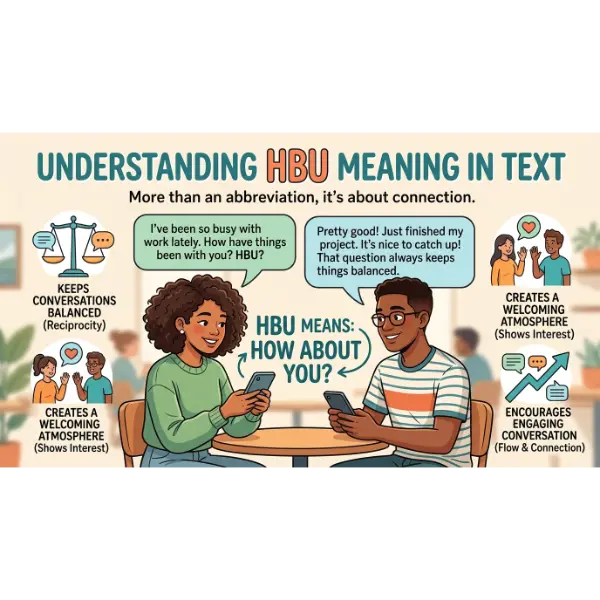
Understanding HBU meaning in text is about more than learning another internet abbreviation. At its core, HBU means “How About You?”—a simple phrase that keeps conversations balanced, welcoming, and engaging.
If you’re texting a close friend, replying in a group chat, or commenting on social media, HBU signals interest in the other person’s thoughts and experiences.
Its lasting popularity shows how digital communication has evolved toward faster, more conversational interactions without losing the human need for connection.
Even as new slang terms appear across TikTok, Instagram, and messaging apps, HBU remains one of the easiest ways to turn a one-sided message into a genuine exchange. Knowing HBU meaning in text helps you read conversations more confidently and participate in today’s online culture with the right tone, timing, and context.

I am Maxwell Ford, the creator of meaningosho.com, where I explore the origins and clear definitions of everyday words. I built this platform to help readers easily decode complex vocabulary and deepen their understanding of language. Through my articles, I love sharing simple, engaging insights that make learning new words both fun and useful.