
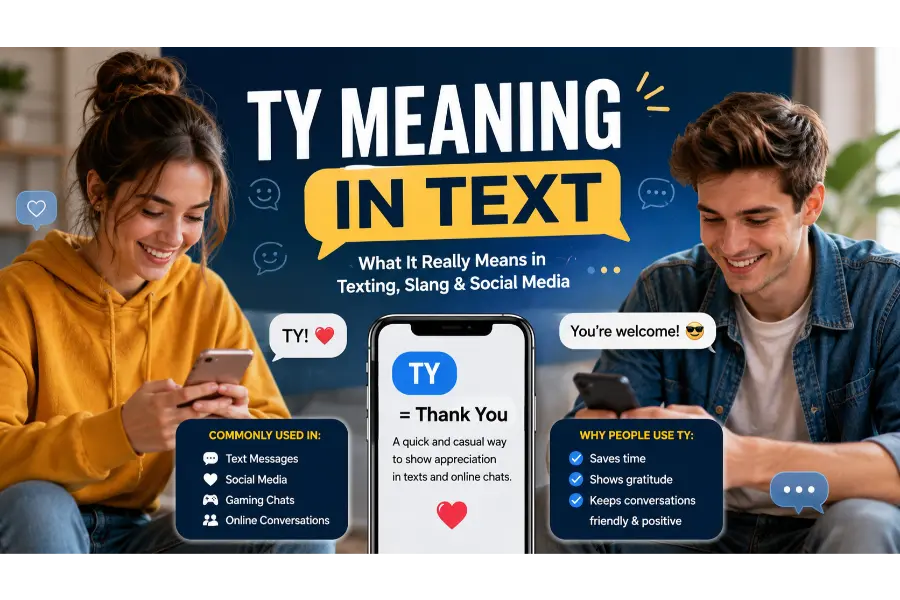
Have you ever received a quick “TY ❤️”, “tysm!”, or simply “ty” after helping someone online and wondered whether it meant more than just gratitude? If you’ve searched for TY meaning in text, you’re not alone.
Modern conversations move fast, and people often shorten common phrases into just two letters. While “TY” looks simple, its meaning can change slightly depending on the conversation, relationship, and platform.
Example Chat
Alex: I sent you the notes for tomorrow’s exam.
Jordan: TY! You’re a lifesaver. 😊
In this conversation, “TY” simply means “Thank You.” But on social media, gaming platforms, or close friendships, it can also express appreciation, warmth, politeness, or even playful sarcasm depending on the tone.
As texting culture evolves, understanding these tiny abbreviations helps you avoid misunderstandings and communicate more naturally.
Quick Definition & Meanings
TY is a widely used internet abbreviation that primarily stands for “Thank You.” It’s a quick and casual way to express gratitude without typing the entire phrase.
TY = Thank You
This is the most common meaning.
Example
“TY for helping me finish the project.”
The sender appreciates your help but keeps the message short and friendly.

TY as Casual Appreciation
Sometimes “TY” isn’t deeply emotional—it simply acknowledges someone’s effort.
Example
“TY for the reminder.”
The tone is polite and appreciative without sounding overly formal.
TY as Warm Gratitude
When paired with emojis, hearts, or exclamation marks, TY feels much more personal.
Example
“TY so much ❤️”
The extra emotion shows genuine appreciation.
TY as Friendly Conversation Closer
People often end conversations with TY after receiving information.
Example
“TY! Have a great day.”
It politely wraps up the chat.
TY Used Playfully
Friends sometimes use TY humorously after someone makes a joke or gives obvious advice.
Example
Friend: “Don’t forget to breathe.”
You: “TY 😂”
The appreciation is intentionally exaggerated for comedic effect.
Other Meanings of TY
Although Thank You is by far the most common meaning, TY may occasionally represent other phrases in specific communities or industries.
| Meaning | Where It’s Used |
|---|---|
| Thank You | Text messages, social media, gaming, emails |
| Type | Technical discussions (rare abbreviation) |
| Territory | Business or logistics contexts |
| Tax Year | Finance and accounting documents |
| Taiwan | Country abbreviation in some databases (not texting slang) |
In everyday texting and social media, TY almost always means “Thank You.”
Similar Meanings and Related Text Abbreviations
People searching for TY meaning in text often also encounter these similar abbreviations.
| Abbreviation | Meaning |
|---|---|
| TYSM | Thank You So Much |
| THX | Thanks |
| TQ | Thank You |
| TX | Thanks (informal) |
| TIA | Thanks In Advance |
| NP | No Problem |
| YW | You’re Welcome |
| Appreciate it | A more conversational way to thank someone |
| Much appreciated | Formal gratitude |
| Cheers | Casual thanks (common in the UK, Australia, and elsewhere) |
Each expresses gratitude but carries a slightly different tone.
TY Meaning in Texting & Messaging
In private messaging, every word carries emotional weight because body language is missing. That’s why “TY” works so well.
Private DMs
A quick TY keeps conversations flowing naturally.
“TY for checking on me.”
It feels friendly without becoming overly emotional.
Group Chats
In busy group conversations, TY acknowledges help without interrupting the discussion.
“TY everyone!”
Gaming Chats
Gamers frequently type TY after receiving healing, equipment, or strategic help.
“TY healer.”
Speed matters during gameplay, making abbreviations ideal.
Customer Support Chats
Many people finish conversations with
“TY, problem solved.”
It’s short, respectful, and efficient.
Origin, Evolution & Social Media Spread
TY became popular during the early internet era when texting was limited by character counts and mobile keyboards were slower to use.
Platforms like:
- SMS texting
- AOL Instant Messenger
- MSN Messenger
- Yahoo Messenger
- IRC chatrooms
encouraged shorter messages.
Later, social media accelerated its popularity through:
- Twitter (X)
- TikTok
- Snapchat
- Discord
- Twitch
- Online gaming communities
As communication became faster, abbreviations like TY became part of digital etiquette. Instead of typing “Thank you” dozens of times every day, users naturally shortened it.
Internet slang constantly evolves because communities value speed, familiarity, and shared understanding.
Real-Life Conversations
WhatsApp Chat
Emma: I picked up your package.
Noah: TY!! I’ll grab it tonight.
Instagram DM
Follower: Love your recommendations.
Creator: TY ❤️ Glad you enjoyed them!
TikTok Comments
Commenter: This tutorial actually worked.
Creator: TY! Happy it helped 😊
Discord Gaming Chat
Player 1: Revived you.
Player 2: TY!!
Emotional Pattern
People use TY because it communicates appreciation while maintaining the fast rhythm of digital conversation. It’s efficient, friendly, and socially expected.
Psychological & Emotional Dynamics
Although TY contains only two letters, it communicates several social signals.
It may show:
- Gratitude
- Respect
- Good manners
- Positive engagement
- Emotional warmth
- Community belonging
Tiny expressions of appreciation strengthen online relationships.
Using TY also reduces social friction. Even brief acknowledgments make conversations feel more balanced and considerate.
Contextual Usage Guidelines
Social Media
TY feels casual and completely natural.
Example:
TY for following!
Private Texts
Works well between friends, family, or partners.
Example:
TY for always being there.
Close Friends
Often paired with emojis.
TY 😂❤️
Casual Acquaintances
Simple and polite.
TY!
Professional Settings
While acceptable in quick internal chats, writing “Thank you” is usually better in formal emails or professional communication.
When NOT to Use TY & Common Misconceptions
Avoid TY when:
- Writing formal job applications
- Sending professional business emails
- Communicating with clients who expect formal language
- Offering condolences
- Serious conflict resolution
Common Misconceptions
Myth: TY sounds rude.
Reality: It usually sounds polite unless the surrounding tone is cold.
Myth: TY always feels lazy.
Reality: Most internet users see it as normal digital etiquette.
Myth: TY means something romantic.
Reality: By itself, it simply means “Thank You.”
TY Compared with Similar Expressions
| Expression | Primary Meaning | Tone | Best Usage Context |
|---|---|---|---|
| TY | Thank You | Casual | Texting, social media, gaming |
| TYSM | Thank You So Much | Warm, enthusiastic | Friends, family, creators |
| THX | Thanks | Very casual | Fast online conversations |
| Thanks | Appreciation | Neutral | Everyday communication |
| Thank You | Gratitude | Professional and polite | Emails, work, formal situations |
Although all express appreciation, TY feels the quickest, TYSM adds emotion, THX sounds relaxed, while Thank You remains the safest choice for professional settings.
Variations, Derivatives & Responding to TY
Common Variations
- TY
- TY!
- TYSM
- TYVM (Thank You Very Much)
- tysm
- tyyy
- tyy
- thx
- tq
Casual Replies
- You’re welcome!
- Anytime!
- No problem.
- Happy to help!
- Glad I could help.
Funny or Sarcastic Replies
- I accept snacks as payment.
- I’ll remember this favor.
- You’re welcome… probably.
- My work here is done. 😎
Mature & Direct Replies
- You’re very welcome.
- It was my pleasure.
- Happy to assist anytime.
- I’m glad it helped.
Generational & Regional Perspectives
Gen Z
Frequently uses TY alongside emojis, memes, and abbreviations like TYSM or THX.
Millennials
Comfortable using TY in texts, gaming, and workplace chats while switching to “Thank you” in professional emails.
Older Generations
Some prefer writing the complete phrase because it feels warmer or more formal.
Global Internet Culture
Millions of non-native English speakers learn abbreviations like TY through TikTok, Instagram, YouTube, gaming, and online communities. Today, TY is recognized almost everywhere English internet culture exists.
FAQs
What does TY meaning in text?
TY usually means “Thank You.”
What does TY mean on TikTok?
It almost always means Thank You in comments, captions, and direct messages.
Is TY rude?
No. Most people consider it a polite and casual abbreviation.
How do you reply to TY?
Common replies include:
- You’re welcome
- Anytime
- No problem
- Happy to help
What’s the difference between TY and TYSM?
TY means Thank You, while TYSM means Thank You So Much, expressing stronger gratitude.
Can I use TY in work messages?
Yes, in informal workplace chats. For formal emails or professional communication, writing Thank you is generally more appropriate.
Conclusion
Understanding TY meaning in text is simple once you see how people actually communicate online. In almost every texting, gaming, and social media conversation, TY means “Thank You.” Despite being only two letters, it conveys appreciation, politeness, and positive social connection. Depending on emojis, punctuation, and context, it can feel casual, heartfelt, or even playful.
Digital communication continues to evolve, but gratitude remains timeless. Whether you type TY, TYSM, or Thank You, the intention behind those words still helps build stronger conversations and more meaningful online relationships.

I am Maxwell Ford, the creator of meaningosho.com, where I explore the origins and clear definitions of everyday words. I built this platform to help readers easily decode complex vocabulary and deepen their understanding of language. Through my articles, I love sharing simple, engaging insights that make learning new words both fun and useful.