Have you ever received a message that simply says “IDC” and wondered whether the other person was being honest, sarcastic, upset, or simply ending the conversation? You’re not alone.
The phrase IDC meaning in text has become one of the internet’s most recognizable abbreviations, but its emotional meaning changes depending on the conversation.
Imagine this chat:
Alex: Are you okay if we watch a different movie?
Sam: IDC.
At first glance, it seems simple. But is Sam genuinely flexible, emotionally detached, annoyed, or quietly disappointed? That tiny three-letter abbreviation can communicate several emotions without explicitly stating them.
As texting, memes, TikTok videos, gaming chats, and social media conversations continue to shape how we communicate, abbreviations like IDC have become shortcuts for emotions as much as words. Understanding them helps avoid misunderstandings and improves digital communication.
Quick Definition & Meanings
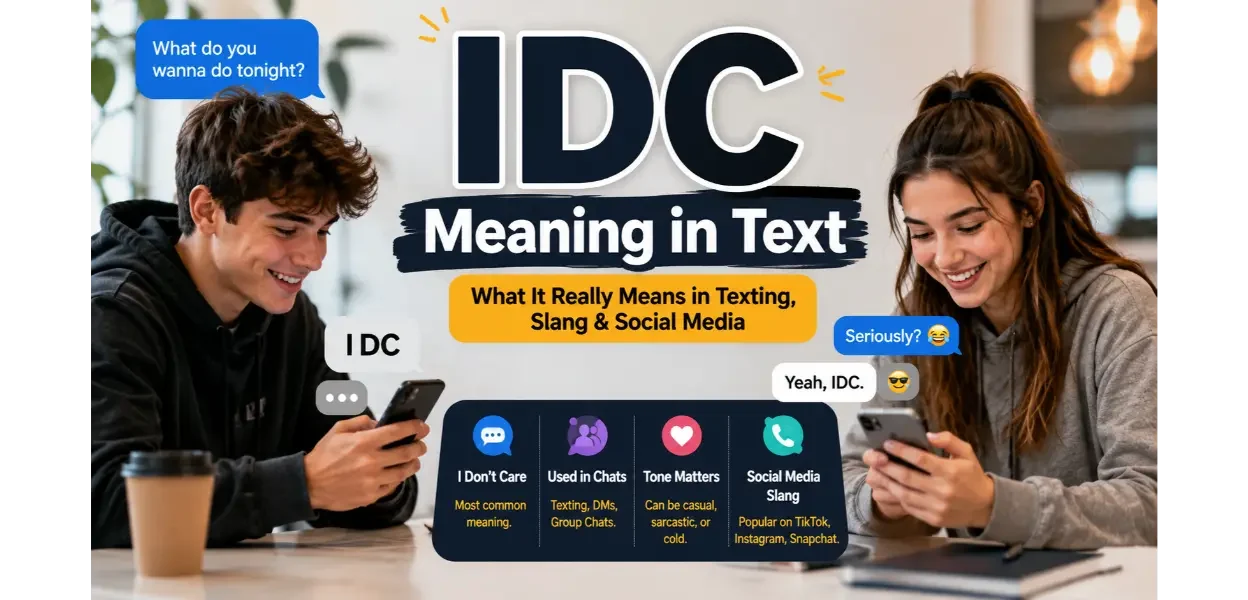
The most common IDC meaning in text is:
It expresses indifference, lack of preference, emotional distance, or sometimes frustration. However, the tone depends almost entirely on context, punctuation, and the relationship between the people chatting.
IDC Meaning in text #1: I Don’t Care (Neutral)
Sometimes IDC genuinely means someone has no preference.
Example
Friend: Pizza or burgers?
You: IDC. You choose.
Tone: Relaxed, easygoing.
IDC Meaning #2: I’m Fine Either Way
Instead of expressing disinterest, IDC can mean the speaker trusts the other person’s decision.
Example
Roommate: Which apartment should we rent?
You: IDC, whichever works best.
Tone: Flexible and cooperative.
IDC Meaning #3: Emotional Detachment
During serious conversations, IDC often signals emotional withdrawal.
Example
Them: Are you still upset?
You: IDC anymore.
Tone: Hurt, exhausted, emotionally distant.
IDC Meaning #4: Frustration or Anger
People also use IDC as a defensive response when they’re irritated.
Example
Friend: Everyone is talking about you.
You: IDC what they think.
Tone: Defiant and protective.
IDC Meaning #5: Sarcasm
Online conversations frequently use IDC sarcastically.
Example
“I totally failed the test.”
“IDC… tell me everything.”
Tone: Playful sarcasm.
IDC Meaning #6: Ending the Conversation
Sometimes IDC becomes a conversation stopper.
Example
“I’ve already explained everything.”
“IDC.”
Tone: Cold, dismissive, or intentionally final.
Other Meanings of IDC
Although I Don’t Care is by far the most popular meaning in texting, IDC can also represent different phrases depending on the setting.
| Meaning | Where It’s Used |
|---|---|
| I Don’t Care | Texting, Snapchat, TikTok, Instagram, WhatsApp |
| International Data Corporation | Technology and business |
| Industrial Development Corporation | Government and finance |
| Internet Data Center | IT and cloud computing |
| Infection Disease Control (less common abbreviation) | Medical discussions |
When someone texts “IDC,” they’re almost always referring to I Don’t Care, not the business or technical meanings.
Similar Slang Meanings Related to IDC
Many internet abbreviations express similar emotions.
| Slang | Meaning |
|---|---|
| IDK | I Don’t Know |
| NVM | Never Mind |
| TBH | To Be Honest |
| BRB | Be Right Back |
| IMO | In My Opinion |
| IMHO | In My Humble Opinion |
| WTV | Whatever |
| K | Okay (sometimes cold) |
| Meh | Not interested |
| IG | I Guess |
While these expressions overlap, each carries a slightly different emotional tone.
IDC Meaning in Texting & Messaging
Texting removes facial expressions and voice tone, so abbreviations carry emotional weight.
Private Messages
Between close friends, IDC often sounds casual.
“I don’t mind either option.”
Group Chats
People use IDC to avoid long discussions.
“IDC where we eat.”
It keeps conversations moving.
Read Receipts and Timing
Timing changes meaning.
If someone immediately replies “IDC,” they probably mean they have no preference.
If they disappear for hours and later answer with “IDC,” it may suggest annoyance or emotional distance.
Even punctuation matters.
“IDC”
vs.
“IDC.”
The second often feels colder because the period creates a stronger sense of finality.
Origin, Evolution & Social Media Spread
IDC became popular during the early internet era, appearing in chat rooms, AOL Instant Messenger, SMS texting, and online gaming communities where character limits encouraged shorter messages.
As smartphones became common, abbreviations spread even faster.
Platforms including:
- TikTok
- Snapchat
- X (formerly Twitter)
- Discord
helped normalize short emotional expressions. Viral memes, relatable screenshots, and humorous comment sections introduced IDC to millions of users who quickly adopted it in everyday conversations.
Today’s internet slang spreads through algorithms that reward relatable content. A single viral video can popularize an abbreviation worldwide within hours.
Real-Life Conversations
WhatsApp Chat
Emma: Italian or Mexican tonight?
Ryan: IDC. Surprise me.
Meaning: Ryan trusts Emma’s decision.
Instagram DM
Friend: People are criticizing your outfit.
You: IDC 😂
Meaning: Confident and unbothered.
TikTok Comments
“This trend is overrated.”
“IDC I’m doing it anyway.”
Meaning: Independent attitude.
Gaming Chat
“Everyone says this weapon is weak.”
“IDC—it works for me.”
Meaning: Personal preference over popular opinion.
Emotional Pattern
People choose IDC because it’s quick, emotionally efficient, and leaves room for interpretation. Rather than writing a full explanation, they communicate an entire emotional state using only three letters.
Psychological & Emotional Dynamics
IDC can communicate much more than indifference.
It may signal:
- Emotional independence
- Confidence
- Social resilience
- Frustration
- Burnout
- Protective emotional distance
- Passive aggression
- Humor
Internet slang often serves as emotional armor. Saying “IDC” may protect someone from appearing vulnerable while still expressing their feelings indirectly.
It also creates belonging. Using shared internet language helps people feel connected to online communities.
Contextual Usage Guidelines
Social Media
IDC often appears humorous, bold, or meme-like.
Private Texts
Meaning depends heavily on the relationship and recent conversation.
Close Friends
Usually interpreted as casual flexibility.
Casual Acquaintances
May sound dismissive or uninterested.
Professional Settings
Avoid using IDC in work emails or business communication.
Instead say:
- I don’t have a preference.
- Either option works.
- I’m happy with your decision.
Matching the tone of the conversation is important. What feels funny among friends may sound rude in professional environments.
When NOT to Use It & Misconceptions
Avoid using IDC when:
- Responding to emotional conversations
- Talking to teachers or managers
- Writing professional emails
- Discussing sensitive family matters
- Speaking with people unfamiliar with internet slang
Common Misconceptions
Myth: IDC always means someone is rude.
Reality: Sometimes it simply means they have no preference.
Myth: IDC always ends friendships.
Reality: Context determines whether it’s harmless or hurtful.
Semantic Comparison Table
| Expression | Primary Meaning | Tone | Best Usage Context |
|---|---|---|---|
| IDC | I Don’t Care | Neutral, dismissive, or relaxed | Casual texting |
| IDK | I Don’t Know | Uncertain | Questions and discussions |
| NVM | Never Mind | Moving on | Correcting yourself or ending a topic |
| WTV | Whatever | Indifferent or annoyed | Casual chats with friends |
| Meh | Not impressed | Mild boredom | Reviews, reactions, opinions |
Although these expressions appear similar, they communicate different emotions. IDC emphasizes indifference, IDK expresses uncertainty, NVM closes a topic, WTV often signals annoyance, while Meh communicates boredom or lack of enthusiasm.
Variations, Derivatives & Responding
People sometimes modify IDC for humor or emphasis.
Common variations include:
- IDC lol
- IDC tbh
- IDC anymore
- IDC fr
- IDC 😂
- idc (lowercase)
- IDCCCC (dramatic emphasis)
Casual Replies
- Fair enough.
- Sounds good.
- No worries.
- That’s okay.
Funny Replies
- You cared enough to reply 😂
- Bold strategy.
- The drama continues.
Mature Replies
- I understand.
- Thanks for letting me know.
- We can decide later.
- I appreciate your honesty.
Generational & Regional Perspectives
Gen Z
Uses IDC frequently in memes, TikTok captions, gaming chats, and everyday texting. Tone is often humorous or intentionally dramatic.
Millennials
Generally use IDC for convenience in texting but may interpret it more literally than younger users.
Older Generations
Some older adults view IDC as abrupt or impolite because they grew up with more formal digital communication.
Global Internet Culture
Even many non-native English speakers recognize IDC because they encounter it through TikTok videos, YouTube creators, online games, K-pop communities, esports, and international social media. Like many internet abbreviations, IDC has become part of a shared global digital vocabulary.
Frequently Asked Questions
What does IDC meaning in text?
IDC usually means “I Don’t Care.” It expresses indifference, flexibility, frustration, or emotional distance depending on the context.
Is IDC rude?
Not always. Between friends, it often means “I’m okay with either option.” In serious conversations, however, it can sound dismissive.
What does IDC mean on TikTok?
On TikTok, IDC usually expresses confidence, humor, rebellion, or refusing to worry about other people’s opinions.
How should I reply to IDC?
Respond according to the situation. If the conversation is casual, simply make the decision. If the topic is emotional, ask whether the person truly doesn’t mind or if something is bothering them.
Is IDC the same as IDK?
No. IDC means “I Don’t Care,” while IDK means “I Don’t Know.” One expresses indifference, and the other expresses uncertainty.
Can IDC be sarcastic?
Yes. Many people use IDC sarcastically to exaggerate emotions, joke with friends, or tease someone in a playful way.
Conclusion
Understanding IDC meaning in text is about more than decoding three letters. While its primary meaning is “I Don’t Care,” the phrase can also communicate flexibility, confidence, emotional exhaustion, sarcasm, or frustration depending on the situation and relationship between the people involved.
As digital conversations become faster and more expressive, abbreviations like IDC continue to shape how people communicate across texts, social media, gaming platforms, and messaging apps. Paying attention to context, timing, and tone helps you interpret the message accurately and respond in a way that keeps conversations clear and respectful.
If someone uses IDC casually or emotionally, it’s a small phrase that reveals how modern internet communication packs complex feelings into just a few characters.

I am Maxwell Ford, the creator of meaningosho.com, where I explore the origins and clear definitions of everyday words. I built this platform to help readers easily decode complex vocabulary and deepen their understanding of language. Through my articles, I love sharing simple, engaging insights that make learning new words both fun and useful.