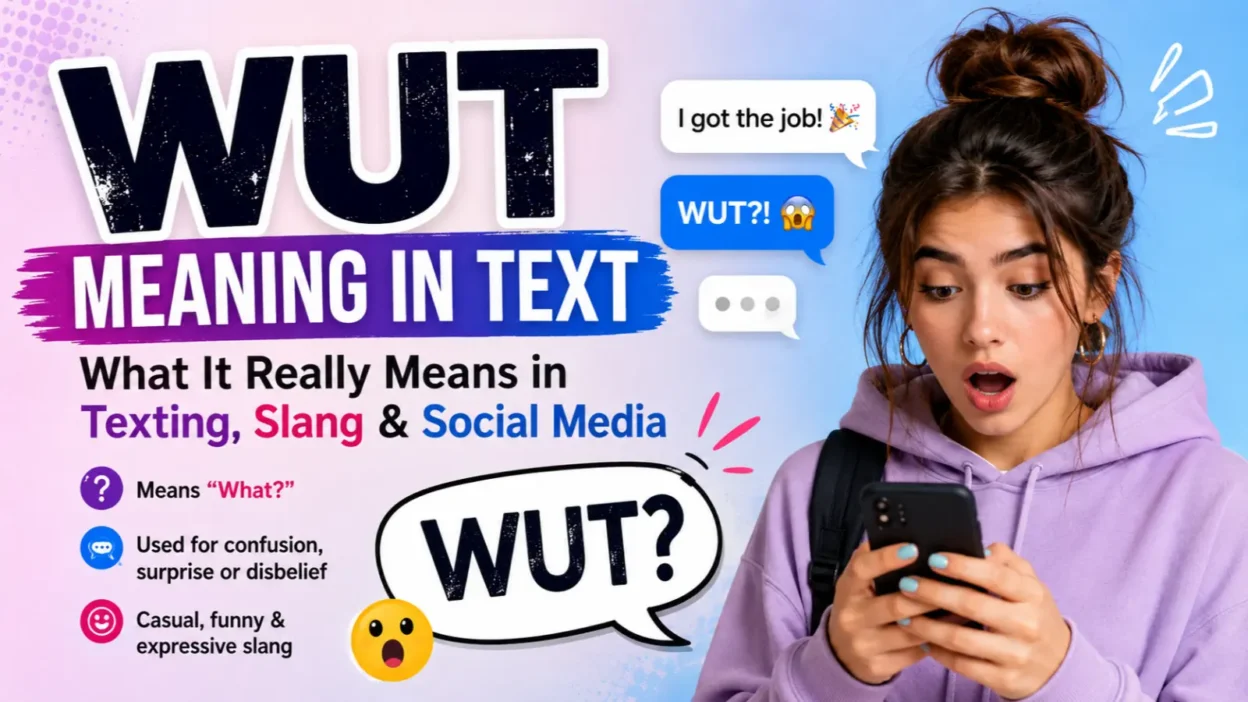
You get a message from a friend saying, “WUT 😭”, and suddenly you wonder whether it is an acronym, a typo, or some slang you somehow missed. If you’re searching for WUT meaning in text, the short answer is simple: WUT usually means “what.” It is an intentionally informal spelling used to express confusion, surprise, disbelief, or playful reaction.
Example:
Friend: “I just spent $80 on a sandwich.”
You: “WUT 😭”
Here, WUT does not introduce some hidden phrase. It communicates something closer to “What?! Seriously?” The unusual spelling adds personality and often makes the reaction feel more humorous or exaggerated.
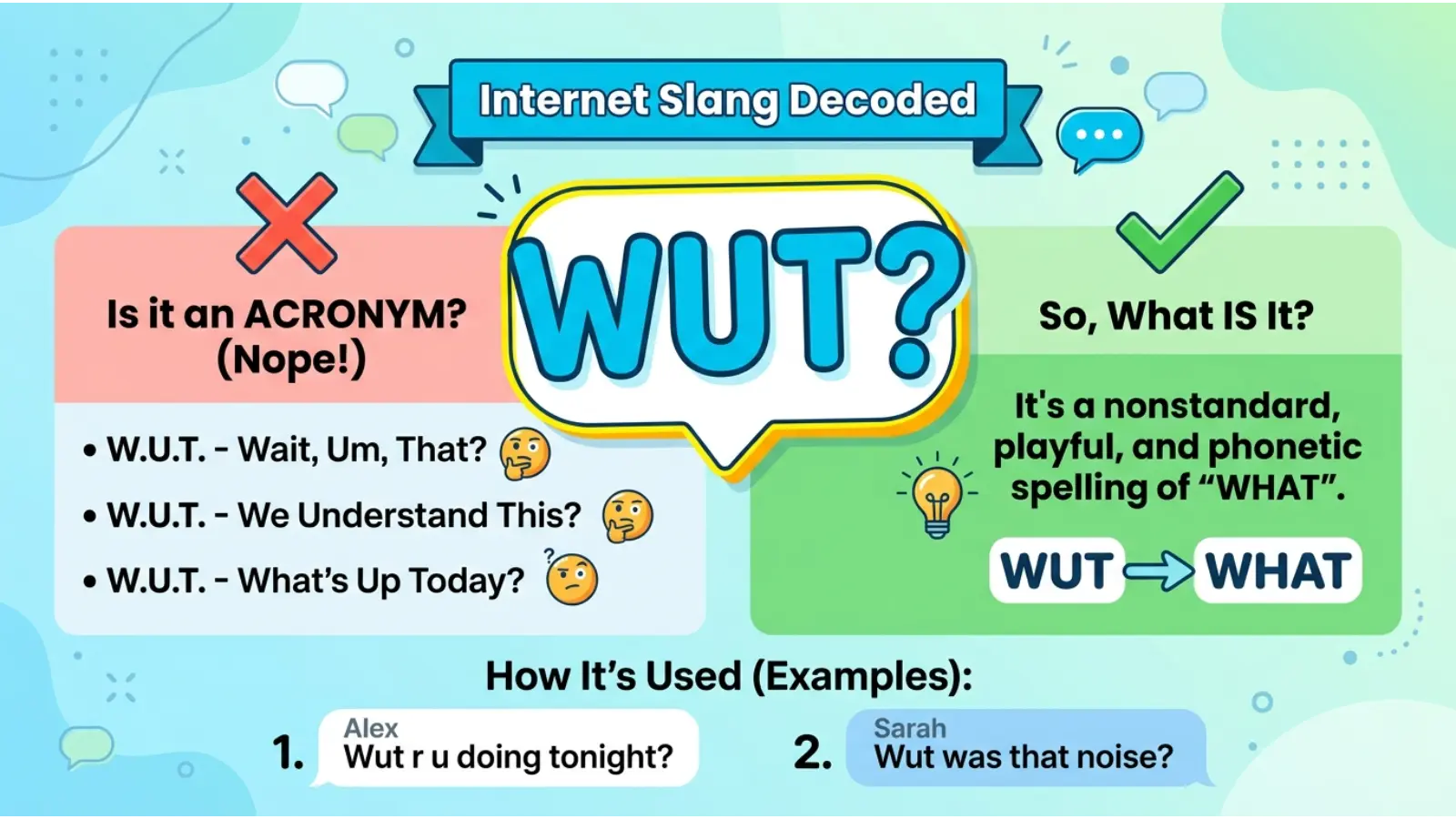
Unlike many texting abbreviations, WUT is generally not an acronym. It is a nonstandard, playful spelling of “what.” Slang references describe it as an online/texting expression that can appear particularly as a response to something confusing, unexpected, or absurd.
Quick Definition & Meanings
1. WUT Means “What?”
The most direct meaning is simply “what?”
Someone may type it instead of the standard spelling because they want their message to sound casual.
Example:
“WUT are you talking about?”
Meaning:
“What are you talking about?”
The spelling changes, but the basic question remains the same.
2. WUT Means “What?!”
When someone sends only “WUT?”, the expression often carries more emotion than ordinary “what?”
It can signal that they are confused, surprised, or caught off guard.
Example:
You: “The teacher canceled the exam.”
Friend: “WUT?!”
The implied meaning is:
“What?! Are you serious?”
3. WUT Means “I’m Confused”
Sometimes WUT is less about asking for information and more about showing that something makes no sense.
Example:
“He said he hates pizza, then ordered three pizzas. WUT.”
Here, WUT works almost like a reaction meme: “I genuinely do not understand this.”
4. WUT Means “Seriously?”
Context can turn WUT into a mild expression of disbelief.
Example:
“You woke up at 4 a.m. just to play Fortnite?”
“WUT 😂”
The person may actually mean:
“Seriously? Why would you do that?”
5. WUT Can Show Shock or Surprise
A dramatic situation can make WUT function like an emotional reaction.
Example:
“She just won the competition after practicing for only two days.”
“WUT 😭”
The emotion is closer to:
“Wait, WHAT? That’s crazy!”
6. WUT Can Be Playful or Sarcastic
Friends sometimes use WUT when they already understand what was said but pretend to be confused for comedic effect.
Example:
“You said you weren’t hungry and then ate my fries.”
“WUT? I have no idea what you’re talking about.”
That is not genuine confusion. It is playful denial.
7. WUT Can Tease Someone
Among friends, WUT can exaggerate a reaction and create a joking tone.
Example:
“I think pineapple belongs on pizza.”
“WUT 💀”
The speaker may understand perfectly well. They are simply pretending the opinion is outrageous.
WUT Meaning in Texting & Messaging
In texting, WUT works because digital communication has limited ways to express facial expressions, voice tone, pauses, and body language.
When someone says “what?” aloud, their voice tells you whether they are confused, annoyed, surprised, flirting, or joking.
Text removes much of that information.
So people use spelling, punctuation, capitalization, emojis, and timing to recreate those emotional signals.
Compare these:
- What? — neutral or direct
- what? — softer or casual
- WHAT?! — shocked
- wut — playful, informal, internet-style
- WUT 😭 — humorous disbelief
- wut 💀 — “I cannot believe this”
- wut?? — confused or surprised
- WUT 😂 — probably joking
That small spelling difference can therefore change the social texture of a message.
WUT in Private DMs
In a one-on-one conversation, WUT often appears as a quick reaction.
A: “I accidentally sent the screenshot to him.”
B: “WUT 😭”
The sender isn’t necessarily requesting a detailed explanation. They may simply be reacting emotionally.
WUT in Group Chats
Group chats make the expression even more useful because conversations move quickly.
Sam: “Guys, I just saw our teacher at the concert.”
Alex: “WUT”
Mia: “NO WAY 😭”
Here, WUT helps someone jump into a fast-moving conversation without writing a full sentence.
WUT and Read Receipts
Timing matters too.
A fast “WUT” immediately after surprising news feels spontaneous.
A delayed “wut?” might suggest the person reread the message and still doesn’t understand it.
A lone “WUT.” can feel more dramatic or deadpan.
Digital communication is full of these tiny signals. The words stay the same, but timing and formatting influence how the reader interprets them.
WUT Origin, Evolution & Social Media Spread
WUT belongs to the older tradition of deliberately altered internet spellings.
It is generally treated as a nonstandard spelling of “what,” rather than a conventional acronym. Dictionaries and slang references describe it as internet slang used especially for confusion, surprise, or reactions to something unexpected.
The term became associated with early online communities, message boards, gaming spaces, and chat culture. Older internet slang frequently played with spelling because users wanted messages to feel faster, more humorous, exaggerated, or distinctly “online.” Some community references connect with early chat and gaming/message-board culture.
That history matters because today’s social media slang did not appear from nowhere.
The basic pattern has existed for decades:
standard word → altered spelling → community joke → recognizable internet expression → broader social-media usage
As online communities became more interconnected, expressions that once belonged to particular forums or gaming spaces could travel into mainstream social platforms.
Today, people may encounter WUT in memes, comments, chats, gaming conversations, and casual posts.
Algorithms also accelerate this process. A funny expression used in one viral post can suddenly appear thousands of times in comments and reposts. People then copy the spelling because they already understand the emotional meaning.
Real-Life Conversations
WhatsApp / iMessage Chat
Maya: “I forgot my keys again.”
Leo: “WUT 😭”
Maya: “Don’t judge me.”
Leo: “How do you forget them three days in a row?”
Here, WUT communicates surprise mixed with playful disbelief.
Instagram DM
A: “Guess who liked my old 2019 photo?”
B: “WUT”
A: “My ex 💀”
B: “Okay that’s actually wild.”
The WUT creates a pause before the explanation. It essentially says, “Wait, what? I need details.”
TikTok Comment
Creator: “I made this entire cake in 12 minutes.”
Commenter: “WUT 😭”
In a public comment, WUT becomes a compact emotional reaction. The commenter doesn’t need to write “I can’t believe you made that in 12 minutes.”
Gaming Chat
Player 1: “The boss just respawned.”
Player 2: “WUT?”
1: “Yeah, apparently that can happen.”
Here, WUT is closer to genuine confusion.
Why Choose WUT Instead of “What?”
The difference is often emotional rather than informational.
Typing “what?” can sound straightforward.
Typing “wut” can sound deliberately unserious.
That’s why people may choose the slang spelling when they want to communicate:
- “I’m confused.”
- “That’s ridiculous.”
- “Are you serious?”
- “Wait, what?”
- “I cannot believe this.”
- “You’re joking, right?”
- “I’m pretending not to understand because this is funny.”
The Psychological & Emotional Dynamics of WUT
Slang isn’t only about saving typing time. It also helps people manage social tone.
A message like “WUT” can act as emotional shorthand.
Humor as Emotional Armor
Sometimes people use humor because a direct emotional reaction feels too serious.
Instead of saying:
“I’m genuinely shocked by what you just told me.”
They type:
“WUT 😭”
The second version is lighter and easier to send.
Creating Social Belonging
Internet language can also signal that someone understands the communication style of a particular online community.
Using slang appropriately tells others:
“I understand the vibe here.”
That doesn’t mean every slang term belongs to one generation or group. Internet expressions travel quickly. But shared language can still create a sense of familiarity.
Softening a Reaction
Imagine someone says something embarrassing.
“What?” might sound confrontational.
“wut 😭” can make the reaction feel more playful.
The spelling becomes a kind of social cushion.
Setting a Playful Boundary
WUT can also communicate:
“That statement is so ridiculous that I’m not treating it seriously.”
For close friends, this can be funny. With strangers, however, the same message might be interpreted as dismissive.
That’s why context matters more than the slang itself.
Contextual Usage Guidelines
Social Media vs. Private Texts
On social media, WUT often works as a public reaction.
“WUT 😭”
In private texts, it can be more conversational:
“Wut are you even saying?”
The meaning stays close to “what,” but the social function changes.
Close Friends vs. Casual Acquaintances
With close friends, exaggerated spellings are usually easier to interpret.
“WUT 💀 you actually did that?”
With someone you barely know, it may come across as immature, sarcastic, or dismissive.
Professional or Formal Environments
Avoid WUT in formal writing unless you’re deliberately discussing internet language.
Don’t write:
“WUT happened with the report?”
Instead write:
“Could you clarify what happened with the report?”
Professional communication depends on clarity and appropriate tone. WUT is primarily a casual internet expression.
When NOT to Use WUT
WUT is harmless in most casual contexts, but there are situations where it can create unnecessary confusion.
During a Serious Argument
If someone is explaining a genuine problem and you respond:
“WUT 💀”
they may feel mocked rather than heard.
In Professional Messages
A manager, client, professor, or formal contact may interpret WUT as careless writing.
When Someone Is Sharing Sensitive Information
If someone is telling you something emotional, a playful reaction may feel inappropriate.
With Audiences Unfamiliar With Internet Slang
Older users, non-native English speakers, or people outside online communities may simply interpret WUT as a typo.
The issue isn’t that they are “wrong.” Slang depends on shared cultural knowledge.
Common Misconceptions About WUT
WUT is not normally an acronym.
It usually represents an informal spelling of “what,” rather than a phrase formed from several words.
WUT does not automatically mean “angry.”
It can express confusion, surprise, disbelief, humor, or sarcasm depending on context.
WUT isn’t always a genuine question.
Someone can use it as a reaction even when they already understand what happened.
Capitalization changes the intensity.
1“wut” feels casual.
2“WUT?!” feels much more dramatic.
WUT and Similar Expressions: Comparison Table
| Expression | Primary Meaning | Tone | Best Usage Context |
| WUT | What? | Playful, confused, surprised | Casual texts, memes, chats |
| What? | Request for clarification | Neutral/direct | Everyday conversation |
| Huh? | I don’t understand | Casual, sometimes puzzled | Informal conversation |
| WTF? | What the heck/what the f***? | Strong shock or disbelief | Very casual settings |
| Wait, what? | Hold on, explain that | Surprised, curious | Conversations and DMs |
The key difference is emotional intensity. WUT usually keeps things lighter than stronger expressions such as WTF, while “what?” can sound more neutral. “Huh?” often signals genuine confusion, whereas WUT can deliberately exaggerate confusion for humor.
WUT Variations, Derivatives & Related Expressions
Because internet slang changes through repetition and remixing, you may see several related forms.
Wut?
A simple question or moment of confusion.
“Wut? You already left?”
WUT?!
A more dramatic reaction.
“WUT?! You won?”
Wut 😭
Often humorous disbelief.
“You ate the entire cake? Wut 😭”
Wut 💀
Usually communicates extreme disbelief or amusement.
“He sent the message to the wrong group. Wut 💀”
What Are You Talking About?
A longer version that makes the meaning explicit.
“Wut are you talking about? 😂”
Similar Expressions
Related informal expressions include:
- What?
- Huh?
- Wait, what?
- What?!
- WTF?
- WTH?
- What the heck?
- Are you serious?
- Seriously?
- No way
- What are you talking about?
These expressions overlap, but they aren’t interchangeable in every situation.
How to Respond When Someone Says WUT
Casual Replies
“I said what I said 😂”
“You heard me 😭”
“Yeah, seriously.”
“Long story lol.”
Funny or Sarcastic Replies
“WUT yourself 💀”
“I have no further comments at this time.”
“Please remain calm 😂”
“Exactly what you think happened.”
Mature or Direct Replies
If the other person genuinely seems confused:
“I mean that the plans changed.”
Or:
“Sorry, let me explain that more clearly.”
This is where understanding the emotional context matters. If their WUT is playful, you can play along. If it signals real confusion, give them the missing information.
Generational & Regional Perspectives
Gen Z
Younger internet users are generally comfortable with intentionally distorted spelling, memes, emojis, and highly compressed reactions. WUT may feel humorous, ironic, or deliberately exaggerated.
However, it isn’t necessarily a uniquely Gen Z expression. Its history reaches back into older online communication.
Millennials
Many Millennials encountered variations such as wut, wat, lol, omg, and other unconventional spellings during earlier internet and gaming culture.
For this group, WUT can sometimes feel nostalgic or distinctly “old internet.”
Older Audiences
Someone unfamiliar with internet slang may interpret WUT literally as a spelling mistake.
That’s why audience awareness matters.
Global Internet Culture
English-language slang frequently travels across national borders through TikTok, Instagram, YouTube, Reddit, gaming communities, and memes.
Non-native English speakers may encounter WUT long before they encounter its formal equivalent in a textbook.
This is one reason internet slang can function almost like a second layer of language: users learn not only vocabulary but also the emotional meaning attached to spelling, punctuation, emojis, and timing.
FAQs About WUT Meaning in Text
What does WUT mean in text?
WUT usually means “what.” It is an informal internet spelling commonly used to express confusion, surprise, disbelief, or playful reaction.
Is WUT an acronym?
Usually, no. WUT is generally an intentionally informal spelling of “what,” rather than an acronym.
Is WUT rude?
Not necessarily. WUT is usually casual and playful, but it can sound dismissive or sarcastic depending on the conversation.
What does WUT mean on TikTok?
On TikTok, WUT usually works as a short reaction meaning “what?”, “wait, what?”, or “I can’t believe this.” The exact emotion depends on the video and surrounding comments.
What does WUT mean from a girl or guy?
The word itself doesn’t have a special gender-specific meaning. A person may use WUT to express confusion, surprise, disbelief, teasing, or humor.
How should I reply to WUT?
Match the context. If they’re joking, reply playfully. If they’re genuinely confused, explain yourself. For example: “LOL, I mean the plans changed to Friday.”
Final Thoughts on WUT Meaning in Text
Understanding WUT meaning in text is less about memorizing a three-letter definition and more about recognizing the emotion behind the spelling.
At its core, WUT means “what.” But in real digital conversations, it can carry several shades of meaning: “What?” “Wait, what?” “Are you serious?” “I don’t understand,” or even “That is so ridiculous that I need to pretend I don’t understand.”
That’s what makes internet language interesting. People don’t simply shorten words; they reshape them to communicate attitude.
A normal “what?” asks for information. “WUT 😭” can tell an entire emotional story in three letters and an emoji.
In modern digital communication, sometimes the spelling isn’t just the message. The spelling is part of the message.

I am Maxwell Ford, the creator of meaningosho.com, where I explore the origins and clear definitions of everyday words. I built this platform to help readers easily decode complex vocabulary and deepen their understanding of language. Through my articles, I love sharing simple, engaging insights that make learning new words both fun and useful.