You send a thoughtful message, explain your plans, or ask someone a simple question—and they reply with just “K.” Suddenly, that tiny letter feels much bigger than it should.
For example:
You: “I’ll send you the notes tonight. Is that okay?”
Them: “K”
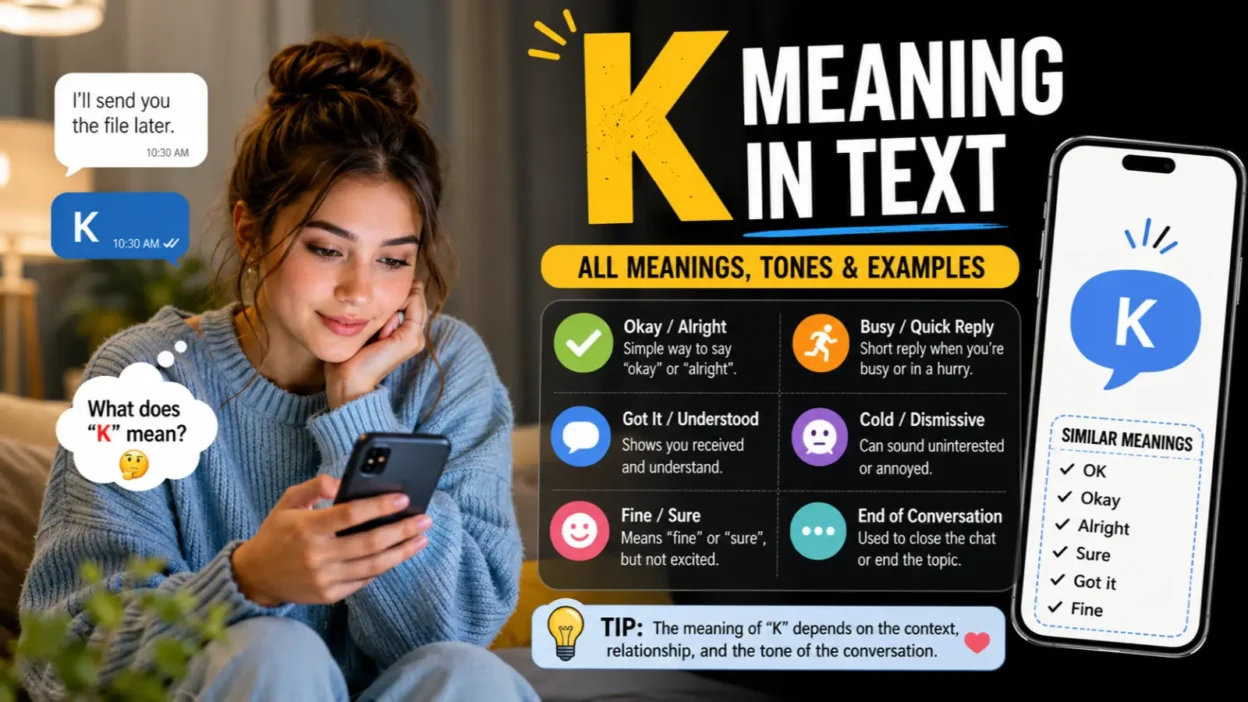
Does k meaning in text simply equal “okay”? Usually, yes. But depending on the relationship, timing, punctuation, and conversation, it can also sound cold, rushed, annoyed, sarcastic, or dismissive.
That emotional ambiguity explains why people keep searching for what K means in text. Digital conversations remove many of the signals we normally use to understand emotion—voice, facial expression, pauses, and body language. A one-letter response therefore leaves plenty of room for interpretation.
The simplest rule is this: K usually means “okay,” but its emotional meaning comes from context.
Quick Definition & Meanings
K is a shortened, highly informal version of “OK” or “okay.” People use it to acknowledge information, agree with something, confirm a plan, or quickly close a conversation.
Common related meanings include:
- Okay
- Alright
- Got it
- Understood
- Sure
- Fine
- I agree
- I acknowledge that
- I don’t have anything else to add
- I’m busy, so I’m replying quickly
- Sometimes: I’m annoyed or uninterested
The important point is that these aren’t completely separate dictionary definitions. Most are contextual interpretations of the same basic acknowledgment.
K Meaning: Okay or Agreement
This is the most straightforward use.
“Meet me at 7?”
“K.”
Here, K simply means “okay” or “sure.”
There may be no hidden emotion at all.
K Meaning: Got It or Understood
Someone may use K to confirm that they received information.
“The meeting moved to Room 4.”
“K, thanks.”
Here, the message functions almost like “Got it.”
K Meaning: Fine or Alright
Sometimes K communicates acceptance without enthusiasm.
“Let’s just meet tomorrow instead.”
“K.”
The sender may mean “Fine” or “Alright.”
This is where tone becomes harder to read. They could genuinely be okay with the change—or they could be accepting it reluctantly.
K Meaning: Quick or Busy Reply
A person might type K because they’re occupied.
“Can you grab some milk?”
“K, I’m driving.”
In this situation, interpreting the short reply as anger would probably be a mistake.
The surrounding message provides useful context.
K Meaning: Cold or Dismissive
A one-letter response can feel emotionally distant when it follows a serious or detailed message.
“I didn’t like how you spoke to me earlier. Can we talk about it?”
“K.”
Here, K may feel like “whatever” or “I don’t want to discuss this.”
It doesn’t automatically prove that the person is angry, but the context makes a dismissive interpretation more plausible.
K Meaning: Sarcasm or Passive-Aggressive Tone
Sometimes people deliberately use K to sound dry.
“You promised you’d remember.”
“K.”
In an argument, the same letter can function almost like a conversational door being slammed shut.
That is why K can sometimes feel stronger than “okay.”
K Meaning: Conversation Ending
People also use K when they want to acknowledge something without continuing the exchange.
“I’ll text you when I get home.”
“K.”
The conversation can naturally end there.
This isn’t necessarily rude. Some people simply prefer minimal texting.
K Meaning in Texting & Messaging
The real story behind K meaning in text isn’t just vocabulary. It’s micro-communication.
When people text, they constantly make tiny decisions:
- “Should I say okay or k?”
- “Should I add an emoji?”
- “Should I use an exclamation mark?”
- “Should I reply immediately?”
- “Should I keep the conversation going?”
Those choices communicate social information.
Compare:
Okay!
Okay
ok
k
k.
kk 😊
All of these can communicate basic acknowledgment, but they don’t necessarily create the same emotional impression.
Why “K” Can Feel So Short
“K” removes almost everything except the basic message.
There is no enthusiasm in the spelling itself. There is no emotional explanation. And there isn’t even a second letter.
That’s why recipients sometimes interpret it as emotionally flat.
But interpretation depends heavily on the relationship.
A longtime friend who routinely sends one-word messages may send “k” without any negative intention. Someone who normally writes detailed, warm messages may make the exact same reply feel unusual.
Read Receipts Change the Experience
Modern messaging also adds timing.
If someone normally responds within seconds and suddenly takes three hours before sending “K,” you may interpret it differently from an immediate “k.”
Again, timing doesn’t prove intent.
It simply gives your brain additional information to interpret.
Lowercase “k” vs. Capital “K”
Many people perceive these differently, although there is no universal rule.
- k — often casual or understated
- K — can feel more direct
- K. — may feel especially final, serious, or annoyed
- kk — often feels softer or friendlier
- okay — clearer and generally less ambiguous
- okay! — warmer or more enthusiastic
These are social conventions, not fixed grammatical rules.
Where Did K Come From? Origin and Evolution
The modern texting form K comes from shortening OK, which itself has a surprisingly old history.
Merriam-Webster dates the first known use of OK to 1839 and traces it to the humorous expression “oll korrect,” a deliberately misspelled version of “all correct.” The expression appeared during a period when playful abbreviations were fashionable in Boston newspapers.
So the basic evolution is roughly:
all correct → OK → okay/ok → k
The interesting part is that shortening language isn’t a uniquely modern habit.
People have always compressed familiar expressions when a community understands the shorthand. Mobile texting, internet chat, social media, gaming, and instant messaging simply accelerated the process.
From SMS to Modern Social Media
Early mobile messaging encouraged concise communication because typing on phones was slower and less convenient than typing on a full keyboard.
As instant messaging and SMS became everyday communication tools, K became a convenient way to acknowledge a message.
Today, people encounter it across:
- iMessage
- Snapchat
- TikTok
- Discord
- Gaming chats
- SMS
- Dating apps
- Group conversations
Social platforms also accelerate slang because users constantly copy, remix, and reinterpret language.
A short expression can move from private messages to memes, comments, screenshots, and viral discussions surprisingly quickly.
Real-Life Conversations
WhatsApp / iMessage Chat
You: “I’ll be there around 8.”
Friend: “K”
Meaning: Most likely “Okay.”
But consider:
You: “I’m sorry I couldn’t come earlier. I really wanted to see you.”
Friend: “K.”
Possible meaning: “Okay,” but perhaps with emotional distance.
The second example contains more emotional context, so the same word feels different.
Instagram DM
You: “That outfit looks amazing 🔥”
Them: “K lol”
Here, K could be playful or intentionally dry.
The “lol” softens the interaction and makes a hostile interpretation less likely.
TikTok Comment / Public Thread
Person 1: “This trend is officially dead.”
Person 2: “k”
Here, k may work as a sarcastic dismissal rather than a literal “okay.”
Public internet conversations often exaggerate short replies because users understand that minimal language can itself become humor.
Group Chat
Friend 1: “Movie at 9?”
Friend 2: “K”
Friend 3: “I’m in”
Here, K is probably nothing more than confirmation.
Group-chat culture often rewards speed over complete sentences.
Why Does K Sometimes Sound Rude?
The psychology is surprisingly simple: text removes vocal tone.
If someone says “Okay” aloud, you can hear whether they’re excited, irritated, tired, amused, or sarcastic.
In text, you only see the characters.
So the recipient mentally supplies the missing tone.
This creates a phenomenon where a technically neutral word can feel emotionally loaded.
For example:
“Okay!”
feels visibly energetic.
“Okay.”
feels more controlled.
“K”
feels compressed.
“K.”
can feel final.
That doesn’t mean the sender intended those differences. It means digital communication makes readers rely on small visual cues.
What K Signals Socially
Using K can communicate several different social signals.
Efficiency
The person may simply value speed.
They don’t need a full sentence to communicate “I understand.”
Emotional Distance
In certain conversations, minimal replies create space.
The sender may not want to engage further.
Confidence
Sometimes short replies signal that someone doesn’t feel the need to over-explain.
Irritation
During conflict, K can become a deliberately cold response.
Humor
Friends may use K ironically because they know how dramatic a one-letter reply can look.
Boundary Setting
A short acknowledgment can also communicate:
“I’ve heard you, but I’m not continuing this conversation.”
That can be useful when someone doesn’t want to argue.
K in Different Social Contexts
Social Media vs. Private Texts
On TikTok or Instagram, k may be playful, sarcastic, dismissive, or meme-like.
In private texts, the relationship matters more.
A close friend might use k constantly without intending anything negative.
Close Friends vs. Casual Acquaintances
With close friends, you already understand each other’s communication habits.
With a newer acquaintance, K can be harder to interpret because you haven’t established a shared texting style yet.
Professional or Formal Environments
Avoid relying on K in professional communication.
Instead of:
“K”
use:
“Okay, understood.”
or:
“Thanks, I’ll take care of it.”
The problem isn’t that K is universally rude. It’s that it can look unnecessarily abrupt in situations where clarity and professionalism matter.
When NOT to Use K
There are situations where a longer response is safer.
During Serious Arguments
If someone is explaining that they’re hurt, replying with “K” can appear dismissive.
Instead, say:
“I understand. Let’s talk about it.”
When Someone Shares Vulnerable Feelings
If a person tells you something emotionally important, a one-letter response can unintentionally communicate indifference.
In Professional Messages
Use “Okay,” “Understood,” “Sounds good,” or a specific acknowledgment instead.
With Someone You Don’t Know Well
If you haven’t established a casual communication style, avoid creating unnecessary ambiguity.
When You Actually Mean More
If you mean “I understand and I’m willing to help,” simply saying K doesn’t communicate the second half.
Clearer language is often better.
Common Misconceptions About K
“K Always Means Someone Is Angry”
No.
K usually means “okay.” The possibility of anger comes from context, not from the letter itself.
“K Is Always Rude”
Not necessarily.
Friends, family members, gamers, coworkers, and casual texters may use it as a normal shorthand.
“K Is an Acronym”
Not in the usual texting sense.
It’s better understood as a clipped or shortened form of “OK/okay.” Wiktionary specifically identifies the texting use as a clipping of OK.
“K Means the Same Thing as Kk”
Not exactly.
Both can communicate acknowledgment, but kk often feels more casual or friendly, while a single K can appear more abrupt.
“K Always Ends the Conversation”
It can, but it doesn’t have to.
The next message and the surrounding context determine whether the exchange continues.
K vs. Similar Expressions
| Expression | Primary Meaning | Tone | Best Usage Context |
| K | Okay / understood | Very brief; can feel cold | Casual texting, quick acknowledgment |
| OK | Okay / agreement | Neutral | General everyday communication |
| Okay | Agreement / acknowledgment | Clearer and warmer | Most casual situations |
| Kk | Okay / got it | Casual, friendly | Friends and informal chats |
| Got it | I understand | Clear and cooperative | Plans, instructions, work chats |
| Sure | Yes / agreement | Cooperative | Requests and plans |
The distinction is mostly about emotional packaging.
The literal information may be almost identical, but the social signal changes.
That’s one of the defining characteristics of internet language: tiny formatting choices can communicate interpersonal meaning.
Variations, Derivatives & How to Respond
You may see several related forms.
Common Variations
- k — casual, minimal
- K — direct
- K. — potentially curt or final
- kk — casual acknowledgment
- kkk — playful in some communities, but context matters
- okay — clearer and more neutral
- ok — short but generally less extreme than “k”
- okayy — playful or warmer
- okayyy — often exaggerated for humor or enthusiasm
These forms don’t have universally fixed meanings. Online language depends heavily on community and personal style.
Casual Replies to K
If someone sends you K, you don’t necessarily need to analyze it.
Try:
“Cool 👍”
“Sounds good.”
“Perfect.”
“Alright.”
Funny or Sarcastic Replies
If you’re close enough to joke:
“The enthusiasm is overwhelming 😂”
“K is crazy 😭”
“Only one letter? I feel honored.”
Mature or Direct Replies
If the context feels tense:
“Just checking—are we good?”
“I wasn’t sure how you meant that.”
“If something’s bothering you, we can talk about it.”
The last approach is especially useful when you genuinely need clarification instead of guessing someone’s emotions.
Generational and Regional Perspectives
Gen Z
Gen Z is generally highly sensitive to small differences in digital tone because texting, memes, short-form video, and online communities are deeply integrated into everyday communication.
For some younger users, “K” can intentionally sound dry, ironic, or dismissive.
Millennials
Millennials grew up alongside the transition from email and SMS to social media and smartphones.
Many understand K as a normal shorthand but also recognize that it can sound cold depending on context.
Older Generations
Someone less immersed in current texting conventions may interpret K more literally as simply “okay.”
They may not automatically attach the same emotional weight that younger users associate with punctuation, capitalization, or response length.
Global Internet Culture
English internet slang travels internationally through TikTok, Instagram, YouTube, gaming, memes, and messaging platforms.
Non-native English speakers may encounter K before they learn all of its subtle social associations.
That means its literal meaning can be easy to understand while its emotional meaning remains harder to decode.
Why One Letter Can Carry So Much Meaning
There’s a bigger cultural lesson hiding inside K.
Digital communication has made language incredibly efficient, but efficiency comes with a trade-off.
The shorter the message becomes, the more responsibility the reader sometimes has to reconstruct the missing emotion.
A face-to-face conversation might contain:
“Okay, yeah, that’s fine. Don’t worry.”
A text might reduce all of that to:
“k”
The information survives.
The emotional detail may not.
That gap is where misunderstandings happen.
FAQs:
What does K mean in text?
K usually means “okay,” “alright,” “got it,” or “understood.” It is a very short form of “OK/okay” commonly used in informal digital communication.
Is K rude in texting?
K is not automatically rude, but it can sound cold, dismissive, or annoyed depending on the conversation, relationship, timing, and punctuation.
What does K mean from a girl or guy?
Usually, K simply means “okay.” It does not automatically indicate anger, rejection, or disinterest. You need to consider the surrounding conversation and the person’s normal texting style.
What does K mean on TikTok?
On TikTok, k can mean “okay,” but commenters may also use it sarcastically to dismiss something, joke about it, or signal that they aren’t impressed.
Is K the same as OK?
Not exactly in tone. Both can communicate “okay,” but K is more compressed and can feel more abrupt than OK or okay.
What should I reply when someone says K?
For a casual conversation, you can simply move on, say “cool,” “sounds good,” or continue with your next point. If the conversation is emotionally tense, ask directly rather than assuming what the person meant.
Final Thought:
The simplest k meaning in text is “okay.” It can acknowledge information, confirm a plan, show agreement, or quietly end a conversation.
But modern digital communication rarely stops at literal definitions.
A single K can feel neutral between two people who text casually every day and surprisingly cold when it appears after an emotional message. The difference isn’t necessarily the word itself. It’s the relationship, timing, punctuation, conversation history, and emotional context surrounding it.
That is what makes internet slang fascinating. People aren’t only communicating information—they’re communicating attitude, distance, humor, confidence, hesitation, and emotion through tiny choices.
So when you receive a “K,” don’t immediately assume it’s anger.
Sometimes K really is just okay.
And sometimes, that one little letter is saying, “I saw your message, but I’m not giving you anything more than that.”

I am Maxwell Ford, the creator of meaningosho.com, where I explore the origins and clear definitions of everyday words. I built this platform to help readers easily decode complex vocabulary and deepen their understanding of language. Through my articles, I love sharing simple, engaging insights that make learning new words both fun and useful.