You get a message like, “Want to come with us tonight?” and the reply is simply, “NTY.” Three letters, no explanation. Is the person being polite, dismissive, sarcastic, or just typing quickly?
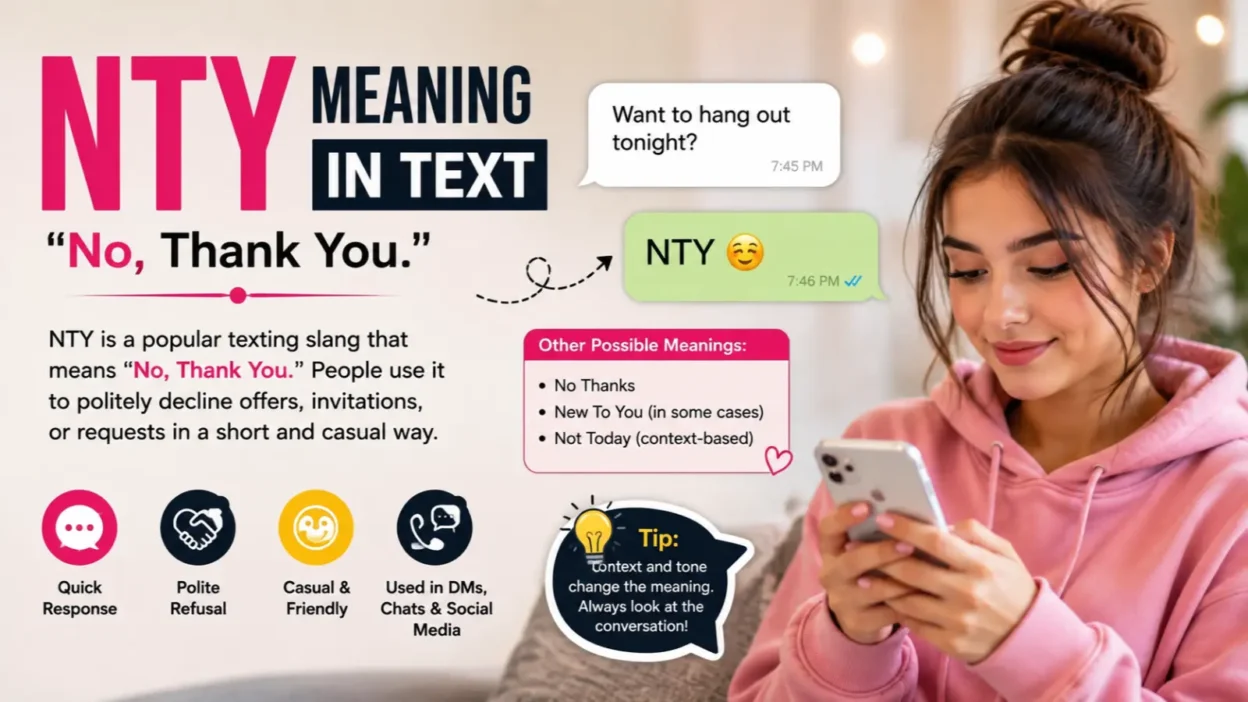
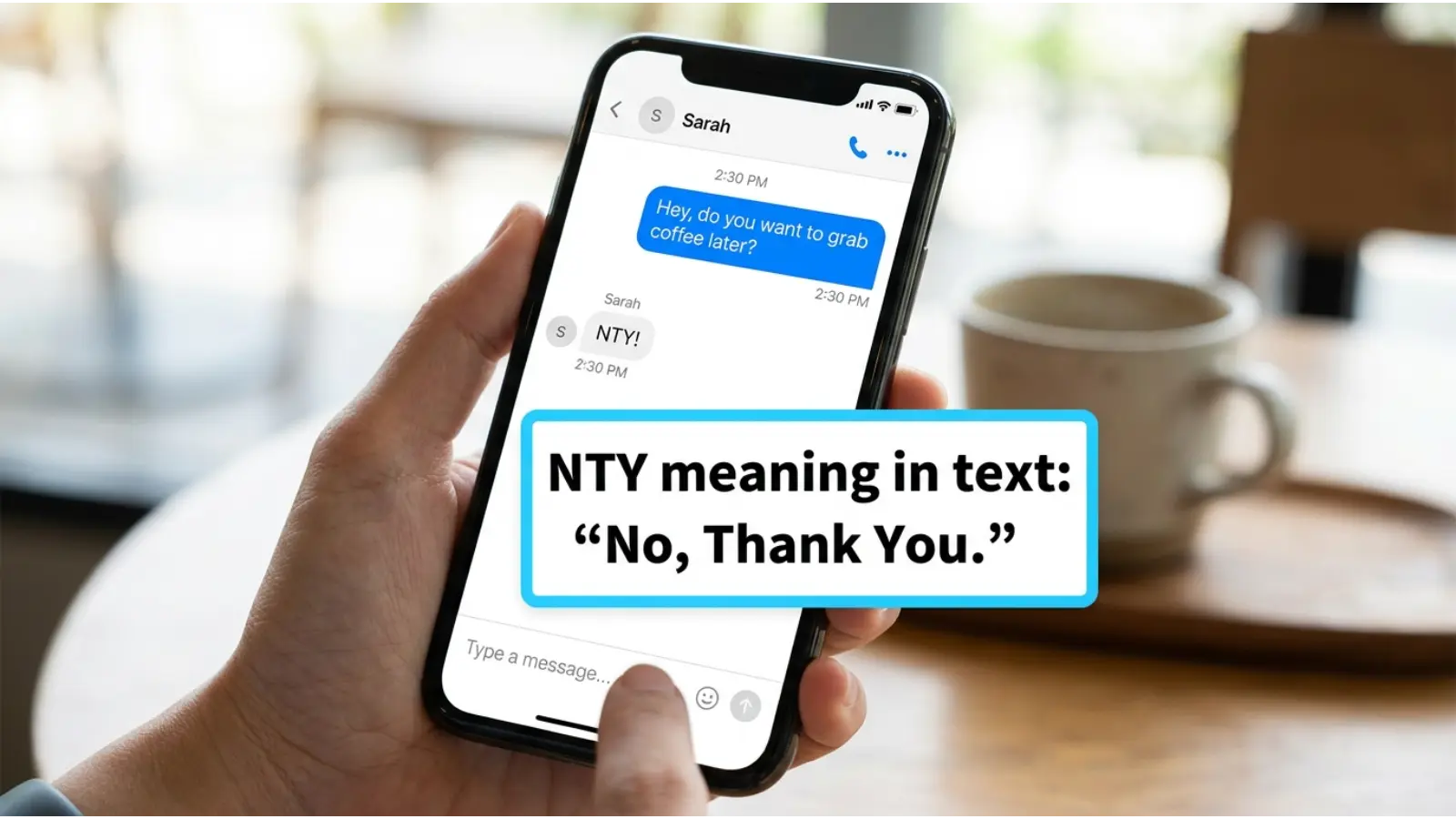
The most common NTY meaning in text is “No, Thank You.” It is an informal abbreviation people use to decline an offer, invitation, suggestion, or request without typing the full phrase.
For example:
Alex: Want me to grab you a coffee?
Sam: NTY, I already had one.
At face value, it sounds simple. But digital communication rarely depends on words alone. Capitalization, punctuation, response speed, emojis, and the relationship between two people can all change how “NTY” feels.
Quick Definition & Meanings
1. NTY Means “No, Thank You”
This is the standard meaning in texting, messaging, and online chat.
Someone uses NTY when they want to politely say no without writing the complete “No, thank you.”
Example:
“Want another slice?”
“NTY, I’m full.”
This is generally neutral and friendly.
2. NTY as a Polite Refusal
NTY can soften a simple rejection. Instead of replying with a blunt “No,” the sender acknowledges the offer while declining it.
Example:
“Do you want to join the group call?”
“NTY, I’ve got some work to finish.”
The “thank you” element makes the refusal less abrupt.
3. NTY as “No Thanks”
In everyday internet language, NTY can function almost exactly like “no thanks.” The expressions communicate the same basic idea: appreciation plus refusal.
Example:
“Want to try this challenge?”
“NTY 😂”
Here, the abbreviation keeps the response casual.
4. NTY as a Firm Boundary
Context can make NTY more direct.
If someone repeatedly asks the same question and receives:
“NTY.”
the message may communicate more than simple politeness. It can mean, “I’ve already answered, so please leave it there.”
The period can make the response feel firmer than:
“nty haha”
That difference illustrates an important feature of texting: formatting can carry emotional information.
5. NTY Used Playfully or Sarcastically
Friends sometimes use NTY jokingly when the situation is obviously exaggerated.
Example:
“Want to do five hours of homework on Saturday?”
“NTY 😭”
The person is not necessarily making a serious social rejection. The abbreviation becomes part of the joke.
6. NTY as a Dry or Dismissive Reply
A standalone “NTY” can occasionally sound cold, especially when the other person expects enthusiasm or a detailed response.
Compare:
“NTY, but thanks for asking!”
with:
“NTY.”
The first feels considerate. The second may feel final.
That does not automatically make it rude. It simply shows why context matters more than the abbreviation itself.
Other Possible Meanings
Although “No, Thank You” is the established texting meaning, acronyms can have unrelated meanings in specific communities. Some slang references list alternatives such as “New To You,” while other interpretations may appear in usernames, organizations, gaming communities, or niche contexts.
So if “NTY” appears somewhere unusual, don’t automatically assume it means “No, Thank You.” Look at the surrounding conversation.
NTY Meaning in Texting & Messaging
Texting rewards efficiency. People often remove words that are grammatically unnecessary because the other person can reconstruct the intended meaning instantly.
That is exactly where NTY fits.
Instead of:
“No, thank you. I don’t think I want to go tonight.”
someone might write:
“NTY, I’m staying home tonight.”
Or simply:
“NTY.”
The abbreviation works particularly well when the context is already obvious.
In Private Texts
Among friends, NTY can feel completely natural:
Mia: Want pizza?
Lena: NTY, I ate already.
Because the relationship is familiar, neither person needs a formal explanation.
In Group Chats
NTY can help someone decline without interrupting the flow of a busy conversation.
Chris: Anyone want to play later?
Jay: NTY
Chris: All good 😂
The short answer communicates the decision without creating a lengthy side conversation.
In DMs
A DM can be more emotionally sensitive because the recipient may analyze every word.
“NTY” can therefore sound different depending on the relationship.
If someone says:
“Want to hang out this weekend?”
“NTY, maybe another time.”
The additional phrase makes the refusal warmer.
But:
“NTY.”
may suggest that the person does not want to continue the conversation.
Read Receipts and Response Timing
Digital communication adds another layer: when someone replies.
A quick “NTY” may simply mean they immediately knew their answer.
A delayed “NTY” after repeated messages could feel more like boundary-setting.
Still, response timing is not reliable proof of emotion. People may be busy, distracted, offline, or simply not know what to say.
NTY Origin, Evolution & Social Media Spread
NTY belongs to the broader tradition of internet and texting abbreviations designed to make digital communication faster. References to the abbreviation appear in online slang records going back many years, including an Urban Dictionary entry from 2005 and a Slang.net entry dating to 2020.
It is better understood as part of the evolution of text-message shorthand than as a term created by one particular TikTok trend or influencer.
Early online communication encouraged abbreviations because typing was slower and interfaces were less convenient. Expressions such as “TY,” “TBNT,” and “NT” developed alongside other short forms for saying thanks or declining something. CyberDefinitions, for example, groups NTY with related expressions such as “NT” and “TBNT” (“Thanks, But No Thanks”).
Social media then helped normalize this compressed style.
Instagram comments, TikTok discussions, gaming chats, Discord communities, WhatsApp groups, and messaging apps all encourage fast exchanges. A three-letter response can travel across communities without requiring a full sentence.
But there is an important distinction: NTY is not necessarily Gen Z slang in the same way as newer viral expressions. Its roots are more closely connected to longstanding online shorthand and texting culture.
Real-Life Conversations
WhatsApp / iMessage Chat
A: Want to come over for dinner?
B: NTY, I already ate 😭
A: Fair enough lol
What is happening emotionally?
B declines the invitation but adds context. The extra explanation prevents NTY from sounding like a hard rejection.
Instagram DM
A: You should totally try this new restaurant.
B: NTY 😂 I’m broke this week.
A: LMAO understandable.
Here, NTY works as a casual refusal rather than a serious rejection.
TikTok Comment
Creator: Who else would actually try this?
Commenter: NTY 💀
The commenter is likely using NTY humorously. The surrounding emoji and exaggerated context can turn a straightforward refusal into a playful reaction.
Group Chat
A: Anyone want to wake up at 5 AM for a hike?
B: NTY
C: Absolutely not 😭
D: I’m sleeping in.
In this environment, NTY is efficient because everyone understands what is being declined.
Flirty Conversation
A: Dinner with me Friday? 👀
B: NTY haha
A: No worries!
Here, NTY may function as a gentle romantic rejection. The “haha” softens the delivery, but it does not necessarily change the underlying answer.
Why Do People Choose NTY Instead of “No, Thank You”?
There is a subtle psychological advantage to shorthand: distance.
Writing “No, thank you” can feel more deliberate. Writing “NTY” can make the refusal feel lighter, quicker, and less emotionally loaded.
That does not mean the sender is hiding something. Digital language simply gives people different levels of emotional intensity.
Compare:
- “No.” → direct and potentially blunt
- “No thanks.” → casual refusal
- “No, thank you.” → polite and complete
- “NTY.” → compressed, casual, potentially firm
- “NTY haha.” → lighter and friendlier
- “NTY 😭” → humorous or exaggerated refusal
The words remain similar, but the social packaging changes.
Psychological & Emotional Dynamics of NTY
It Can Signal Confidence
Someone who writes NTY may be comfortable saying no without providing a long explanation.
That can communicate a healthy degree of decisiveness:
“NTY, I’m good.”
There is no need to invent an elaborate excuse.
It Can Create Emotional Distance
A short abbreviation also reduces conversational investment.
If someone sends a long invitation and receives only:
“NTY.”
they may perceive less warmth than they would from:
“Thanks for inviting me, but I can’t make it.”
The sender may not intend to sound distant, but the recipient can still experience the message that way.
It Can Establish a Boundary
Repeated unwanted requests can make a short refusal useful.
“Want to join?”
“NTY.”
“Come on, it’ll be fun.”
“NTY.”
At this point, the abbreviation can become a clear boundary rather than merely a casual shorthand.
It Can Build Social Belonging
Slang also works as a marker of shared digital culture.
People who understand abbreviations instantly do not need to translate every phrase into formal English. The shorthand becomes part of the conversational rhythm.
That is one reason internet language spreads so quickly: shared vocabulary creates shared social space.
Contextual Usage Guidelines
Social Media vs. Private Texts
On social media, NTY often appears as a quick reaction.
In private messages, however, the recipient may pay more attention to the emotional meaning behind it.
A public:
“NTY 😂”
may simply be a joke.
A private:
“NTY.”
could carry more weight.
Close Friends vs. Casual Acquaintances
With close friends, abbreviations are usually easier to interpret because both people understand each other’s communication style.
With acquaintances, adding a few words can prevent accidental coldness.
Instead of:
“NTY.”
try:
“NTY, but thanks for asking!”
Professional or Formal Environments
NTY is generally better suited to informal communication.
In professional emails, client communication, job applications, official requests, or sensitive workplace conversations, use standard language.
Instead of:
“NTY.”
write:
“Thank you for the offer, but I’ll have to decline.”
The longer version communicates professionalism and respect.
When NOT to Use NTY
During a Serious Argument
If someone is expressing genuine hurt or frustration, “NTY” can appear dismissive.
A fuller response is usually safer.
When Declining an Important Invitation
If someone personally invited you to a wedding, interview, event, or meaningful gathering, a simple abbreviation may seem too casual.
In Professional Communication
Avoid relying on slang when communicating with clients, managers, recruiters, professors, or unfamiliar professional contacts.
With People Who May Not Know Internet Slang
Not everyone recognizes NTY immediately. If clarity matters, write “No, thank you.”
When You Need to Explain Why
NTY only communicates the decision. It does not explain the reason.
If the relationship requires context, add a sentence.
“NTY, but I really appreciate the invitation. I already have plans.”
Common Misconceptions About NTY
Misconception 1: NTY is always rude.
Not true. Its basic meaning is polite: “No, thank you.” Tone depends heavily on context.
Misconception 2: NTY always means the person dislikes you.
No. Someone can reject an offer while still liking the person who made it.
Misconception 3: NTY always means “never.”
Not necessarily. It can simply mean “not this time.”
Misconception 4: NTY is only used by teenagers.
Online shorthand crosses age groups, although individual familiarity varies. Slang references describe its users broadly rather than limiting it to one generation.
Misconception 5: NTY has only one possible interpretation everywhere.
“No, thank you” is the dominant texting interpretation, but niche communities can assign different meanings to the same letters.
NTY vs. Similar Expressions
| Expression | Primary Meaning | Tone | Best Usage Context |
| NTY | No, thank you | Casual, neutral, sometimes firm | Texts, DMs, chats |
| No thanks | Politely decline | Casual and natural | Everyday conversation |
| TBNT | Thanks, but no thanks | More explicit, sometimes playful | Informal online conversations |
| NT | No thanks | Very brief | Fast chats and texting |
| I’ll pass | I don’t want it | Casual, sometimes confident | Offers, suggestions, invitations |
The key difference is emotional texture. NTY feels compressed and digital. “No thanks” sounds more conversational. “I’ll pass” can sound more relaxed or decisive. “TBNT” may carry a slightly playful or emphatic edge.
Variations, Derivatives & Responding to NTY
Common Variations
You may encounter:
- NTY — standard uppercase form
- nty — more casual lowercase form
- NTY haha — softened refusal
- NTY 😂 — humorous refusal
- NTY 😭 — exaggerated or playful refusal
- NTY, but thanks — warmer version
- NTY this time — makes the refusal less final
The lowercase “nty” can feel more relaxed, while uppercase “NTY” may look more deliberate. But capitalization is not a fixed rule.
Casual Replies
If someone says:
“NTY.”
you can answer:
- “All good!”
- “No worries.”
- “Fair enough.”
- “Haha okay.”
- “Totally fine.”
Funny or Sarcastic Replies
If you’re close friends:
- “Your loss 😂”
- “The audacity of saying no 😭”
- “I respect the commitment to NTY.”
- “Fine, more for me 💀”
Mature or Direct Replies
If the situation is more serious:
- “No problem, thanks for letting me know.”
- “Understood.”
- “That’s completely fine.”
- “Thanks for being clear.”
The best response usually matches the energy of the conversation rather than trying to force humor into a serious moment.
Generational & Regional Perspectives
Gen Z
Gen Z users are highly accustomed to compressed digital communication, but that does not mean every Gen Z user uses NTY constantly. The abbreviation can feel ordinary in fast chats, particularly when the context is obvious.
Millennials
Many millennials encountered abbreviations such as NTY through early texting, forums, gaming, instant messaging, and social platforms. For this group, NTY may feel familiar without necessarily being considered trendy.
Older Generations
People less familiar with internet shorthand may interpret NTY as an unexplained acronym. In formal or mixed-age communication, writing “No, thank you” is often clearer.
Global Internet Culture
Non-native English speakers frequently encounter expressions such as NTY through TikTok, Instagram, gaming, YouTube, Discord, and international group chats.
This is part of a larger pattern: internet English often spreads beyond traditional regional boundaries. Users may learn an abbreviation from a meme or comment section before ever encountering it in a classroom.
FAQs:
What does NTY mean in text?
NTY usually means “No, Thank You.” It is an informal abbreviation used to politely decline an offer, invitation, suggestion, or request.
Is NTY rude?
Not necessarily. NTY is normally a polite refusal, but a standalone “NTY.” can feel blunt or dismissive depending on the relationship, punctuation, and situation.
What does NTY mean on TikTok?
On TikTok, NTY generally means “No, Thank You.” It may appear in comments as a serious refusal or as a humorous reaction to a video, suggestion, trend, or challenge.
What does NTY mean from a girl or guy?
If someone sends NTY, regardless of gender, the most common meaning is “No, Thank You.” If it appears after a romantic invitation, it may indicate a polite rejection.
How do you reply to NTY?
A natural response is “No worries,” “All good,” “Fair enough,” or “Thanks for letting me know.” With close friends, a playful response can also work.
Is NTY the same as “No Thanks”?
Yes. In most texting contexts, NTY and “No Thanks” communicate essentially the same message: the person is politely declining something.
Final Thought
The simplest answer to the NTY meaning in text is “No, Thank You.” It is a compact way to decline an offer, invitation, suggestion, or request while retaining a basic level of politeness.
But the interesting part is what happens around those three letters.
1 “NTY 😂” can sound playful.
2 “NTY, but thanks!” can sound warm.
3 “NTY.” can sound firm.
4 “NTY, maybe another time” can leave the door open.
That is the larger lesson of internet communication: slang rarely carries its entire meaning by itself. Context, punctuation, timing, relationship, and shared culture all help determine what the sender actually communicates.
NTY may only contain three letters, but modern digital language has become remarkably good at making a tiny message carry a surprisingly large amount of social meaning.

I am Maxwell Ford, the creator of meaningosho.com, where I explore the origins and clear definitions of everyday words. I built this platform to help readers easily decode complex vocabulary and deepen their understanding of language. Through my articles, I love sharing simple, engaging insights that make learning new words both fun and useful.