
Have you ever opened a text message, seen someone reply with “IDEK”, and wondered whether they were confused, annoyed, or simply ending the conversation? You’re not alone.
The phrase IDEK meaning in text has become one of the internet’s favorite shorthand expressions because it captures uncertainty, surprise, frustration, and even emotional exhaustion in just four letters.
Example Chat
Alex: Are you still going to the party tonight?
Sam: IDEK 😭 It’s been such a long day.
In this conversation, “IDEK” doesn’t simply mean someone doesn’t know. It also reflects their mood. That’s exactly why so many people search for IDEK meaning in text—the same abbreviation can communicate different emotions depending on the situation, relationship, and platform.
Let’s explore what IDEK really means, why millions of people use it every day, and how it became a staple of modern digital communication.
Quick Definition & Meanings
The most common IDEK meaning in text is:
IDEK = I Don’t Even Know
People use it when they’re unsure, overwhelmed, shocked, confused, speechless, or unable to explain something.
Although the literal meaning stays the same, the emotional tone changes dramatically depending on the conversation.
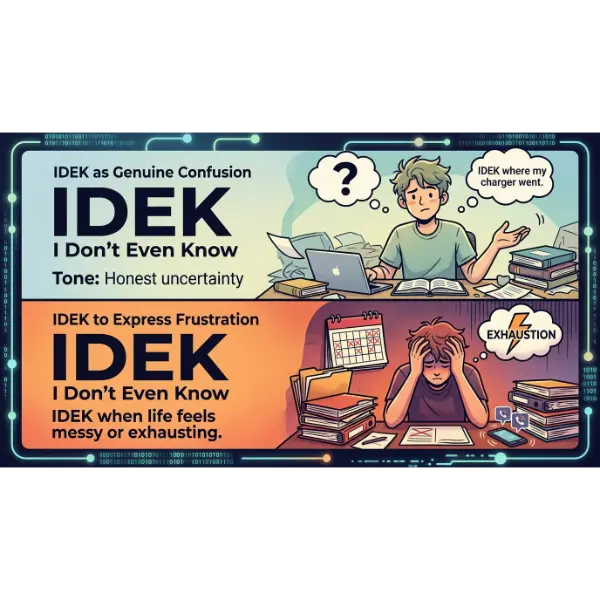
IDEK as Genuine Confusion
Sometimes someone honestly doesn’t know the answer.
Example:
“IDEK where my charger went.”
Tone: Honest uncertainty
IDEK to Express Frustration
People often use IDEK when life feels messy or exhausting.
Example:
“IDEK why today has been so stressful.”
Tone: Frustrated, emotionally tired
IDEK as Emotional Overwhelm
Instead of explaining complicated feelings, many people simply type IDEK.
Example:
“IDEK how I’m feeling right now.”
Tone: Vulnerable and emotionally drained
IDEK After Something Unexpected
When something surprising happens, IDEK expresses disbelief.
Example:
“IDEK what just happened 😂”
Tone: Shock, surprise, amusement
IDEK in Sarcasm
Friends frequently use IDEK sarcastically.
Example:
“IDEK why I even expected you to be on time.”
Tone: Playful criticism
IDEK During Awkward Moments
Sometimes people use IDEK to avoid giving a detailed explanation.
Example:
“IDEK…it’s complicated.”
Tone: Reserved or avoiding discussion
Other Meanings People Associate with IDEK
While I Don’t Even Know is overwhelmingly the standard definition, people sometimes use IDEK to communicate related emotions rather than a different literal meaning.
Depending on context, IDEK can imply:
- I’m confused.
- I have no idea.
- I’m speechless.
- I can’t explain it.
- I’m overwhelmed.
- I honestly don’t know.
- I’m mentally exhausted.
- Your guess is as good as mine.
- I’m still figuring it out.
- I don’t even want to think about it.
These are emotional interpretations rather than separate dictionary definitions.
Similar Slang Related to IDEK
If you understand IDEK, you’ll probably recognize these internet expressions too:
| Slang | Meaning |
|---|---|
| IDK | I Don’t Know |
| IDC | I Don’t Care |
| TBH | To Be Honest |
| NGL | Not Gonna Lie |
| SMH | Shaking My Head |
| FR | For Real |
| IMO | In My Opinion |
| ICYMI | In Case You Missed It |
IDEK Meaning in Texting & Messaging
In texting, speed matters. Rather than writing long explanations, people compress emotions into abbreviations.
When someone replies with IDEK, they’re often communicating much more than uncertainty.
In Private Chats
It can signal vulnerability.
“IDEK what I should do.”
In Group Chats
It often shows shared confusion.
“IDEK what’s happening anymore 😂”
After Delayed Replies
Someone may answer:
“Sorry… IDEK where the day went.”
Here IDEK softens the conversation while sounding honest.
During Emotional Conversations
Rather than pretending to have answers, IDEK admits uncertainty.
That honesty often feels more genuine than forced confidence.
Origin, Evolution & Social Media Spread
IDEK emerged during the rise of internet abbreviations alongside terms like LOL, BRB, OMG, and IDK.
As texting became faster on early mobile phones, people naturally shortened common phrases.
Later, platforms such as Twitter, Tumblr, Snapchat, TikTok, Discord, Reddit, Instagram, and gaming communities helped IDEK spread even further.
Algorithms also played a role. Viral memes, relatable videos, reaction posts, and humorous screenshots repeatedly exposed millions of users to abbreviations like IDEK.
Today, IDEK appears across:
- TikTok captions
- Instagram comments
- X posts
- Snapchat conversations
- Discord chats
- WhatsApp messages
- Gaming voice chat text channels
Its meaning has stayed surprisingly stable, even as internet culture continues evolving.
Real-Life Conversations
WhatsApp Chat
Emma: Did you finish the assignment?
Ryan: IDEK where my notes are 😭
Instagram DM
Friend: Why were you laughing so hard?
You: IDEK 😂 That video broke my brain.
TikTok Comments
Comment: Why did he actually do that?
Reply: IDEK but I’m crying 😂😂
Group Chat
Alex: Anyone know what’s happening tonight?
Chris: IDEK anymore lol.
Why People Choose IDEK
Instead of writing lengthy explanations, IDEK communicates emotion efficiently.
It feels casual, relatable, authentic, and emotionally honest.
That’s why it has become one of the internet’s favorite conversational shortcuts.
Psychological & Emotional Dynamics
Internet slang isn’t just about saving time.
It also communicates identity.
When someone says IDEK, they may be signaling:
- Humility
- Emotional honesty
- Social awareness
- Mild frustration
- Self-awareness
- Vulnerability
- Playfulness
- Shared confusion
Modern slang allows people to express complicated emotions without sounding overly dramatic.
In many ways, IDEK acts as emotional shorthand.
It tells others, “I’m processing this too.”
Contextual Usage Guidelines
Social Media
Perfect for memes, comments, reactions, and humorous content.
Private Texts
Great for honest conversations with friends, siblings, or partners.
Close Friends
Frequently used because everyone understands the casual tone.
Casual Acquaintances
Generally acceptable, although complete sentences may sometimes feel clearer.
Professional Settings
Avoid IDEK in business emails, academic writing, client communication, or job applications.
Writing “I don’t know at the moment” sounds more professional.
Matching the tone of your audience always matters.
When NOT to Use It & Misconceptions
Avoid IDEK:
- In professional emails
- During formal presentations
- In legal or official communication
- When speaking with people unfamiliar with internet slang
- During serious conflicts where clarity is important
Common Misconceptions
Myth: IDEK means someone is unintelligent.
Reality: It usually expresses uncertainty or emotion—not intelligence.
Myth: IDEK is always sarcastic.
Reality: It can be sincere, emotional, humorous, or sarcastic depending on context.
IDEK Compared with Similar Expressions
| Expression | Primary Meaning | Tone | Best Usage Context |
|---|---|---|---|
| IDEK | I Don’t Even Know | Emotional, uncertain | Personal chats, social media |
| IDK | I Don’t Know | Neutral | Everyday conversations |
| TBH | To Be Honest | Honest | Opinions and confessions |
| NGL | Not Gonna Lie | Candid | Sharing genuine thoughts |
| IDC | I Don’t Care | Indifferent | Casual conversations with friends |
Although IDEK and IDK look similar, IDEK usually carries stronger emotion. It often suggests confusion, disbelief, exhaustion, or being overwhelmed rather than simply lacking information.
Variations, Derivatives & Responding
Common variations include:
- idek
- IDEKKK
- idekkkk
- idek lol
- idek 😭
- idek honestly
- idek anymore
- IDEK bro
- idek fr
Casual Replies
- Same here.
- Me neither.
- I get it.
- Honestly, same.
- Fair enough.
Funny Replies
- Welcome to the club 😂
- Nobody knows.
- The mystery continues.
- That’s everyone’s mood today.
- Certified IDEK moment.
Mature Replies
- Take your time.
- It’s okay not to know.
- We can figure it out together.
- Let me know if you need help.
- No pressure.
Generational & Regional Perspectives
Gen Z
Uses IDEK naturally in everyday conversations, memes, gaming, and TikTok culture.
Millennials
Comfortable using IDEK, especially in texting and social media.
Older Generations
May recognize it but often prefer writing complete sentences.
Global Internet Users
Millions of non-native English speakers encounter IDEK while watching TikTok videos, gaming online, scrolling Instagram, or chatting on Discord.
As English internet slang spreads globally, abbreviations like IDEK become part of everyday digital vocabulary.
Frequently Asked Questions
What does IDEK meaning in text?
IDEK stands for I Don’t Even Know.
Is IDEK rude?
No. It’s generally casual and harmless unless used sarcastically.
What does IDEK mean on TikTok?
It usually expresses confusion, disbelief, emotional reactions, or humorous uncertainty.
What’s the difference between IDK and IDEK?
IDK simply means “I don’t know.” IDEK adds emotional emphasis and often suggests stronger confusion or frustration.
How do you reply to IDEK?
You can reply with empathy, humor, or more questions depending on the conversation.
Can IDEK be used professionally?
It’s better to avoid IDEK in formal emails, workplace communication, or academic writing.
Conclusion
Understanding IDEK meaning in text is about more than memorizing an abbreviation. While it literally stands for “I Don’t Even Know,” its real power comes from expressing emotions that are difficult to explain quickly.
If someone feels confused, overwhelmed, surprised, emotionally drained, or simply speechless, IDEK communicates those feelings in a way that feels natural in today’s fast-moving digital conversations.
As internet slang continues evolving across TikTok, Instagram, WhatsApp, Discord, and countless other platforms, IDEK remains one of the clearest examples of how a few simple letters can carry genuine emotion. Knowing when—and why—people use it helps you understand not just the words, but the human connection behind modern online communication.

I am Maxwell Ford, the creator of meaningosho.com, where I explore the origins and clear definitions of everyday words. I built this platform to help readers easily decode complex vocabulary and deepen their understanding of language. Through my articles, I love sharing simple, engaging insights that make learning new words both fun and useful.