Have you ever received a message that simply says “WYA?” and wondered whether the sender was just asking for your location—or hinting at something more?
Imagine opening your phone and seeing this conversation:
Alex: WYA? 👀
Jordan: Just got home. What’s up?
Alex: We all went out. Come join us!
At first glance, it looks like a simple question. But depending on who sends it, WYA meaning in text can express curiosity, urgency, affection, excitement, flirting, or even frustration.
As texting culture becomes faster and more casual, abbreviations like WYA have become part of everyday digital conversations. People search for this phrase because its meaning often depends on context, tone, emojis, and the relationship between the people chatting.
This guide explains every major meaning of WYA, where it came from, how people use it across social media, and how to respond naturally.
Quick Definition & Meanings
WYA stands for:
- Where Are You At?
- Where Are You?
It’s an informal abbreviation people use in text messages, Snapchat, Instagram DMs, WhatsApp, TikTok comments, Discord chats, and gaming conversations to ask someone’s location or availability.
However, the emotional meaning changes depending on the conversation.
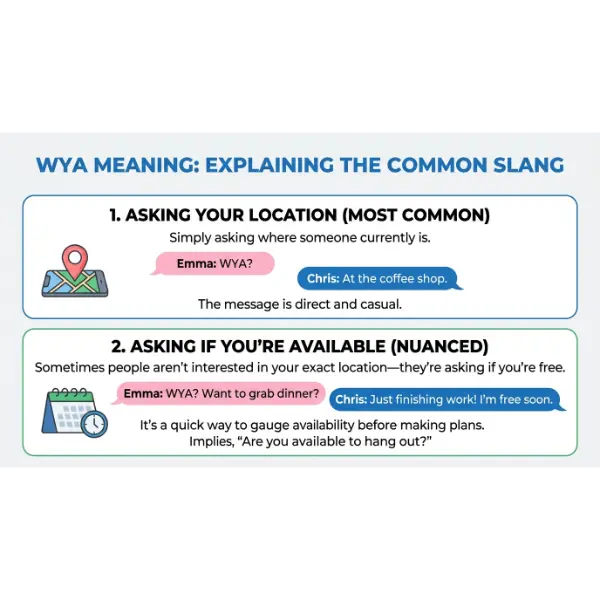
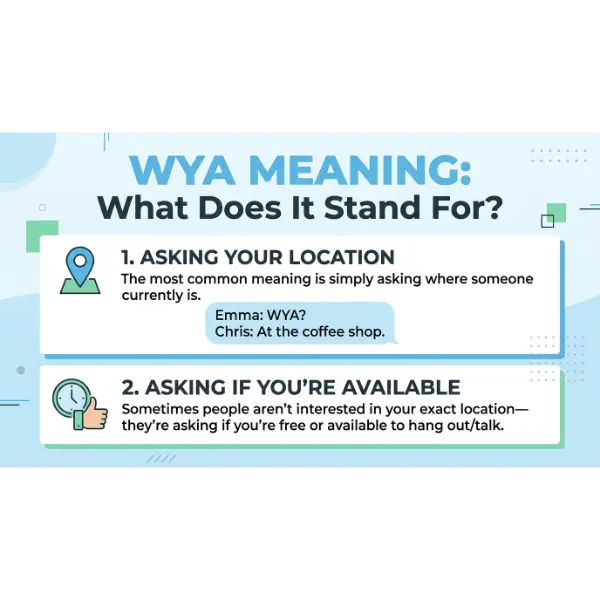
WYA Meaning: Asking Your Location
The most common meaning is simply asking where someone currently is.
Example:
Emma: WYA?
Chris: At the coffee shop.
The message is direct and casual.
WYA Meaning: Asking If You’re Available
Sometimes people aren’t interested in your exact location—they’re asking if you’re free.
Example:
“WYA? Wanna hop on the game?”
Here it means:
Are you available right now?
WYA Meaning: Invitation to Hang Out
Friends often use WYA before inviting someone somewhere.
Example:
“WYA? We’re at Jake’s house.”
The location matters because they’re inviting you.
WYA Meaning: Flirting
Among romantic interests, WYA can feel much warmer.
Example:
“WYA? I miss you ❤️”
Now the question expresses emotional interest rather than simple curiosity.
WYA Meaning: Impatience
Sometimes WYA signals frustration.
Example:
“WYA?? We’ve been waiting 30 minutes.”
Adding multiple question marks changes the tone.
WYA Meaning: Checking In
People also use it when they haven’t heard from someone recently.
Example:
“WYA? Haven’t seen you online today.”
This version often shows care and concern.
Other Meanings Related to WYA
Although “Where You At?” is by far the most common definition, people sometimes use WYA with slightly different intentions depending on context.
| Meaning | What It Usually Implies |
| Where are you? | Asking your physical location |
| Where are you at mentally? | Asking how you’re doing emotionally |
| What are you doing? | Casual check-in among close friends |
| Are you coming? | Asking if you’re on the way |
| Are you free? | Checking availability |
| Why aren’t you here? | Expressing disappointment |
| Come join us | Invitation hidden inside the question |
Similar Slang Meanings Related to WYA
People often confuse WYA with similar texting abbreviations.
| Slang | Meaning |
| WYD | What Are You Doing? |
| WSG | What’s Good? |
| WSP | What’s Up? |
| HBU | How About You? |
| LMK | Let Me Know |
| BRB | Be Right Back |
| OMW | On My Way |
| ETA | Estimated Time of Arrival |
Each serves a different purpose, although they frequently appear in the same conversations.
WYA Meaning in Texting & Messaging
Private messaging relies on speed. WYA works because it’s short and instantly understood.
In Private Chats
It often means:
- Where are you?
- Are you free?
- Can we meet?
In Group Chats
Someone may text:
“WYA? Everyone’s here.”
This encourages participation without sounding formal.
Read Receipts & Timing
If someone sends WYA after you’ve been inactive for hours, they may genuinely be wondering where you’ve been.
If they send it repeatedly:
“WYA??”
”WYA bro?”
The emotional urgency increases.
Origin, Evolution & Social Media Spread
WYA originated as a shortened version of “Where You At?”, a phrase commonly used in spoken English before becoming popular in digital messaging.
During the rise of SMS texting in the early 2000s, character limits encouraged people to shorten common phrases. WYA became one of many abbreviations that saved time while remaining easy to understand.
Later, platforms like:
- Snapchat
- Twitter (now X)
- TikTok
- Discord
helped spread the abbreviation across different online communities.
Gaming communities also adopted WYA when coordinating multiplayer matches.
TikTok creators further popularized the phrase through captions like:
“WYA when the food arrives 😂”
or
“WYA bestie?”
Today, WYA is understood almost universally by younger internet users.
Real-Life Conversations
WhatsApp Chat
Mia: WYA?
Noah: At work.
Mia: Cool. Text me later.
Instagram DM
Alex: WYA tonight?
Taylor: Probably staying home.
Alex: Want to grab dinner instead?
TikTok Comments
Person 1:
“WYA people born in 2005 😂”
Person 2:
“Right here 🙋”
Gaming Chat
Player 1:
“WYA?”
Player 2:
“Respawning.”
Emotional Pattern
People choose WYA because it feels faster, friendlier, and less formal than asking:
“Where are you currently located?”
It creates conversational warmth while keeping communication effortless.
Psychological & Emotional Dynamics
Slang like WYA does more than save time.
It often signals:
- Social closeness
- Familiarity
- Shared internet culture
- Casual confidence
- Immediate connection
Instead of formal language, WYA feels spontaneous and natural.
Among close friends, it reinforces belonging.
In dating, it can communicate interest without sounding overly serious.
In groups, it helps coordinate plans quickly.
Contextual Usage Guidelines
Social Media
Very common.
Examples:
- WYA?
- WYA bestie?
- WYA lol
Private Texts
Most natural setting.
People use it daily.
Close Friends
Perfectly appropriate.
Friends understand the casual tone.
Casual Acquaintances
Still acceptable, though slightly less personal.
Professional Settings
Avoid using WYA.
Instead say:
- Where are you?
- Are you available?
- Where are you located?
Professional communication benefits from complete sentences.
When NOT to Use WYA & Common Misconceptions
Avoid WYA when:
- Writing work emails
- Contacting clients
- Speaking with professors
- Writing formal documents
- During serious disagreements
Common Misconceptions
Myth: WYA always means someone’s asking for your GPS location.
Reality: It often means:
- Are you free?
- Why aren’t you here?
- Want to hang out?
Context always matters.
Semantic Comparison Table
| Expression | Primary Meaning | Tone | Best Usage Context |
| WYA | Where are you? | Casual | Friends, dating, group chats |
| WYD | What are you doing? | Curious | Everyday texting |
| WSG | What’s good? | Friendly | Social conversations |
| WSP | What’s up? | Relaxed | Casual greetings |
| Where are you? | Asking location | Neutral | Formal and informal communication |
Although these expressions seem similar, they serve different purposes. WYA focuses on location or availability, WYD asks about someone’s activity, WSG starts a friendly conversation, while WSP works as a casual greeting. Choosing the right one helps your message match the situation and the relationship.
Variations, Derivatives & Responding to WYA Meaning in Text
Common Variations
- WYA?
- WYA at?
- Wyaaa
- WYA bro
- WYA lol
- WYA rn (right now)
- WYA tho?
- WYA 👀
Casual Replies
- At home.
- Just got here.
- On my way.
- At work.
- Almost there.
Funny Replies
- Hiding from responsibilities.
- Somewhere on Earth.
- Lost in the snack aisle.
- Mentally on vacation.
- In your Wi-Fi.
Mature & Direct Replies
- I’m busy at the moment.
- I’ll be there in 20 minutes.
- I can’t make it tonight.
- Thanks for checking in.
Generational & Regional Perspectives
Gen Z
Gen Z uses WYA naturally across nearly every messaging platform. It often carries playful, social, or flirtatious energy and is deeply woven into online culture.
Millennials
Millennials commonly understand and use WYA, especially in text messages and group chats, though they may switch to full phrases in more formal situations.
Older Generations
Many older adults recognize WYA but are generally more likely to write “Where are you?” in full, particularly outside casual conversations.
Global Internet Culture
For non-native English speakers, WYA is one of the first internet abbreviations they encounter through TikTok, Instagram, gaming, and meme culture. As a result, it’s now widely recognized well beyond English-speaking countries.
FAQs About WYA Meaning in Text
What does WYA meaning in text?
WYA means “Where You At?” or “Where Are You?” It usually asks about someone’s location or availability.
What does WYA mean on TikTok?
On TikTok, WYA often appears in captions and comments to ask where people are, invite interaction, or jokingly call out a particular group of viewers.
Is WYA rude?
No. WYA is generally friendly and informal. However, repeatedly sending “WYA???” can come across as impatient or demanding.
How do you reply to WYA?
Respond with your location, availability, or plans. For example: “At home,” “On my way,” or “Just finished work.”
Is WYA flirting?
It can be. If you’re interested in texts “WYA?” late at night or follows it with affectionate emojis or an invitation to meet, it may express romantic interest.
Can I use WYA in professional messages?
It’s better not to. Use complete phrases like “Where are you?” or “Are you available?” in professional or formal communication.
Conclusion
Understanding WYA meaning in text goes beyond knowing that it stands for “Where You At?”. In today’s digital conversations, the phrase can ask about someone’s location, check their availability, invite them to join a group, express concern, or even add a flirtatious touch.
Its meaning shifts with context, tone, timing, and the relationship between the people communicating.
As online language continues to evolve, WYA remains one of the internet’s most recognizable and versatile abbreviations. Knowing when—and how—to use it helps you communicate more naturally, understand social cues, and stay connected in the fast-moving world of modern texting and social media.

I am Maxwell Ford, the creator of meaningosho.com, where I explore the origins and clear definitions of everyday words. I built this platform to help readers easily decode complex vocabulary and deepen their understanding of language. Through my articles, I love sharing simple, engaging insights that make learning new words both fun and useful.