Have you ever received a simple text saying “IMY ❤️” after a long day and wondered If it was just friendly or something more? That’s one reason so many people search for IMY meaning in text.
Even though it’s only three letters, IMY can carry warmth, affection, nostalgia, or even romantic feelings depending on who sends it and when.
Example Chat
Alex: It’s been forever since we talked. IMY.
Jordan: Aww, IMY too! We should catch up this weekend.
In today’s fast-moving digital conversations, people often shorten emotional expressions. IMY is one of those abbreviations that saves time while expressing genuine feelings. Understanding its tone can help you avoid misunderstandings and respond naturally.
Quick Definition & Meanings
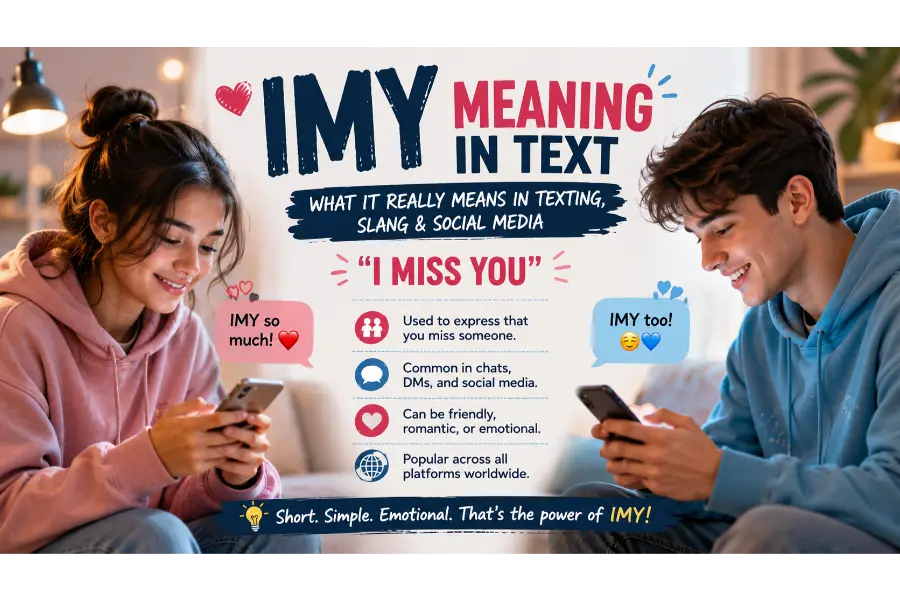
IMY Meaning in Text most commonly stands for “I Miss You.”
People use it in text messages, social media, gaming chats, and direct messages to tell someone they miss their presence. Depending on the relationship and context, IMY can express friendship, romance, nostalgia, or emotional support.
IMY Meaning in text : I Miss You (Most Common)
This is the standard meaning.
Example:
“IMY. Hope you’re doing okay.”
The sender genuinely misses spending time with the other person.

IMY as Romantic Affection
Between couples or people dating, IMY often signals emotional closeness and longing.
Example:
“Goodnight ❤️ IMY already.”
The message expresses love and emotional attachment.
IMY Between Friends
Friends also use IMY after being apart for weeks or months.
Example:
“College isn’t the same without you. IMY!”
The tone is caring without being romantic.
IMY During Difficult Times
Sometimes IMY expresses emotional support after someone moves away or experiences hardship.
Example:
“Everyone here IMY. Stay strong.”
The message communicates comfort and reassurance.
Playful or Casual IMY
Friends occasionally use IMY humorously.
Example:
“You’ve been offline for like two hours. IMY 😂”
Here, it’s exaggerated for comedic effect.
Other Meanings of IMY
Although “I Miss You” is overwhelmingly the most common definition, IMY can occasionally have different meanings depending on the community or context.
| Meaning | Context | Frequency |
|---|---|---|
| I Miss You | Texting, dating, friendships, social media | ⭐⭐⭐⭐⭐ Very Common |
| I Mean You | Rare conversational shorthand | ⭐ Rare |
| Instant Message You | Informal internet usage | ⭐ Very Rare |
| Internal company abbreviations | Business or workplace jargon | Depends on organization |
If you see IMY on TikTok, Instagram, Snapchat, WhatsApp, Facebook Messenger, Discord, or iMessage, it almost always means “I Miss You.”
Similar Meanings & Related Slang
People also express similar emotions using these abbreviations and phrases:
- ILY — I Love You
- LY — Love You
- ML — Much Love
- XOXO — Hugs and Kisses
- MISS U — Alternative spelling
- Thinking of You
- Wish You Were Here
- Can’t Wait to See You
- Come Back Soon
- Been Missing You
These expressions vary in emotional intensity, from casual friendship to deep romantic affection.
IMY Meaning in Texting & Messaging
In texting, IMY works as an emotional shortcut. Rather than writing a long paragraph, people communicate closeness in just three letters.
Private Chats
IMY usually feels sincere and personal.
Example
“I’ve been so busy lately. IMY.”
Group Chats
Friends sometimes say IMY after someone hasn’t participated for a while.
Example
“Where have you been? IMY!”
Long-Distance Relationships
Couples frequently exchange IMY throughout the day to maintain emotional connection despite physical distance.
Read Receipts and Timing
Receiving IMY unexpectedly often creates emotional warmth. Likewise, responding promptly usually reinforces the feeling of closeness.
Origin, Evolution & Social Media Spread
IMY became popular during the early days of SMS texting when character limits encouraged abbreviations.
Later, instant messaging platforms like MSN Messenger, AOL Instant Messenger, and Yahoo Messenger helped normalize shortened expressions.
As smartphones became widespread, IMY spread across:
- Snapchat
- TikTok
- Discord
- Facebook Messenger
- iMessage
Today, social media algorithms amplify emotional content. Posts about friendships, relationships, reunions, military families, study abroad experiences, and long-distance couples frequently include IMY, helping the abbreviation remain relevant across generations.
Unlike trendy slang that disappears quickly, IMY has stayed popular because missing someone is a timeless human emotion.
Real-Life Conversations
WhatsApp Chat
Emma: Flight landed safely.
Jake: Glad you made it ❤️ IMY already.
Emma: Miss you too.
Instagram DM
Friend: Your vacation looks amazing!
You: Thanks! IMY though. We should travel together next time.
TikTok Comments
User 1: School friends really become strangers.
User 2: IMY to everyone I grew up with.
Emotional Pattern
People choose IMY because it’s brief yet emotionally meaningful. It feels more personal than saying “hello” while remaining less intense than “I love you.”
Psychological & Emotional Dynamics
Using IMY often communicates:
- Emotional attachment
- Nostalgia
- Caring
- Affection
- Vulnerability
- Desire for reconnection
Digital slang helps people express emotions that might otherwise feel awkward to say directly.
For many users, typing IMY feels easier than writing an entire emotional message.
It also creates a sense of belonging. Whether between close friends or romantic partners, IMY reassures the other person that they’re remembered and valued.
Contextual Usage Guidelines
Social Media
IMY is often casual and public.
Example:
“IMY bestie ❤️”
Private Messages
The phrase usually carries deeper emotional meaning.
Example:
“IMY. Can we talk tonight?”
Close Friends
Comfortable and affectionate without necessarily being romantic.
Casual Acquaintances
Less common unless reconnecting after a long time.
Professional Settings
Avoid IMY in work emails or business communication unless you genuinely know the recipient personally.
Matching the emotional energy of the relationship is important. Sending IMY too early in a new friendship or relationship may feel overly personal.
When NOT to Use It & Common Misconceptions
Avoid IMY when:
- Sending professional emails
- Speaking with clients
- During serious workplace conversations
- Messaging someone who prefers formal communication
- Trying to manipulate emotions after an argument
Common Misconceptions
Myth: IMY always means romantic love.
Reality: Friends, family members, classmates, and coworkers may also use it.
Myth: IMY equals ILY.
Reality: Missing someone and loving someone are related but different emotional expressions.
Semantic Comparison Table
| Expression | Primary Meaning | Tone | Best Usage Context |
|---|---|---|---|
| IMY | I Miss You | Affectionate | Friends, family, partners |
| ILY | I Love You | Deeply emotional | Romantic partners, close family |
| MISS U | I Miss You | Casual | Everyday texting |
| Thinking of You | You are on my mind | Caring | Sympathy, encouragement, friendships |
| Wish You Were Here | Missing someone’s presence | Nostalgic | Travel, memories, relationships |
Although these phrases express similar emotions, IMY feels quick, modern, and conversational. ILY communicates stronger affection, while Thinking of You often emphasizes care without necessarily expressing longing.
Variations, Derivatives & Responding
Common Variations
- IMYSM — I Miss You So Much
- Miss u
- Miss ya
- Miss youuu
- IMY ❤️
- IMY 🥹
- IMY lol (playful)
- IMY fr (for real)
Casual Replies
- IMY too!
- Same here.
- Can’t wait to see you.
- Been thinking about you too.
Funny Replies
- You finally noticed? 😂
- I know, I’m unforgettable.
- Took you long enough.
- Miss me more!
Mature & Direct Replies
- I appreciate hearing that.
- I’ve missed you too.
- Let’s plan time together.
- Thanks, that means a lot.
Generational & Regional Perspectives
Gen Z
Uses IMY naturally across Snapchat, TikTok, Instagram, and Discord. Emojis often accompany the abbreviation.
Millennials
Commonly use IMY in texting, Facebook Messenger, and WhatsApp. Many grew up using internet abbreviations like BRB, LOL, and TTYL.
Older Adults
Some prefer writing “I miss you” in full, though many now understand IMY thanks to messaging apps.
Global Internet Culture
Millions of non-native English speakers learn IMY through social media, online gaming, K-pop communities, streaming platforms, and international friendships. It has become part of global digital vocabulary.
FAQs
What does IMY meaning in text?
IMY means “I Miss You.” It’s used to express that someone wishes another person were with them or wants to reconnect.
What does IMY mean on TikTok?
On TikTok, IMY almost always means “I Miss You.” People use it in captions, comments, and videos about friendships, relationships, and memories.
Is IMY romantic?
Not always. It can be romantic, friendly, or family-oriented depending on the relationship.
How do you reply to IMY?
You can respond with:
- IMY too.
- Miss you too!
- Can’t wait to see you.
- Thanks, I’ve missed you too.
Is IMY the same as ILY?
No. IMY means “I Miss You,” while ILY means “I Love You.” Missing someone doesn’t necessarily mean romantic love.
Can friends say IMY?
Absolutely. Friends often use IMY after being apart, moving away, or simply not talking for a while.
Conclusion
Understanding IMY meaning in text is about more than decoding an abbreviation—it’s about recognizing the emotion behind it. Most often, IMY means “I Miss You,” a simple yet meaningful way to express affection, nostalgia, or the desire to reconnect.
If it’s shared between close friends, family members, or romantic partners, those three letters can carry genuine warmth that long messages sometimes fail to capture.
As digital communication continues to evolve, abbreviations like IMY remind us that even the shortest messages can create real emotional connections. Knowing when and how to use IMY helps you communicate naturally, match the tone of the conversation, and strengthen relationships in today’s online world.

I am Maxwell Ford, the creator of meaningosho.com, where I explore the origins and clear definitions of everyday words. I built this platform to help readers easily decode complex vocabulary and deepen their understanding of language. Through my articles, I love sharing simple, engaging insights that make learning new words both fun and useful.