You’re chatting with a friend, the conversation seems finished, and then they suddenly type, “BTW, did you finish that assignment?” You probably understand the sentence instantly, but the tiny abbreviation still raises a question: what does BTW meaning in text, and does it carry any hidden tone?
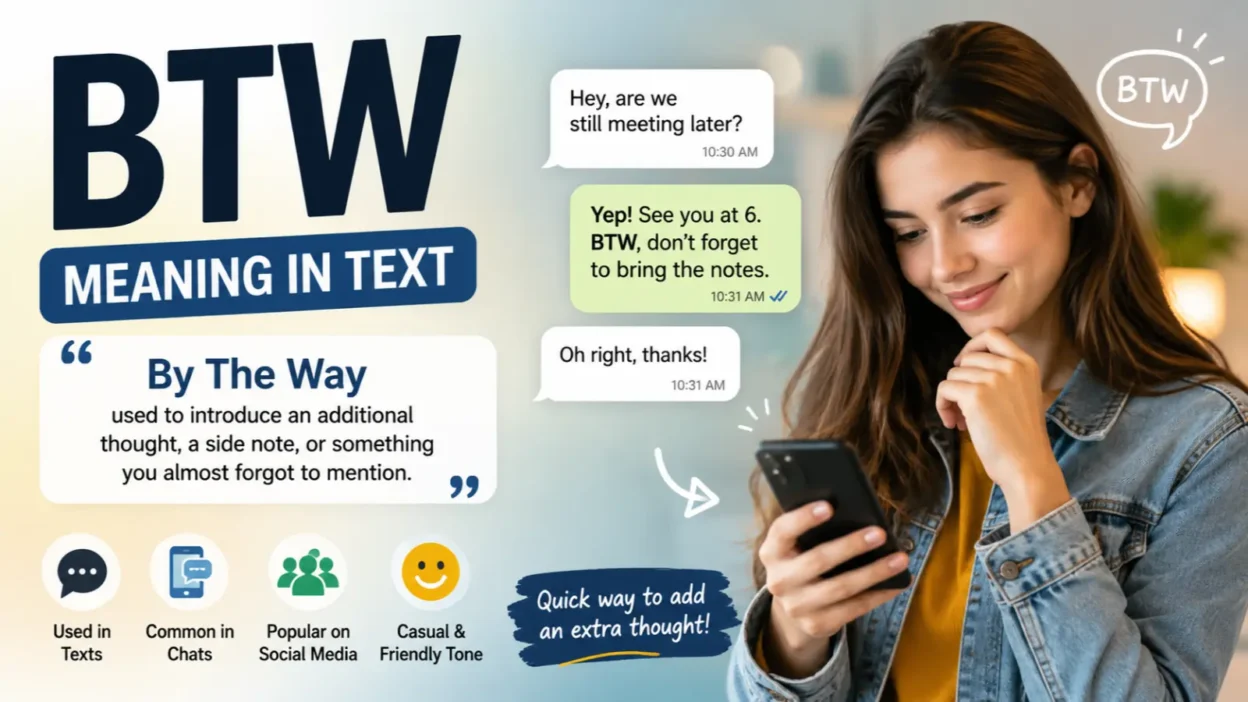
BTW most commonly means “by the way.” People use it to introduce an additional thought, a side note, a reminder, or something they almost forgot to mention. Its meaning is usually straightforward, but the emotional tone can change depending on the conversation.
Example:
Are you coming to the party tonight?
Sam: Yeah, probably around 8. BTW, can you bring my charger?
Here, BTW simply introduces an extra point. It makes the message feel casual rather than formal.
Quick Definition & Meanings
1. BTW = By the Way
The primary and standard meaning of BTW in texting is “by the way.”
It signals that the speaker is adding something related to the conversation but not necessarily central to the original topic.
Example:
“BTW, your presentation was really good.”
This sounds natural, quick, and friendly.
2. BTW for Adding a Side Note
Sometimes people use BTW when they suddenly remember something.
Example:
“BTW, don’t forget we have a meeting tomorrow.”
The abbreviation works almost like saying, “Oh, one more thing.”
3. BTW for Changing the Topic Slightly
BTW can introduce a new but loosely connected subject.
Example:
“I finally finished that movie. BTW, have you watched the new season yet?”
The speaker moves from one topic to another without making the transition feel formal.
4. BTW for Giving an Extra Detail
A person may use BTW to add information that isn’t essential but still matters.
Example:
“The restaurant was great. BTW, they’re opening another location downtown.”
5. BTW as a Casual Conversation Marker
In social messaging, BTW can make a statement feel less structured and more spontaneous.
Example:
“BTW, I liked your new profile picture.”
Depending on the relationship, this can sound friendly, complimentary, or even slightly flirty.
6. BTW in a Playful or Teasing Context
The abbreviation itself isn’t inherently sarcastic, but the sentence following it can make the entire message playful.
Example:
“BTW, you still owe me pizza 😂”
Here, BTW softens the transition into a teasing reminder.
7. BTW in a Slightly Passive-Aggressive Message
Context matters. Someone can use an innocent abbreviation while delivering criticism.
Example:
“BTW, you never replied to my message yesterday.”
The abbreviation doesn’t make the message aggressive by itself. The surrounding words create the tension.
What Does BTW Mean in Texting and Messaging?
In texting, BTW means “by the way,” but its practical role is broader than the dictionary definition.
It works as a micro-communication cue. Instead of writing a full transition such as “I also wanted to mention something else,” people simply write “BTW.”
That efficiency fits the rhythm of digital conversation.
In Private Texts
Friends and family frequently use BTW to add reminders, gossip, questions, compliments, or random thoughts.
“BTW, Mom said dinner is at 7.”
“BTW, did you ever call the dentist?”
The abbreviation keeps the conversation relaxed.
In Group Chats
BTW can help someone introduce an unrelated thought without making the message feel disruptive.
Because group chats move quickly, short abbreviations help people keep up with multiple conversational threads.
In DMs
Instagram, Facebook, Snapchat, and other messaging platforms often encourage short, informal communication.
“BTW, where did you get that jacket?”
The abbreviation makes the question sound more conversational than:
“By the way, where did you purchase that jacket?”
BTW and Read Receipts
Digital communication adds another layer of meaning. If someone sends several messages and then adds “BTW…”, the timing can matter.
For example:
“Okay, I understand.”
“BTW, are you still mad at me?”
The second message may reveal what the person actually wanted to ask but didn’t feel comfortable saying immediately.
This is why understanding slang isn’t only about decoding letters. The surrounding conversation, timing, punctuation, emojis, and relationship often carry more emotional information than the abbreviation itself.
BTW Origin, Evolution & Social Media Spread
BTW developed as an abbreviation of “by the way,” following a broader pattern of shortening common English expressions for faster communication.
Its popularity grew alongside digital communication, including online forums, chat rooms, instant messaging, texting, and social media.
Unlike some newer slang terms, BTW isn’t strongly tied to one specific online community or generation. It belongs to a broader family of internet abbreviations such as:
- FYI — for your information
- TBH — to be honest
- IDK — I don’t know
- IMO — in my opinion
- BRB — be right back
- BTW — by the way
As texting became mainstream, abbreviations moved beyond computer screens and into everyday digital conversation.
Social platforms accelerated this process because users constantly communicate through captions, comments, DMs, short posts, and fast-moving conversations. The more people encountered abbreviations, the more familiar they became.
Today, BTW generally feels less like “internet slang” and more like standard informal digital English.
Real-Life Conversations
WhatsApp / iMessage Chat
Maya: Are we still meeting at 6?
Liam: Yep, same place.
Maya: Perfect. BTW, can you bring the notes?
What’s happening?
BTW introduces a practical reminder without interrupting the main conversation.
Instagram DM
Ella: Your vacation photos are amazing.
Noah: Thanks!
Ella: BTW, where is that beach?
What’s happening?
The abbreviation creates a smooth transition from a compliment to a question.
TikTok Comment
User 1: This recipe actually looks easy.
User 2: I tried it yesterday 😂
User 3: BTW the sauce is the best part.
Here, BTW works as a quick conversational bridge inside a public discussion.
A More Emotional Example
Jordan: I’m not upset anymore.
Taylor: Okay, good.
Jordan: BTW, I did miss talking to you.
This example shows why context matters. The abbreviation looks casual, but the statement after it can carry emotional weight.
People sometimes use BTW to make a vulnerable thought feel less intense. Instead of announcing an emotional statement directly, they package it as “one more thing.”
The Psychological & Emotional Dynamics of BTW
Why do people write BTW instead of simply saying what they mean?
Part of the answer is social efficiency.
Digital conversations require people to communicate quickly while managing emotional impressions. A tiny abbreviation can make a message feel lighter.
BTW Can Reduce Formality
Compare:
“By the way, I wanted to ask you something.”
with:
“BTW, can I ask you something?”
The second version feels more relaxed and conversational.
BTW Can Soften a Topic Shift
Abruptly changing subjects can feel awkward. BTW gives the reader a small signal that another thought is coming.
BTW Can Create Emotional Distance
Sometimes people use casual language when discussing something slightly uncomfortable.
“BTW, are we okay?”
The abbreviation can make a serious question feel less confrontational.
BTW Can Signal Familiarity
Friends who regularly text each other don’t usually need formal transitions. Short forms such as BTW fit the shared conversational style.
Slang Can Build Social Belonging
Internet language often functions as a social shortcut. Using familiar abbreviations tells others that you understand the communication norms of the platform or group.
That doesn’t mean every abbreviation is “Gen Z slang.” BTW is much older and more widely understood than many newer social-media expressions.
Contextual Usage Guidelines
Social Media vs. Private Texts
On social media, BTW often introduces an additional opinion, joke, or detail.
In private messages, it may introduce something more personal.
Social media:
“BTW, this song is underrated.”
Private text:
“BTW, are you free tomorrow?”
Close Friends vs. Casual Acquaintances
With close friends, BTW can be extremely informal.
“BTW you still owe me coffee 😂”
With an acquaintance, you might choose the full phrase:
“By the way, I wanted to ask…”
The difference isn’t about correctness. It’s about matching the communication style of the relationship.
Professional or Formal Environments
BTW can be acceptable in very casual workplace chats, but it’s usually better to write “by the way” in formal emails, reports, proposals, and official communication.
For example:
Casual team chat:
“BTW, the deadline moved to Friday.”
Formal email:
“By the way, the deadline has been moved to Friday.”
Even better, formal writing may simply state the information directly.
When NOT to Use BTW & Common Misconceptions
Don’t Assume BTW Is Always Friendly
BTW itself is neutral. The sentence around it determines whether the message sounds warm, sarcastic, irritated, or serious.
“BTW, thanks for helping me yesterday!”
“BTW, why didn’t you tell me?”
Those messages clearly have different emotional energy.
Avoid It in Sensitive Arguments
If someone is already upset, adding “BTW” before a criticism can sound dismissive.
“BTW, you were wrong about everything.”
The issue isn’t the abbreviation. It’s the emotional context.
Don’t Treat BTW as a Secret Code
BTW generally does not automatically mean:
- “I’m annoyed.”
- “I’m flirting.”
- “I’m being sarcastic.”
- “I’m about to criticize you.”
Those meanings come from context rather than the abbreviation itself.
Don’t Overuse It
Putting BTW before every new sentence can make a conversation feel repetitive.
Use it when you genuinely want to create a side-note or topic shift.
BTW vs. Similar Expressions
| Expression | Primary Meaning | Tone | Best Usage Context |
|---|---|---|---|
| BTW | By the way | Casual, quick | Texts, DMs, group chats |
| FYI | For your information | Informational, sometimes firm | Work chats, messages, announcements |
| TBH | To be honest | Candid, personal | Opinions, confessions, reactions |
| Also | Adding another point | Neutral | Casual and formal writing |
| Oh, and… | Adding another thought | Conversational | Face-to-face speech and texts |
The key distinction is purpose. BTW usually signals a side note or conversational shift, while FYI focuses on passing along information. TBH signals honesty or personal opinion, and also simply adds another point without the same conversational flavor.
BTW Variations, Derivatives & How to Respond
People don’t usually create complicated grammatical forms from BTW because the abbreviation already represents a fixed phrase. However, you’ll see playful punctuation and combinations such as:
- BTW…
- btw
- BTW 😂
- btw lol
- btw tho
- oh btw
- and btw…
Capitalization usually doesn’t change the meaning.
Casual Replies
If someone writes:
“BTW, are you coming tonight?”
You could respond:
“Yeah, I’ll be there.”
Or:
“Probably! What time?”
Funny or Sarcastic Replies
“BTW, you still owe me pizza.”
Possible response:
“Wow, exposed in 4K 😂”
Or:
“I was hoping you’d forget.”
Mature or Direct Replies
If the conversation is more serious:
“BTW, are we still okay?”
A direct response might be:
“Yes. I’m glad you asked.”
Or:
“I think we should talk about it honestly.”
The best response isn’t determined by BTW. Match the emotional energy of the sentence that follows it.
Generational & Regional Perspectives
Gen Z
Younger internet users commonly recognize BTW without needing an explanation. However, Gen Z communication also includes newer abbreviations, memes, reaction language, emojis, and platform-specific slang.
BTW may therefore feel less like trendy slang and more like an everyday shorthand.
Millennials
Millennials encountered abbreviations such as BTW, BRB, LOL, and OMG during the growth of instant messaging, forums, SMS, and early social networks.
For many Millennials, BTW is familiar digital language rather than a new trend.
Older Generations
Some older users may prefer the full phrase “by the way,” particularly in formal communication. However, BTW is widely recognizable because it has been present in digital communication for decades.
Global Internet Culture
Non-native English speakers frequently encounter BTW through YouTube comments, Instagram, TikTok, gaming communities, messaging apps, and international online conversations.
Because English dominates much of internet culture, abbreviations can cross linguistic boundaries quickly. Users often learn the meaning from context rather than from formal language lessons.
FAQs:
What does BTW meaning in text?
BTW means “by the way.” People use it to introduce an extra thought, side note, reminder, question, or slightly different topic.
Is BTW rude?
No, BTW is not inherently rude. Its tone depends on the surrounding words, punctuation, relationship, and situation.
What does BTW mean on TikTok?
On TikTok, BTW still means “by the way.” Users may use it in captions, comments, or messages to add another thought or introduce a related point.
What does BTW mean in a text from a girl or guy?
Usually, it simply means “by the way.” It does not automatically indicate flirting or romantic interest. The rest of the message provides the important context.
How do you reply to BTW?
Reply to the statement or question that follows BTW. For example, if someone says, “BTW, are you free tonight?”, you can answer, “Yeah, I’m free after 7.”
Is BTW considered slang?
BTW is an informal abbreviation rather than highly niche slang. It is widely recognized in texting, online messaging, and social media.
Final Thoughts on BTW Meaning in Text
The simplest answer to BTW meaning in text is “by the way.” But its usefulness goes beyond those three words.
BTW helps people move between ideas, add forgotten details, soften transitions, make casual observations, and sometimes introduce emotionally meaningful thoughts without making them feel overly serious.
That is part of what makes digital communication interesting. A tiny abbreviation can change the rhythm of a message even when its literal meaning stays the same.
So when someone sends “BTW…”, don’t automatically search for a hidden message. Read what comes next, consider the relationship, notice the timing, and pay attention to the overall tone.
BTW is simple language doing subtle social work—and that’s exactly why context matters.

I am Maxwell Ford, the creator of meaningosho.com, where I explore the origins and clear definitions of everyday words. I built this platform to help readers easily decode complex vocabulary and deepen their understanding of language. Through my articles, I love sharing simple, engaging insights that make learning new words both fun and useful.