You open your phone and see a message that simply says “HY”. Two letters. No punctuation. No explanation.
Naturally, you may wonder: Does HY mean “hey”? Is it “hell yeah”? Is it a typo? Or does it have another slang meaning?
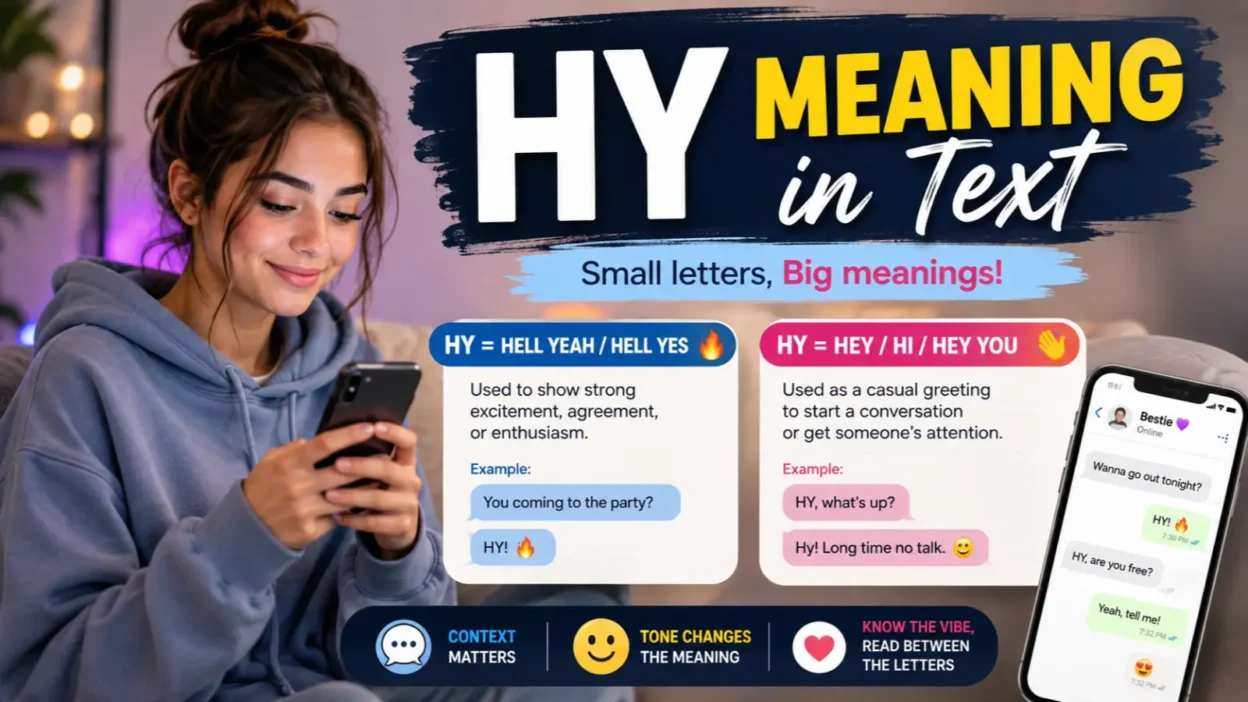
The answer is that HY meaning in text depends heavily on context. In casual online communication, HY can function as an enthusiastic response such as “hell yeah” or “hell yes,” while in other conversations it may be used as a shortened greeting such as “hi,” “hey,” or “hey you.” Some people also interpret it as shorthand for phrases such as “how you?” depending on the surrounding sentence.
For example:
Alex: Wanna go out tonight?
Sam: HY! 🔥
Here, HY probably means “hell yeah”—a strong, excited yes.
But:
Alex: HY, you still awake?
Sam: Yeah lol, what’s up?
Here, HY is more likely being used as a casual “hey” or “hi.”
That small difference explains why people search for the term. Internet slang rarely behaves like a dictionary. The same two letters can change meaning according to sentence position, punctuation, emojis, relationship, and the emotional energy of the conversation.
Quick Definition & Meanings
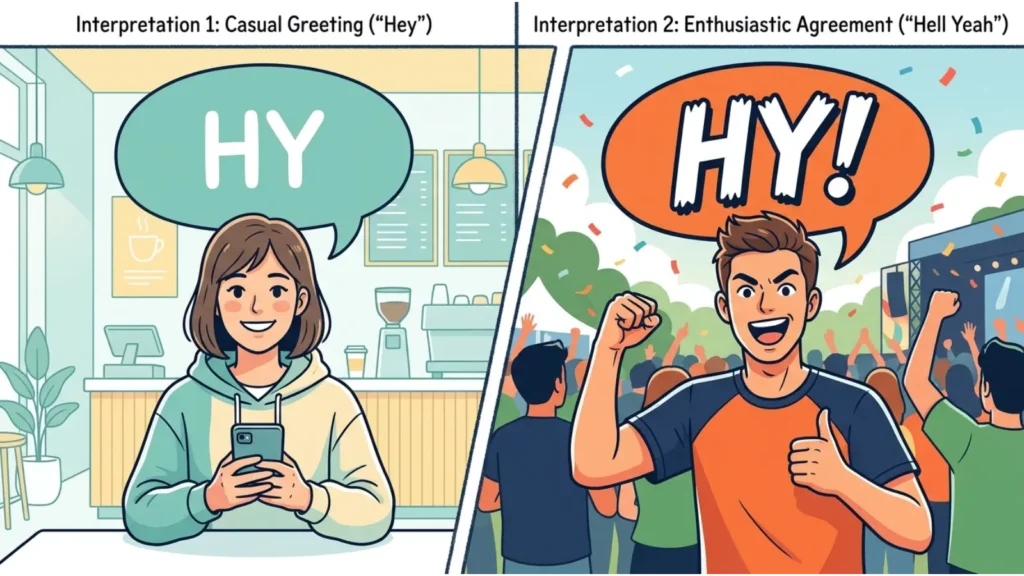
1. HY = Hell Yeah
One widely reported texting use of HY is “hell yeah.” It communicates strong agreement, excitement, approval, or enthusiasm. Current slang references describe this as a common interpretation in casual digital conversations.
Example:
“Are you coming to the concert?”
“HY! I’ve been waiting all week.”
The difference between “yes” and “HY” is emotional intensity. “Yes” confirms. “HY!” sounds like the person is genuinely excited.
Related meanings:
Absolutely, definitely, for sure, heck yes, hell yes, I’m in, count me in.
2. HY = Hell Yes
Some people use HY as a shortened version of “hell yes.” The function is almost identical to “hell yeah.”
Example:
“Would you do that again?”
“HY 😂”
The response communicates an energetic, confident yes.
The exact expansion is less important than the emotional message: strong agreement with attitude.
3. HY = Hey
Another common interpretation is simply “hey.” Several contemporary slang references describe HY as a quick, informal greeting.
Example:
“HY, what are you doing?”
Here, translating HY as “hell yeah” would make no sense. The placement at the beginning of the conversation strongly suggests a greeting.
4. HY = Hi
In some chats, people type hy as an informal or stylized version of “hi.” It may come from fast typing, personal texting habits, or simply a preference for abbreviated language.
Example:
“Hy 😊 how was your day?”
The sender is almost certainly saying hello rather than expressing enthusiastic agreement.
5. HY = Hey You
Depending on the conversation, HY can also be understood as “hey you.” This interpretation can sound more personal or playful, particularly when someone is trying to get another person’s attention.
Example:
“HY 👀 where have you been?”
The added emoji changes the emotional texture. It can make the greeting feel teasing, curious, or even mildly flirty.
6. HY as a Contextual Short Form
Some users interpret HY as part of other informal phrases, including variations around “how you?” or similar conversational shorthand. These meanings are less universal, so you should not automatically assume them without context.
This is an important rule with internet slang: a possible meaning is not necessarily the intended meaning.
HY Meaning in Texting & Messaging
The easiest way to understand HY is to look at what comes immediately before and after it.
If someone sends:
“Movie tonight?”
“HY!”
the enthusiastic-response meaning fits.
If someone starts a conversation with:
“HY, you’re busy?”
The greeting’s meaning fits better.
In Private Texts
Private messaging gives HY more emotional flexibility.
A friend might write:
“HY 😂 you actually did it.”
That could function as an excited reaction.
Another person might write:
“HY, long time no talk.”
That is clearly a greeting.
The relationship also matters. Friends who already share an informal communication style can use extremely short messages without losing meaning.
In Group Chats
Group chats encourage compressed communication because several conversations may happen simultaneously.
Someone might ask:
“Anyone down for pizza?”
A response like:
“HY 🍕”
can mean “hell yeah.”
The abbreviation works because everyone already understands the question.
In DMs
In an Instagram or Snapchat DM, a message such as:
“HY 👀”
could simply mean “hey,” but the emoji may introduce a playful or flirtatious undertone.
That does not automatically mean romantic interest. Emojis and relationship history matter more than the abbreviation itself.
Read Receipts and Pacing Matter
Digital communication has another layer: timing.
1 “HY” sent instantly after a question can feel spontaneous.
2 “HY!!!” after several minutes may feel like an enthusiastic re-entry into the conversation.
3 “hy” with no punctuation can feel more neutral or low-effort.
These aren’t fixed rules. They’re social signals people infer from texting patterns.
Origin, Evolution & Social Media Spread
There is no single, universally documented origin point for every use of HY. That matters because internet abbreviations often emerge through repeated informal use rather than through one official invention.
The broader evolution is easy to understand. Digital communication rewards speed. SMS, instant messaging, gaming chats, DMs, and social platforms all encourage people to compress familiar expressions into fewer characters.
That same environment produced shorthand such as:
- LOL — laugh out loud
- IDK — I don’t know
- TBH — to be honest
- FR — for real
- HY — context-dependent shorthand
Modern social platforms then accelerate the process. A phrase can move from one online community to another through screenshots, comments, memes, gaming conversations, short-form videos, and private messages.
But slang does not spread with a single definition. Communities reshape it.
That is why one person may read HY as “hell yeah” while another reads it as “hey.” Contemporary references themselves show this variation rather than one universally accepted interpretation.
Real-Life Conversations
WhatsApp / iMessage Chat
Friend 1: You wanna grab food after work?
Friend 2: HY 😂
Friend 1: Knew you’d say yes.
Meaning: Here, HY expresses enthusiastic agreement.
Another example:
Friend 1: HY, are you still awake?
Friend 2: Yep. What’s up?
Meaning: Here, HY functions like “hey.”
Instagram DM
Person A: That outfit actually looks amazing on you.
Person B: HY 😭 thank you!
Depending on the surrounding conversation, HY here could be an enthusiastic reaction rather than a greeting.
Another possibility:
Person A: HY 👀
Person B: Heyyy, what’s going on?
Here, HY works more naturally as “hey you” or “hey.”
TikTok Comment / Public Thread
Creator: Would you guys actually try this?
Comment: HY 🔥
The commenter is likely expressing an enthusiastic “hell yeah.”
A short abbreviation works particularly well in comment sections because users often want to react quickly without writing a full sentence.
Why Choose HY Instead of Formal Language?
Because slang communicates more than information.
Compare:
“Yes, I would like to participate.”
with:
“HY 😭🔥”
The first communicates information. The second communicates information plus attitude.
That is one of the central functions of internet slang: it helps people transmit emotional energy quickly.
Psychological & Emotional Dynamics of HY
Confidence
When HY means “hell yeah,” it can project confidence.
“You ready?”
“HY.”
The speaker sounds decisive rather than hesitant.
Excitement
An uppercase HY! can feel more energetic than lowercase hy.
Capitalization isn’t a strict grammatical rule online, but people often use it as a visual cue for emotional intensity.
Humor
HY can also make a response feel lighter.
“You really spent all your money on snacks?”
“HY 😂”
The abbreviation turns a straightforward answer into a playful one.
Emotional Armor
Short slang can sometimes make vulnerable communication feel less serious.
Instead of saying:
“Yes, I’m genuinely excited about seeing you.”
someone might say:
“HY 😭”
The shorter version communicates excitement while keeping the interaction casual.
Social Belonging
Slang can function as a kind of social shorthand. When people understand the same expressions, they can communicate quickly without explaining every phrase.
This is especially noticeable in online communities where users develop shared vocabulary.
Boundary Setting
Slang can also signal informality.
Using HY tells the other person, consciously or unconsciously, “We’re talking casually.”
That is useful with friends but can become inappropriate when the communication requires professionalism.
Contextual Usage Guidelines
Social Media vs. Private Texts
On TikTok, Instagram, Snapchat, Discord, or casual messaging, HY can fit naturally.
In private texts, its meaning becomes more dependent on the relationship and previous messages.
Close Friends vs. Casual Acquaintances
With close friends, you can usually use HY without worrying much about interpretation.
With a new acquaintance, a clearer phrase such as “hey” or “absolutely” may prevent confusion.
Professional or Formal Environments
Avoid HY in formal emails, job applications, academic writing, client communications, and important workplace messages.
Instead of:
“HY, I can join.”
write:
“Absolutely, I can join.”
The goal isn’t to eliminate personality. It’s to match the communication style to the setting.
When NOT to Use HY & Common Misconceptions
Don’t Assume It Always Means “Hell Yeah”
This is the biggest mistake.
If someone writes:
“HY, how are you?”
they are probably greeting you.
Context beats assumptions.
Avoid It During Serious Arguments
If someone is discussing a sensitive issue and you respond with an ambiguous abbreviation, they may read it as dismissive or sarcastic.
Clarity matters more than slang during emotionally serious conversations.
Don’t Force It Into Professional Communication
Even if your coworkers use slang socially, HY may look unclear or overly casual in formal correspondence.
HY Does Not Automatically Mean Flirting
A message like:
“HY 👀”
can feel playful or flirtatious, but the abbreviation alone does not prove romantic interest.
Look at the broader interaction: previous messages, emojis, relationship, timing, and conversational pattern.
HY Isn’t Necessarily a Typo
Sometimes hy really is intended as “hi” or “hey.” But sometimes it is an abbreviation for an enthusiastic “hell yeah.”
The surrounding words usually solve the mystery.
Semantic Comparison Table
| Expression | Primary Meaning | Tone | Best Usage Context |
| HY | Hell yeah / hey / hi, depending on context | Very casual, energetic | Texts, DMs, casual chats |
| FR | For real | Casual, emphatic | Agreement, reactions |
| YAS | Yes, enthusiastically | Excited, playful | Social media, friends |
| Absolutely | Strong agreement | Clear, confident | Casual to professional |
| Definitely | Strong agreement | Positive, direct | Most everyday settings |
The important distinction is that HY is more ambiguous than “absolutely” or “definitely.” Those words communicate agreement clearly. HY requires the reader to interpret the surrounding context.
Similarly, FR usually signals agreement or sincerity, while YAS carries a more expressive, playful tone. HY can occupy several roles, from greeting to enthusiastic approval.
Variations, Derivatives & How to Respond
Common Variations
You may encounter:
- HY
- hy
- HY!
- HY 😂
- HY 🔥
- HYY
- HY 👀
These variations do not have universal definitions. Extra letters, capitalization, punctuation, and emojis mainly modify the perceived tone.
For example:
HY — energetic or direct
hy — softer or more casual
HYY! — exaggerated enthusiasm
HY 👀 — potentially playful or attention-seeking
Casual Replies
If someone uses HY as a greeting:
“Hey! What’s up?”
“Hyy 😂 how are you?”
“Hey you! Long time no talk.”
If HY means “hell yeah”:
“I knew you’d be down 😂”
“Let’s gooo!”
Funny or Sarcastic Replies
“That was an aggressively enthusiastic HY 😂”
“Okayyy, I heard the confidence.”
“HY? Someone woke up excited today 😭”
Mature / Direct Replies
“Absolutely. I’m in.”
“Yes, that works for me.”
“Hey! Good to hear from you.”
These alternatives are useful when you want to remove ambiguity.
Generational & Regional Perspectives
Gen Z
Younger internet users are generally comfortable with compressed expressions, emoji combinations, lowercase typing, and rapidly changing slang.
For them, HY may be understood through context rather than through a formal definition.
Millennials
Millennials who grew up with SMS, AIM, MSN Messenger, forums, and early social media are also familiar with abbreviation-based communication. However, individual familiarity varies widely.
Someone who spends little time on current social platforms may interpret HY differently.
Older Audiences
Older users may not immediately recognize HY, especially when it appears without context.
If clarity matters, writing the full phrase is usually better.
Global Internet Culture
HY also demonstrates how English internet slang travels beyond native-English-speaking communities.
People encounter expressions through TikTok, Instagram, YouTube, gaming communities, memes, and international online friendships. As a result, users may learn the expression socially rather than through traditional English education.
That can produce fascinating variations: people understand the vibe before they fully understand the grammar.
FAQs:
What does HY mean in text?
HY can mean “hell yeah” or “hell yes” when used as an enthusiastic response. It can also mean “hey” or “hi” when used as a greeting. Context determines the intended meaning.
What does HY mean on Snapchat?
On Snapchat, HY may be used as casual shorthand for an enthusiastic “hell yeah,” but it can also function as “hey” or “hi.” Check the message surrounding it before interpreting the abbreviation.
Is HY rude?
Usually, HY is not inherently rude. It is informal slang. However, using an ambiguous abbreviation during a serious conversation or formal exchange could come across as careless or dismissive.
What does HY mean from a girl or guy?
There is no gender-specific meaning. A person may use HY to mean “hell yeah,” “hell yes,” “hey,” or “hi.” Their gender does not determine the definition.
Does HY mean “hey you”?
It can. When HY appears as the opening of a conversation, some users interpret it as a short version of “hey you.”
How should I reply to HY?
First determine the context. If it means “hey,” reply with something like “Hey! What’s up?” If it means “hell yeah,” you can respond with “Let’s go!”, “I knew you’d say yes 😂,” or another enthusiastic reaction.
Conclusion:
The real lesson behind HY meaning in text is that internet slang rarely has one permanent definition.
HY can mean “hell yeah” or “hell yes” when someone wants to express strong agreement or excitement. It can also mean “hey,” “hi,” or “hey you” when someone is opening a conversation. Contemporary slang references show these competing uses, which is exactly why context matters.
Look at the sentence. Notice whether HY appears as a reply or a greeting. Check the emojis, punctuation, relationship, and emotional tone.
That is how modern digital communication works: sometimes two letters carry an entire attitude.
HY isn’t just about what the letters stand for. It’s about what the sender is trying to make you feel.

I am Maxwell Ford, the creator of meaningosho.com, where I explore the origins and clear definitions of everyday words. I built this platform to help readers easily decode complex vocabulary and deepen their understanding of language. Through my articles, I love sharing simple, engaging insights that make learning new words both fun and useful.