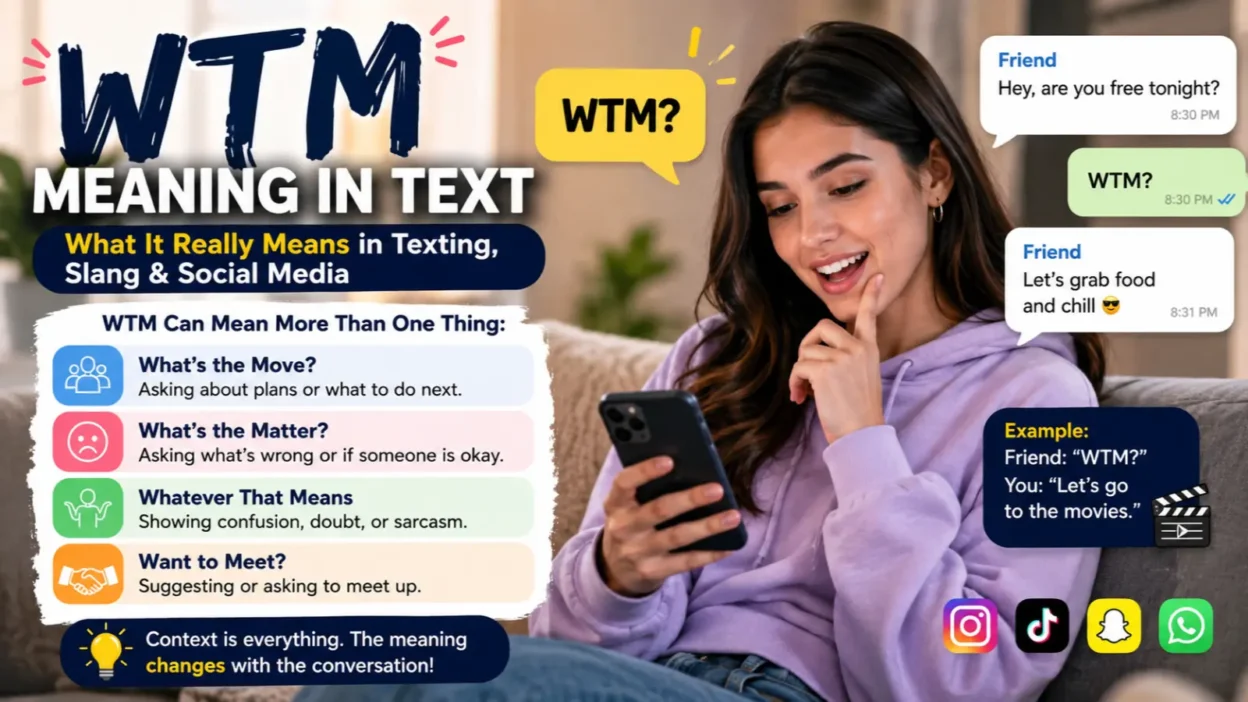
You get a text from a friend that simply says, “WTM?” You stare at it for a second because the three letters could mean more than one thing. Are they asking what you are doing? Are they checking if something is wrong? Or are they making a sarcastic comment?
That is exactly why people search for WTM meaning in text. In modern digital conversations, WTM most commonly means “What’s the Move?”, especially when someone is asking about plans, activities, or what everyone should do next. But WTM can also mean “What’s the Matter?” or “Whatever That Means,” depending on the conversation.
For example:
Friend: “It’s Friday and I’m free tonight.”
You: “WTM?”
Friend: “Let’s grab food and go downtown.”
Here, WTM clearly means “What’s the move?” In other words: What are we doing? What’s the plan?
The interesting part is that texting slang depends heavily on context. The same three letters can shift from playful planning to genuine concern or dry sarcasm without changing a single character.
Quick Definition & Meanings
WTM is an informal internet acronym with several meanings. The intended meaning usually becomes obvious from the surrounding words, relationship between the people, punctuation, and situation.
The most common interpretations are:
- What’s the Move? — asking about plans or the next thing to do
- What’s the Matter? — asking what is wrong or why someone seems upset
- Whatever That Means — expressing skepticism, confusion, or sarcasm
- Want to Meet? — a less common interpretation sometimes used in casual messaging
WTM Meaning: “What’s the Move?”
This is generally the most recognizable social-media meaning of WTM.
When someone writes “WTM?”, they may be asking:
- What are we doing?
- What’s the plan?
- Where are we going?
- What should we do next?
- Are we hanging out?
Example:
“Everyone’s free tonight. WTM?”
The tone is usually relaxed and social. It can carry a subtle invitation too. Instead of directly saying “Do you want to hang out?”, someone can simply say “WTM?” and let the other person suggest the plan.

WTM Meaning: “What’s the Matter?”
WTM can also mean “What’s the matter?”, especially when someone notices that another person seems upset, quiet, angry, or emotionally distant.
Example:
“You’ve been quiet all day. WTM?”
Here, the sender is not asking about weekend plans. They are essentially saying:
“What’s wrong?”
“Is everything okay?”
“What happened?”
The emotional tone is more caring and attentive than the planning-related version.
WTM Meaning: “Whatever That Means”
In another context, WTM can mean “Whatever That Means.”
This version usually carries skepticism, irony, or mild sarcasm.
Example:
“He said the new policy is ‘better for everyone.’ WTM.”
The implied message is:
“I’m not convinced, and I’m not sure what he actually means.”
Tone matters enormously here. A playful friend might use it jokingly, while someone in an argument could use it dismissively.
WTM Meaning: “Want to Meet?”
This interpretation exists, but it is less standardized than the first three. If someone sends “WTM?” while discussing meeting up, the meaning may be understood as “Want to meet?”
Example:
“I’m near your area. WTM?”
Still, don’t assume this meaning automatically. Context should decide.
WTM Meaning in Texting & Messaging
In texting, WTM works because people constantly remove words that can be inferred from context.
Compare:
“What’s the move for tonight?”
with:
“WTM tonight?”
The second version is faster, lighter, and more native to casual digital conversation.
That efficiency is part of what makes internet slang useful. People aren’t necessarily trying to sound cryptic. They are communicating with people who already understand the social shorthand.
In Private Texts
A one-on-one message such as “WTM later?” will usually refer to plans.
But if someone says:
“You seem mad. WTM?”
the emotional context changes the meaning to “What’s the matter?”
In Group Chats
WTM often becomes a coordination tool.
“WTM Saturday?”
can mean:
- Who’s making plans?
- Where are we going?
- What should everyone do?
- What’s happening Saturday?
It creates an opening for someone else to take the lead.
In DMs
WTM can feel particularly casual in Instagram or Snapchat conversations.
Someone might send:
“WTM tonight 👀”
The addition of an emoji can make the message feel more playful, social, or even mildly flirtatious.
A simple “WTM?” can therefore be much softer than:
“Would you like to make plans with me this evening?”
That is the emotional advantage of shorthand: it leaves room for the other person to match the energy.
Origin, Evolution & Social Media Spread
WTM belongs to the broader tradition of internet abbreviations created to make digital communication faster.
The acronym has appeared in online slang communities for years, with “What’s the Move?” becoming particularly associated with casual social planning. Some slang references trace WTM’s online presence back to early internet forums and later SMS culture, although there is no single universally documented creator or launch moment.
The phrase “what’s the move?” itself predates today’s TikTok culture. In everyday speech, “the move” can mean the best action, plan, or next step. Online communities gradually compressed the phrase into WTM.
Social platforms then made this shorthand easier to spread.
A phrase can move from:
spoken language → texting → group chats → Instagram → Snapchat → TikTok → memes
and each community can slightly reshape its tone.
Modern slang doesn’t always have a neat dictionary-style origin. It often develops through repeated use, imitation, and social convenience.
Real-Life Conversations
WhatsApp / iMessage Chat
Alex: “I’m free after 7.”
Sam: “WTM?”
Alex: “Food first, then maybe a movie.”
Here, WTM means “What’s the move?”
Another example:
Sam: “You’ve barely talked today.”
Alex: “Just tired.”
Sam: “WTM?”
In this conversation, WTM means “What’s the matter?”
Instagram DM
Person 1: “Friday night is finally here 😭”
Person 2: “WTM 👀”
Person 1: “I was thinking about coffee and a late-night drive.”
The emoji changes the social texture. The acronym becomes an easy invitation without sounding overly serious.
TikTok Comments / Public Threads
Creator: “When nobody has made plans for the weekend…”
Comment: “WTM 😂”
Here, the commenter is basically saying, “So what are we doing?” or “What’s the plan?”
Why Use WTM Instead of the Full Phrase?
Because shorthand communicates more than information.
It also communicates relationships and familiarity.
Writing “WTM?” suggests:
We both understand this style of communication.
That shared shorthand can make a conversation feel quicker, more relaxed, and less formal.
Psychological & Emotional Dynamics Behind WTM
Internet slang often works as a form of social compression. A few letters can carry a surprisingly large amount of emotional information.
WTM Can Signal Confidence
Someone who writes:
“WTM tonight?”
doesn’t necessarily need a formal invitation. They are comfortable leaving the conversation open-ended.
WTM Can Create Low-Pressure Interaction
Instead of:
“Would you like to spend time together tonight?”
WTM gives the other person more freedom.
They can suggest an activity, decline, or ask another question without either person making the exchange feel overly serious.
WTM Can Show Emotional Awareness
When WTM means “What’s the matter?”, the acronym becomes a quick emotional check-in.
It can signal:
“I noticed your mood changed.”
That is a small message, but it demonstrates social attention.
WTM Can Also Create Emotional Distance
When WTM means “Whatever That Means,” it can function as emotional armor.
Instead of openly saying:
“I don’t believe what you’re saying.”
someone might simply write:
“WTM.”
The shorter response can actually make the sarcasm feel sharper.
Contextual Usage Guidelines
Social Media vs. Private Texts
On social media, WTM often feels playful and broad:
“WTM this weekend?”
In private messages, the same acronym can become more personal:
“You’ve been distant lately. WTM?”
Always read the surrounding message before interpreting it.
Close Friends vs. Casual Acquaintances
With close friends, WTM feels natural.
With a casual acquaintance, it can still work, but the relationship matters. If the person doesn’t use internet slang, they may ask what you mean.
Professional or Formal Environments
Avoid WTM in formal emails, business proposals, academic writing, or important workplace communication.
Instead of:
“WTM for tomorrow’s meeting?”
write:
“What is the plan for tomorrow’s meeting?”
Clarity matters more than speed when communication has professional consequences.
When NOT to Use WTM & Common Misconceptions
WTM is not automatically rude, but the wrong interpretation can create awkwardness.
Misconception 1: WTM Always Means “What’s the Move?”
Not necessarily.
If someone says:
“You look upset. WTM?”
they probably mean “What’s the matter?”, not “What are we doing?”
Misconception 2: WTM Is Always Friendly
Not always.
“WTM.”
after a questionable statement can mean “Whatever That Means,” which may sound dismissive.
Misconception 3: WTM Is Only Used by Gen Z
Younger internet users may use it frequently, but texting abbreviations circulate across age groups. Usage depends more on online habits and social circles than a strict birth-year boundary.
Misconception 4: Punctuation Always Changes the Meaning
Punctuation can help, but context usually matters more.
“WTM?” strongly looks like a question.
“WTM.” can feel more sarcastic when used after someone else’s statement.
Still, punctuation alone cannot determine the meaning.
Semantic Comparison: WTM and Similar Expressions
| Expression | Primary Meaning | Tone | Best Usage Context |
| WTM | What’s the move / What’s the matter / Whatever that means | Casual, flexible | Texting, DMs, group chats |
| WYD | What are you doing? | Casual, curious | Checking what someone is doing |
| WYA | Where are you at? | Direct, casual | Asking someone’s location |
| HBU | How about you? | Friendly, conversational | Returning a question |
| What’s the plan? | Asking about arrangements | Neutral | Casual or professional settings |
These expressions overlap, but they aren’t interchangeable in every situation. WYD focuses more on what someone is currently doing, while WYA focuses on location. WTM, when it means “What’s the Move?”, is more forward-looking and often asks about the next plan. Related slang references commonly group WTM with expressions such as WYD, WYA, HBU, and “What’s the plan?”
WTM Variations, Derivatives & How to Respond
WTM doesn’t have one strict grammatical form because internet slang is intentionally flexible.
You may encounter:
- WTM?
- wtm?
- WTM tonight?
- wtm rn?
- WTM for later?
- WTM 👀
- WTM 😂
Lowercase often feels more casual. Capital letters can make the acronym visually stronger, but neither form changes its core meaning.
Casual Replies
If someone says “WTM?” meaning “What’s the move?”, you could respond:
- “Food and a movie?”
- “I’m down for whatever.”
- “Beach or dinner?”
- “Let’s figure it out.”
- “You tell me 😂”
Funny or Sarcastic Replies
If the conversation is playful:
- “Survive and somehow make it to Friday.”
- “WTM? Probably bad decisions 😂”
- “The move is staying home.”
- “You already know the move 😭”
Mature or Direct Replies
If you want to avoid ambiguity:
- “I’m free tonight. Want to grab dinner?”
- “Nothing planned yet. What did you have in mind?”
- “If you mean what’s wrong, I’m just tired.”
- “I’m not sure what you mean by WTM. Can you clarify?”
The best response depends on which meaning the sender intended.
Generational & Regional Perspectives
Gen Z
For many younger users, WTM can function as a quick social shorthand. It fits naturally beside abbreviations such as WYD, WYA, HBU, and IDK.
The attraction is not simply speed. It is also cultural fluency. Using the right shorthand can make a message feel native to the platform.
Millennials
Millennials who grew up with SMS, AIM, forums, and early social media may already be comfortable with acronym-heavy communication. Some may use WTM naturally, while others may prefer the full phrase.
Older Demographics
People less familiar with contemporary internet slang may interpret WTM as an unknown acronym or assume it refers to a professional abbreviation.
That is why context and audience matter.
Global Internet Culture
WTM also illustrates how English-language internet slang crosses borders. Non-native English speakers can encounter these acronyms through TikTok, Instagram, gaming communities, YouTube comments, and international group chats.
Over time, users learn slang through exposure rather than formal language lessons.
That makes internet culture a kind of informal language classroom.
FAQs:
What does WTM meaning in text?
WTM most commonly means “What’s the Move?” It asks about plans, activities, or what someone should do next. It can also mean “What’s the Matter?” or “Whatever That Means,” depending on context.
What does WTM mean on Snapchat or Instagram?
On Snapchat and Instagram, WTM usually means “What’s the Move?” It is often used to ask about plans, hanging out, or upcoming activities.
What does WTM mean from a girl or guy?
It depends on the conversation. If someone texts “WTM tonight?”, they probably mean “What’s the move?” and may be asking about plans. If they write “You seem upset, WTM?”, they likely mean “What’s the matter?”
Is WTM rude?
WTM is not inherently rude. Its tone depends on context. “WTM?” can sound friendly when discussing plans, while “WTM” used after someone’s statement may sound sarcastic if it means “Whatever That Means.”
How do you reply to WTM?
First determine what the sender means. If WTM means “What’s the move?”, suggest a plan: “Dinner at 8?” If it means “What’s the matter?”, explain what is bothering you or reassure them that you’re okay.
Does WTM mean “What’s the matter?”
Yes. WTM can mean “What’s the matter?”, particularly when someone appears upset, quiet, angry, or emotionally different.
Final Thought:
The most common WTM meaning in text is “What’s the Move?”, a casual way to ask about plans, activities, or what happens next. But WTM can also mean “What’s the Matter?” or “Whatever That Means,” so context remains essential.
That flexibility is what makes internet slang fascinating. Three letters can ask for a plan, show concern, or deliver a sarcastic reaction. The words stay the same, but the emotional meaning changes with the relationship, timing, punctuation, and surrounding conversation.
So when someone sends “WTM?”, don’t decode the acronym in isolation. Look at what came before it.
Because in digital communication, context is often the real punctuation.

I am Maxwell Ford, the creator of meaningosho.com, where I explore the origins and clear definitions of everyday words. I built this platform to help readers easily decode complex vocabulary and deepen their understanding of language. Through my articles, I love sharing simple, engaging insights that make learning new words both fun and useful.