You’re texting a friend and suddenly see, “I know what you’re talking about 😭.” You read it once, then again, because “ion” looks like a chemistry term rather than something someone would casually type in a chat.
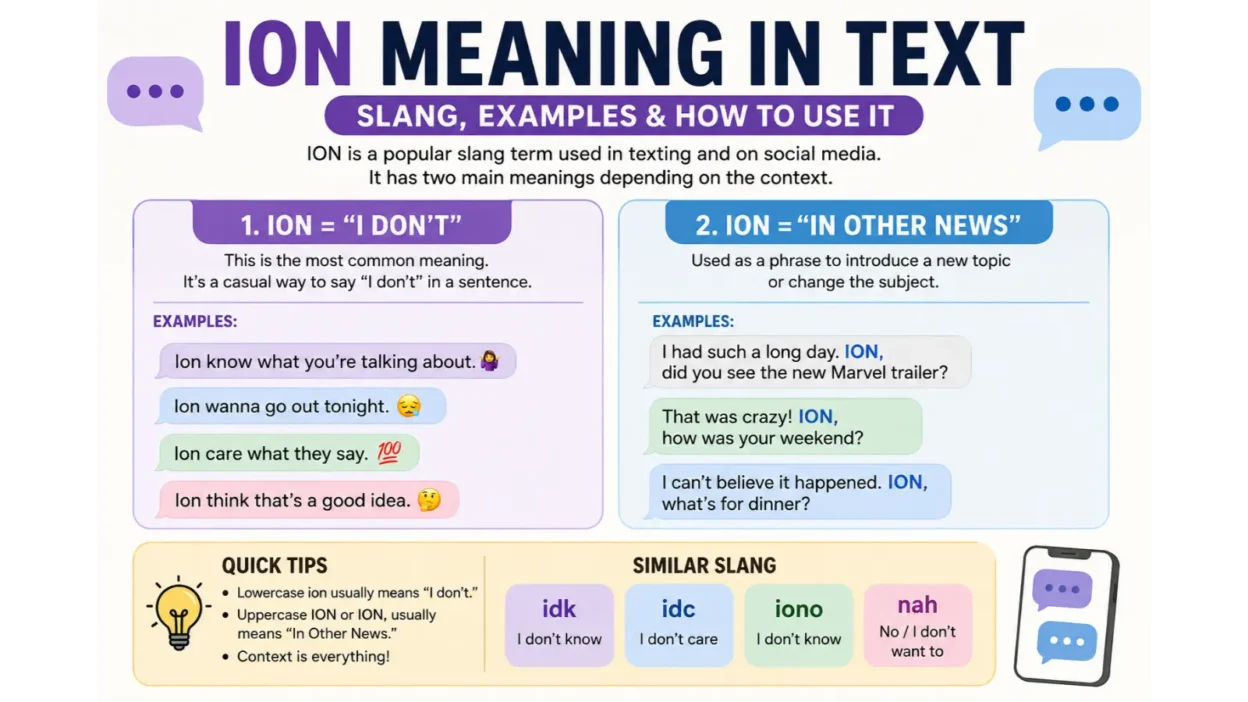
That is exactly why people search for ION meaning in text. In modern internet slang, lowercase “ion” commonly means “I don’t,” while uppercase “ION” can also mean “In Other News.” The surrounding words usually tell you which meaning the sender intends.
A quick example
Maya: You coming tonight?
Jay: ion think so 😭
Maya: Why?
Jay: ion really feel like going out
Here, “ion” is simply a casual spelling of “I don’t.” It changes the sentence less by meaning than by voice. It makes the message sound relaxed, conversational, and rooted in the way people speak rather than the way they would write a formal sentence.
But there is another version worth knowing:
Sam: My exam went terribly.
Alex: ION, did you hear they canceled tomorrow’s class?
In that sentence, ION = “In Other News,” acting as a transition into a new topic.
That small distinction explains most of the confusion around this term.
Quick Definition & Meanings
1. ION = “I Don’t”
This is the most important meaning to recognize when you see lowercase ions inside a sentence.
It is a phonetic or conversational spelling of “I don’t.” Wiktionary records this use as African-American Vernacular English slang, while Dictionary.com notes that the spelling has appeared in internet writing since the 2000s.
Example:
“Ion know what happened.”
Meaning:
“I don’t know what happened.”
This version is especially natural when ion comes directly before a verb:
- ion know
- ion want
- ion care
- ion think
- ion like
- ion have
- ion need
The meaning comes from the entire phrase, not from the three letters by themselves.
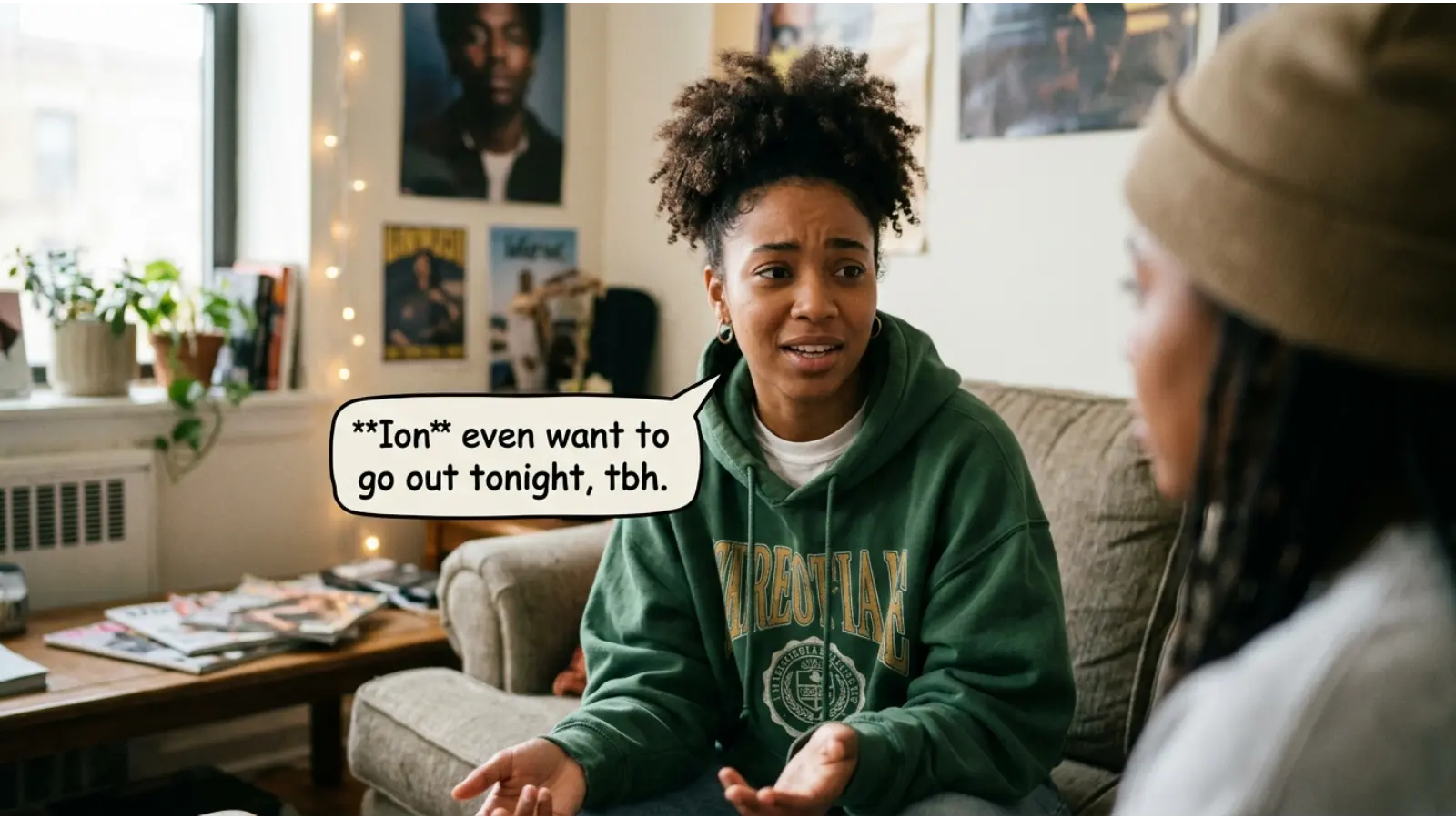
2. ION as a Casual Refusal
Sometimes ion carries more emotional force than a simple “I don’t.”
For example:
“Ion wanna go.”
Literally, it means:
“I don’t want to go.”
Socially, though, it may communicate “No thanks,” “I’m not interested,” or “Please don’t pressure me.”
That makes context important. A friend saying “ion wanna go 😭” may be joking or tired. Someone saying “ion wanna talk about it” during an argument may be setting a genuine boundary.
3. ION as Indifference or Detachment
You may also see:
“ion care”
This means “I don’t care.”
The expression can sound genuinely indifferent, playful, dismissive, or emotionally defensive.
Compare:
“I don’t care.”
This can sound direct or serious.
“ion care 😭”
This may feel more casual, humorous, or intentionally unserious.
The slang spelling softens or stylizes the delivery, although it does not automatically make the statement kind.
4. ION as Disagreement
A message such as:
“ion think that’s true”
means:
“I don’t think that’s true.”
Here, ion introduces a disagreement without necessarily making it confrontational.
That distinction matters. Internet slang often works as a form of tone management. Someone can disagree while keeping the exchange informal.
5. ION as “In Other News”
The second established meaning is “In Other News.”
This version is usually functioning as a conversational transition.
Example:
“I’m still annoyed about yesterday. ION, what are you doing this weekend?”
Here, the writer abruptly moves to another subject.
Dictionary.com and social-media glossaries both identify ION as an abbreviation for “In Other News,” essentially serving as a topic-changing phrase similar to “on another note” or “anyway.”
6. ION as a Sarcastic Topic Shift
“In Other News” can also carry a humorous or slightly sarcastic tone.
For example:
“You forgot my birthday again. ION, what should I order for dinner?”
That sudden switch can deliberately create comedy. The writer acknowledges the previous issue and then acts as though the conversation has moved on.
What Does ION Mean in Text & Messaging?
In everyday texting, the lowercase ion is usually read as “I don’t.”
The easiest way to decode it is to look at what follows it.
“ion know” → “I don’t know”
“ion care” → “I don’t care”
“ion want that” → “I don’t want that”
“ion think so” → “I don’t think so”
“ion like it” → “I don’t like it”
That pattern is much more useful than memorizing a single dictionary definition.
Digital communication also removes many of the cues people rely on in face-to-face conversation. There may be no facial expression, vocal emphasis, or immediate response. As a result, spelling itself can become part of the emotional signal.
Compare these:
“I don’t know.”
“idk.”
“ion know 😭”
All three can communicate uncertainty, but they do not necessarily feel identical.
“I don’t know” is neutral and complete.
“idk” feels compressed and familiar.
“ion know” often carries a stronger sense of conversational voice and social identity.
That is one reason slang survives even when a shorter abbreviation already exists.
ION on TikTok, Instagram, Snapchat, and Group Chats
On platforms where people communicate rapidly, informal language spreads through repetition.
A person may first encounter ion in a TikTok comment, then see it in an Instagram caption, then start recognizing it in Snapchat or private messages.
The term is especially easy to understand once you see common patterns such as:
1 “ion even know 😭”
2 “ion wanna hear it”
3 “ion care anymore”
4 “ion see the problem”
The platform does not necessarily change the core definition. The context changes the emotional flavor.
1 In a private DM, “ion wanna go” may sound vulnerable.
2 In a group chat, “ion wanna go 😭” may be playful.
3 In a TikTok comment, “ion know y’all fr” may signal amused disbelief.
The same slang can perform different social jobs depending on who is reading it.
Where Did ION Come From?
The exact beginning of the spelling is difficult to pin down to one post, person, or platform.
Dictionary.com notes that ion as “I don’t” appeared in internet writing in the 2000s and discusses its connection with conversational speech. Wiktionary identifies the slang form as an African-American Vernacular English usage.
That history matters because internet slang often does not emerge from nowhere. Digital writing frequently reflects existing speech patterns.
People type how they speak.
Sounds blend.
Words get shortened.
Punctuation disappears.
Expressions associated with particular communities can then spread far beyond their original social contexts through music, online communities, memes, Twitter/X, TikTok, and other platforms.
Dictionary.com also points to the use of ion in the title and lyrics surrounding Moneybagg Yo’s 2018 song “Ion Get You,” showing how the spelling appeared in popular culture as well.
It is more accurate to describe the digital spread as amplification and adaptation rather than claiming that one platform invented the term.
Why Social Media Helped ION Spread
Internet slang thrives when it is:
- easy to type
- easy to recognize in context
- expressive
- repeatable
- socially meaningful
“Ion” checks several of those boxes.
It saves a little effort, but its bigger value is stylistic. Writing “ion” can make a sentence feel more like spoken conversation.
Social platforms also accelerate language change because users encounter the same phrasing repeatedly across comments, creators, memes, group chats, and reposts.
A spelling that once seemed unusual can quickly become familiar.
That does not mean everyone uses it, or that everyone who sees it will interpret it correctly.
Real-Life Conversations
WhatsApp / iMessage Chat
Lena: Are you coming over tonight?
Chris: ion think so
Lena: Why not?
Chris: I’m exhausted 😭
Lena: Fair enough
Here, ion think so means “I don’t think so.” It sounds casual and low-pressure.
Instagram DM
A: You really posted that selfie? 😂
B: yes lol
A: ion know about this one
B: HATER 😭
The phrase sounds teasing rather than formal. The slang makes the interaction feel more like spoken banter.
TikTok Comment
User 1: This is the best album this year.
User 2: ion know about that one 😭
User 3: Y’all argue about EVERYTHING
Here, ion now communicates disagreement, but the laughing emoji signals that the commenter may be keeping the disagreement light.
Group Chat
Mia: We should all go at 8.
Noah: ion wanna be outside that late 😂
Zara: Then stay home grandpa
In this case, ion wanna is not merely grammar compressed into slang. It establishes a playful conversational rhythm.
Why People Use ION Instead of “I Don’t”
There is a psychological side to internet slang that is easy to overlook.
People do not choose informal language solely because they want to type faster.
Language also signals belonging, familiarity, attitude, and emotional distance.
Using “ion” may communicate:
“I’m speaking casually.”
“I know this internet style.”
“I’m comfortable enough with you not to write formally.”
“I want this to sound like speech.”
That does not mean every person consciously thinks about those things. Most slang choices are automatic. But communication is social even when the writer is not deliberately analyzing it.
Slang can also provide emotional armor.
Compare:
“I don’t want to talk about it.”
with:
“ion wanna talk about it rn”
The second version may feel less formal and therefore less emotionally exposed. The sender can communicate a boundary without making the sentence sound like a formal declaration.
This is one reason slang often appears in emotionally sensitive conversations.
How ION Can Signal Humor, Confidence, or Detachment
The same phrase can produce different impressions.
Confidence:
“Ion needs everybody’s approval.”
This can sound self-assured.
Humor:
“ion know who let me cook 😭”
This creates self-deprecating humor.
Defensiveness:
“I even wanna explain myself.”
This may indicate emotional frustration.
Indifference:
“I care what they say.”
This can signal detachment.
Playfulness:
“I wanna hear excuses 😂.”
This may be teasing rather than hostile.
The surrounding language, punctuation, emojis, previous messages, and relationship between the speakers all matter.
Contextual Usage Guidelines
Social Media vs. Private Texts
On TikTok, Instagram, X, Snapchat, or casual group chats, ion fits naturally with informal internet language.
Private texts can be even more flexible because close friends already understand each other’s habits.
Close Friends vs. Casual Acquaintances
With close friends, slang usually requires little explanation.
With acquaintances, it is more unpredictable. They may understand it, but they may also interpret it as overly casual, sarcastic, or dismissive.
Matching the other person’s communication style usually works best.
Professional or Formal Environments
Avoid using slang like ion in job applications, formal emails, business proposals, academic writing, or important workplace communication.
Writing:
“ion think this works”
in a professional email can make an otherwise reasonable message look careless.
Use:
“I don’t think this will work.”
The point is not that slang is “bad.” It is about registering—choosing language appropriate to the setting.
When NOT to Use ION
During a Serious Conflict
If someone is upset and you respond:
“ion care”
they may read it as openly dismissive, even if you intended it casually.
In Formal Communication
A professor, manager, client, recruiter, or unfamiliar professional may not appreciate heavily informal slang.
With Someone Who May Not Know Internet Slang
Not everyone spends time on TikTok, X, Snapchat, gaming communities, or online slang-heavy spaces.
A phrase that feels obvious to one person can look like a typo to another.
When Clarity Matters More Than Style
If the message concerns money, deadlines, legal issues, health, safety, or a major decision, write clearly.
Slang is excellent for social tone.
It is not always excellent for precision.
Common Misconceptions About ION
“ION is always ‘In Other News.’”
No. Lowercase ion frequently means “I don’t.” Context determines the interpretation.
“ION is only a typo.”
Not necessarily. In slang contexts, ion is an established informal spelling rather than simply a mistake.
“ION always means ‘I don’t know.’”
Not by itself.
“Ion know” means “I don’t know.”
But “ion care” means “I don’t care.”
The word takes its full meaning from the rest of the sentence.
“ION is the same as IDK.”
Not exactly.
IDK specifically means “I don’t know.”
Ion usually represents “I don’t,” allowing it to appear in many different sentences.
“ION and the scientific word ion are connected.”
Usually, no.
The scientific ion is a charged atom or molecule. The slang spelling is a completely different linguistic use.
Semantic Comparison: ION and Similar Expressions
| Expression | Primary Meaning | Tone | Best Usage Context |
| ion | I don’t | Casual, conversational | Texts, DMs, group chats, social media |
| IDK | I don’t know | Casual, neutral | Texting, comments, online chats |
| IDC | I don’t care | Blunt, detached | Informal conversations |
| I dunno | I don’t know | Relaxed, conversational | Casual speech and texting |
| I don’t think so | Disagreement or uncertainty | Neutral, polite | Everyday and semi-formal conversations |
The subtle difference is that ion behaves more like a spoken-style building block. You can place it before different verbs: “ion know,” “ion care,” “ion want,” or “ion think.” By contrast, IDK is tied specifically to uncertainty or lack of knowledge.
Related Slang and Similar Expressions
Understanding related terms can make internet conversations easier to decode.
IONO
IONO is often used as a compressed form of “I don’t know.”
Example:
“iono what happened.”
It can overlap with “ion know,” but the spelling reflects a slightly different internet shorthand.
IDK
IDK = I don’t know.
Example:
“idk what to eat.”
It is one of the most widely recognized texting abbreviations.
IDC
IDC = I don’t care.
Example:
“idc where we go.”
Compared with “ion care,” IDC can feel more blunt or emotionally detached.
I Don’t Think So
This is the standard-language counterpart to:
“I think so.”
The meaning remains similar, but the formal version is safer when clarity or professionalism matters.
Nah
1 Nah can express refusal, disagreement, or rejection.
2 “Nah, I’m good.”
It overlaps with “ion want that,” but “nah” is often more direct.
Variations, Derivatives, and Playful Forms
Internet slang rarely stays perfectly fixed.
You may see:
1 ion
“I don’t”
2 ion know
“I don’t know”
3 ion even know
“I don’t even know”
4 ion care
“I don’t care”
5 ion wanna
“I don’t want to”
6 ion think so
“I don’t think so”
You may also see intentionally exaggerated spellings, missing punctuation, repeated letters, emojis, or all-lowercase formatting.
For example:
“ionnnn know 😭”
The stretched spelling does not create a new dictionary meaning. It adds emotion, hesitation, exaggeration, or comedic timing.
How to Respond When Someone Says ION
Casual Replies
1 Them: ion know what to do
2 You: same honestly 😭
3 Them: ion wanna go
You: fair 😂
4 Them: ion think that’s happening
You: we’ll see
Funny or Sarcastic Replies
1 Them: ion care
2 You: noted and emotionally devastating 😭
3 Them: ion know
You: impressive answer
4 Them: ion wanna go
You: your couch has officially won
Mature or Direct Replies
Them: ion wanna talk about it
You: That’s okay. We can talk when you’re ready.
Them: ion think so
You: No problem. What would make you more comfortable?
Them: ion care
You: I understand. I just wanted to clarify my side.
The best response depends less on the slang and more on the emotional situation.
Gen Z, Millennials, and Older Audiences
Gen Z
Younger internet users are more likely to encounter ion through fast-moving social platforms, short-form video comments, memes, and slang-heavy online communities.
For many users, it reads naturally as conversational shorthand.
Millennials
Millennials may recognize the term immediately, especially those familiar with Twitter/X, hip-hop culture, internet communities, and older forms of social-media slang.
Others may understand it from context without using it themselves.
Older Audiences
People less exposed to contemporary internet slang may interpret ion literally as the chemistry term or assume it is a typo.
That does not mean the slang is incomprehensible. It simply shows how quickly digital vocabulary can become generational.
Global Internet Culture
Non-native English speakers can encounter ion through TikTok, Instagram, YouTube comments, music, memes, and gaming communities.
This creates an interesting feature of modern English: people can learn slang socially rather than through textbooks. A user may never study the phrase “I don’t” as the origin but recognize or know because they have seen it hundreds of times online.
Is ION AAVE?
The slang spelling is strongly associated with African-American Vernacular English and speech patterns, and reference sources explicitly document that connection.
That context deserves respect.
Internet platforms often spread expressions far beyond the communities where they developed or became established. When that happens, people should recognize that slang can carry cultural history, not just trendy aesthetics.
Using a phrase does not automatically mean someone understands its cultural background. Being aware of that history leads to more thoughtful communication.
ION vs. “In Other News”: How Do You Know Which One Someone Means?
Use grammar as your first clue.
If ion comes before a verb:
“ion know”
“ion care”
“ion want”
it almost certainly means “I don’t.”
If ION appears by itself at the start of a sentence followed by a new topic:
“ION, did you see that new movie?”
it likely means “In Other News.”
The capitalization can help, but it is not a perfect rule. Many people type everything in lowercase, so context is more reliable than capitalization alone.
FAQs:
What does ION meaning in text?
In casual texting, ion usually means “I don’t.” For example, “ion know” means “I don’t know,” and “ion care” means “I don’t care.”
What does ION mean on TikTok?
On TikTok and similar social platforms, ion commonly means “I don’t.” It can appear in comments, captions, messages, and memes, especially in informal conversations.
Can ION mean “In Other News”?
Yes. ION can mean “In Other News,” particularly when it introduces a new or unrelated topic.
Is ION rude?
Not inherently. The meaning is informal, but the tone depends on the sentence. “ion know 😭” may sound harmless, while “ion care” during an argument can sound dismissive.
Is ION the same as IDK?
No. IDK specifically means “I don’t know.” “Ion” usually means “I don’t” and can be followed by different verbs.
How do you reply to someone who says ION?
Reply according to the sentence and emotional tone. If someone says “ion know,” you can say “same 😭” casually. If they say “ion wanna talk,” a respectful response such as “That’s okay, we can talk later” is more appropriate.
Final Thoughts:
The simplest answer to ION meaning in text is this: in modern informal messaging, “ion” most commonly means “I don’t.” It is a conversational spelling that can appear in phrases such as “ion know,” “ion care,” “ion wanna,” and “ion think so.” The uppercase acronym ION can also mean “In Other News,” especially when someone is switching topics.
What makes the term interesting is not the spelling itself but what it communicates socially. Digital language is not merely about saving characters. People use slang to sound familiar, relaxed, funny, expressive, emotionally guarded, or connected to a particular online culture.
So when someone writes “ion know,” do not automatically read it as poor grammar or a random typo. Read the sentence, the relationship, and the tone around it.
That is the real lesson behind modern texting slang: three letters can carry a meaning, but the surrounding conversation tells you what those three letters feel like.

I am Maxwell Ford, the creator of meaningosho.com, where I explore the origins and clear definitions of everyday words. I built this platform to help readers easily decode complex vocabulary and deepen their understanding of language. Through my articles, I love sharing simple, engaging insights that make learning new words both fun and useful.