You’re halfway through a group chat when someone writes, “ISTG, I told you the meeting was at 3.” Then another person replies, “Okay okay, I believe you 😭.” What exactly happened there?
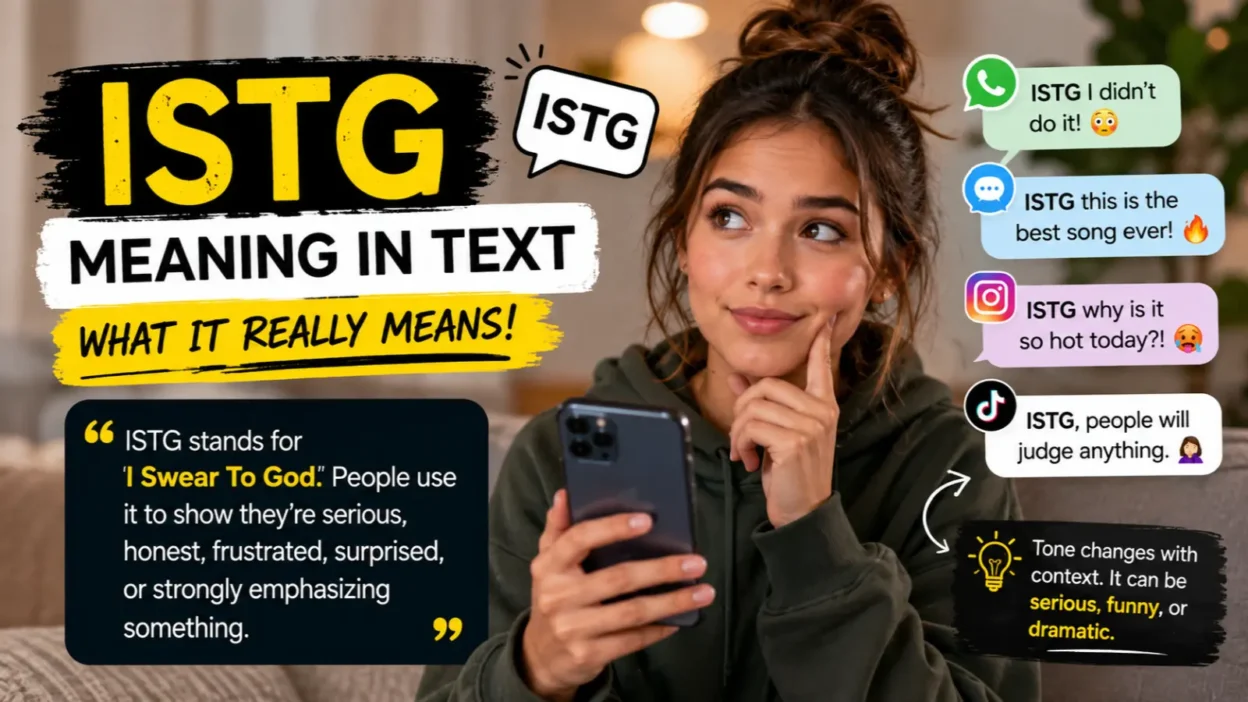
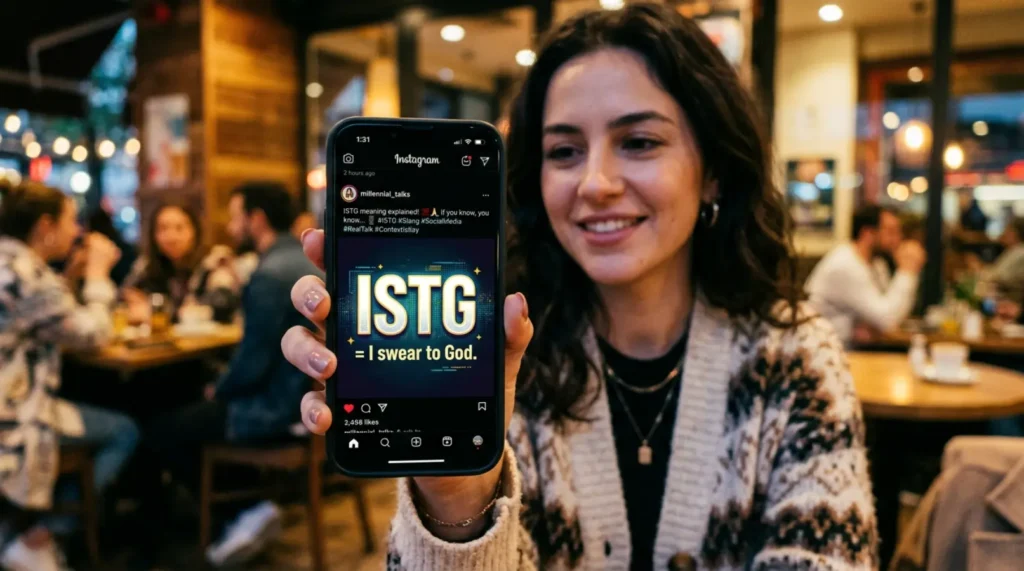
The ISTG meaning in text is usually “I swear to God.” People use it to emphasize that they are telling the truth, feeling strongly about something, becoming frustrated, or seriously insisting on a point.
Dictionary.com describes ISTG as an acronym used for extreme seriousness, exasperation, or surprise, generally outside a formal religious context.
Friend: You seriously forgot your charger again?
You: ISTG I packed it this morning.
Friend: Then where is it? 😭
The interesting part is that ISTG does not always carry the same emotional weight. In one conversation, it can sound like a genuine promise. In another, it can be exaggerated for comedy. And In a tense argument, it may feel like a warning.
That small difference matters because online communication removes many of the clues we normally get from speech, such as facial expression, volume, pauses, and body language. A four-letter acronym can therefore do a surprising amount of emotional work.
Quick Definition & Meanings
ISTG = “I swear to God.”
At its simplest, the acronym tells someone, “I’m being serious,” “I promise,” or “Believe me.” But modern internet slang is rarely that one-dimensional. Context determines what the sender actually wants the reader to feel.
1. ISTG Meaning: “I Swear to God”
This is the most direct meaning.
When someone writes “ISTG”, they may be emphasizing that their statement is true.
Example:
“ISTG, I saw him at the mall yesterday.”
Here, the sender is essentially saying, “I’m telling you the truth.
2. ISTG Meaning: Seriousness or Emphasis
Sometimes the person is not literally making an oath. They simply want to make their sentences stronger.
Example:
“ISTG this song gets better every time.”
The sender is emphasizing their opinion rather than making a formal promise.
This use is extremely common in casual online speech. YourDictionary similarly notes that ISTG can communicate sincerity, surprise, or annoyance.
3. ISTG Meaning: Frustration or Exasperation
This is one of the most recognizable modern uses.
Example:
“ISTG, if my Wi-Fi disconnects one more time…”
The sentence may not even be completed. The acronym itself signals that the person has reached the edge of their patience.
In this context, ISTG works almost like “Seriously…”, “I can’t even…”, or “For real…”.
4. ISTG Meaning: A Warning
In arguments or playful threats between friends, ISTG can introduce a consequence.
Example:
“ISTG if you post that picture, I’m blocking you.”
Depending on the relationship, this could be genuinely angry or completely playful.
That is why reading ISTG in isolation can be misleading. The words surrounding it, the relationship between the people, and the conversation immediately before it all matter.
5. ISTG Meaning: Surprise or Shock
ISTG can also introduce a reaction to something unexpected.
Example:
“ISTG, he actually showed up.”
Here, the phrase communicates disbelief or amazement rather than a literal religious oath.
Dictionary.com specifically lists surprise among the emotions ISTG can convey.
6. ISTG Meaning: Dramatic or Playful Emphasis
Internet culture loves exaggeration. Someone might write:
“ISTG this puppy is the cutest thing I’ve ever seen.”
Nobody reading that necessarily assumes the sender has just made a solemn oath. The acronym simply turns up the emotional volume.
That exaggerated quality is part of what makes ISTG useful in memes, comments, fan conversations, and friend-group chats.
ISTG Meaning in Text & Messaging
In private texting, ISTG often acts as a micro-emotional signal.
Consider these two messages:
“I sent it.”
and
“ISTG I sent it.”
The factual information is almost identical. The emotional information is not.
The second message tells the reader that the sender feels challenged, misunderstood, frustrated, or especially determined to be believed.

In Private DMs
People commonly use ISTG when they want to make a statement sound more forceful without writing a full sentence explaining their emotional state.
Example:
A: Did you delete the photo?
B: No.
A: Are you sure?
B: ISTG I didn’t delete it.
The acronym adds intensity without requiring a long explanation.
In Group Chats
ISTG becomes more performative in group conversations.
A: Who ate my fries?
B: Not me 😂
C: ISTG it was Kevin
D: Kevin left five minutes ago 😭
Here, ISTG helps the speaker sound dramatically certain, even when the exchange is playful.
In Fast-Paced Messaging
Text conversations move quickly. People rarely write every emotional cue explicitly. Instead, abbreviations like ISTG, LOL, FR, OMG, and NGL act as shorthand for attitude.
ISTG can communicate something like:
“Please understand how strongly I mean this.”
That makes it particularly effective when a sender wants emotional emphasis without slowing down the conversation.
Origin, Evolution & Social Media Spread
The phrase “I swear to God” existed long before texting and social media. The acronym ISTG is the digital compression of that familiar expression.
There is evidence for the initialism in online writing well before today’s TikTok era. Wiktionary records a 2003 Usenet example using ISTG in the modern sense of “I swear to God,” while an Urban Dictionary entry for the acronym dates to January 2008.
That history illustrates an important feature of internet slang: its exact “birth” is usually difficult to pinpoint.
Slang does not typically appear one morning because someone officially invents it. A phrase develops in different online communities, gets repeated, gets shortened, and eventually becomes recognizable across wider digital culture.
Texting encouraged that compression. Social networks then gave abbreviations such as ISTG a much larger audience.
As platforms evolved, the acronym became visible across:
- Text messaging
- TikTok
- Snapchat
- X and other public social platforms
- Group chats and online communities
Parade also describes ISTG as a common texting and social-media acronym meaning “I swear to God,” including use on platforms such as TikTok and Snapchat.
What changed was not the basic meaning, but the range of emotional situations in which people could use it.
Originally, “I swear to God” could sound solemn or highly serious. Online, ISTG can be sincere, dramatic, sarcastic, funny, annoyed, affectionate, or exaggerated.
That flexibility is one reason digital slang survives.
Real-Life Conversations
WhatsApp / iMessage Chat
Maya: Did you seriously take my hoodie?
Alex: Nooo 😭
Maya: It literally has your name in the pocket.
Alex: ISTG I thought it was mine.
Maya: That is somehow worse 😂
What ISTG does here: Alex uses it to emphasize sincerity while admitting the mistake.
Instagram DM
A: Have you seen her new haircut?
B: YES
A: ISTG she looks completely different
B: Literally. I almost didn’t recognize her.
Here, ISTG amplifies surprise and agreement.
TikTok Comment
“ISTG every cat acts like it pays rent.”
The commenter is not making a literal oath. They are using ISTG as a humorous emphasis.
Public Thread
“ISTG people online will argue about absolutely anything 😭”
The acronym makes the statement sound exasperated while the emoji softens the seriousness.
Why People Choose ISTG Instead of Formal Language
There is an emotional reason people often choose the acronym.
Compare:
“I genuinely assure you that I am telling the truth.”
with:
“ISTG I’m telling the truth 😭.”
The second version feels faster, more socially natural, and more emotionally recognizable in a casual conversation.
Internet slang allows people to communicate not only what they think, but how they want that thought to sound.
That distinction is central to digital communication.
The Psychological & Emotional Dynamics of ISTG
Slang is often treated as meaningless shorthand, but abbreviations can function as powerful social signals.
ISTG Can Signal Confidence
When someone writes:
“ISTG, that was the funniest movie ever.”
They sound certain and emotionally invested.
ISTG Can Act as Emotional Armor
A person may use an acronym instead of directly saying:
“I’m really frustrated that you don’t believe me.”
“ISTG” gives them emotional distance.
It expresses frustration without requiring a vulnerable explanation.
ISTG Can Create Group Belonging
Shared slang helps people recognize who understands conversational culture.
When friends regularly use terms such as ISTG, FR, NGL, LOL, or IDK, those expressions become part of their shared communication style.
They are not merely shortcuts. They can become markers of familiarity.
ISTG Can Soften Serious Emotion Through Humor
Consider:
“ISTG I’m going to lose my mind 😭”
Without the emoji, the sentence can sound intense. With it, readers may interpret the statement as exaggerated frustration.
That combination of strong wording and playful formatting is a classic feature of online communication.
Contextual Usage Guidelines
Social Media vs. Private Texts
On social media, ISTG often feels more performative.
A TikTok commenter may use it for humor:
“ISTG this dog knows exactly what he’s doing.”
In a private text, however, it may communicate genuine frustration:
“ISTG you said you were already outside.”
Public posts invite exaggeration because the audience is larger. Private messages often carry more direct interpersonal meaning.
Close Friends vs. Casual Acquaintances
With close friends, ISTG can be playful.
“ISTG you are impossible 😂”
Among people who do not know each other well, the exact same sentence could feel aggressive.
Relationship context changes everything.
Professional or Formal Environments
ISTG generally belongs to casual communication rather than formal professional writing.
You would normally avoid:
“ISTG the report was submitted.”
in a professional email.
A clearer alternative would be:
“I can confirm that the report was submitted.”
The issue is not that ISTG is inherently offensive. It simply carries an informal, conversational tone that may not fit the setting.
When NOT to Use ISTG & Common Misconceptions
ISTG is flexible, but it is not universally appropriate.
Avoid it when:
The situation is genuinely sensitive.
During serious conflict, a phrase that sounds playful to one person can sound dismissive to another.
The audience does not understand internet slang.
An older relative, new client, or unfamiliar professional contact may not recognize the acronym immediately.
You need precise professional communication.
Formal situations reward clarity over stylistic shorthand.
Religion is personally sensitive for the audience.
Although ISTG is often used casually without religious intent, it still expands to “I swear to God.” Some people may prefer different wording.
Common Misconception #1: ISTG Is Always Angry
Not true.
It can express anger, but it can also communicate sincerity, surprise, excitement, humor, or exaggeration.
Common Misconception #2: ISTG Always Has a Religious Meaning
Not necessarily.
Modern online users frequently use ISTG as an informal emphasis marker rather than a literal religious oath. YourDictionary notes that despite the word “God,” the abbreviation is commonly used outside a religious context.
Common Misconception #3: ISTG and “STG” Are Completely Different
They are extremely close.
STG usually means “swear to God,” while ISTG means “I swear to God.”
The added “I” makes ISTG slightly more explicitly personal.
Semantic Comparison: ISTG and Similar Expressions
| Expression | Primary Meaning | Tone | Best Usage Context |
| ISTG | I swear to God | Strong, emotional, emphatic | Casual texts, DMs, group chats |
| STG | Swear to God | Direct, emphatic | Informal conversations |
| ONG | On God | Strong assurance, Gen Z-style emphasis | Casual chats and social media |
| FR | For real | Agreement, sincerity | Texts, comments, DMs |
| NGL | Not gonna lie | Honest admission | Opinions, reactions, confessions |
These expressions overlap, but they are not interchangeable in every situation.
ISTG often carries a stronger sense of insistence or exasperation.
STG is similar but slightly more compact.
ONG can emphasize certainty or authenticity in a more distinctly contemporary slang style.
FR usually means “seriously” or “I agree,” rather than explicitly asserting a claim.
NGL, meanwhile, introduces an honest admission: “Not gonna lie…”
This family of slang shows how online speakers constantly fine-tune emotional meaning through tiny lexical choices.
Variations, Derivatives & How to Respond
You may see ISTG written in different formats:
ISTG — uppercase, visually stronger
istg — casual and conversational
I STG — more dramatic spacing
ISTGGG — playful exaggeration
STG — shorter equivalent
The surrounding punctuation also changes the tone.
ISTG.
can feel blunt or irritated.
istg 😭
usually feels softer and more playful.
ISTG!!!
sounds highly emotional.
Casual Replies
“I believe you 😂”
“Okay okay, ISTG noted.”
“Same honestly.”
“FR though.”
Funny or Sarcastic Replies
“You swear every five minutes 😭”
“That sounds suspicious, ISTG 😂”
“Your ISTG defense is not convincing.”
“Bro brought out the ISTG.”
Mature or Direct Replies
“Okay, I understand that you’re serious.”
“Got it. I believe you.”
“Let’s clear up what happened instead of arguing.”
These responses work because they match different levels of emotional intensity.
Generational & Regional Perspectives
Gen Z
Gen Z is highly comfortable with layered digital language, where the same acronym can be serious in one sentence and completely ironic in the next.
For younger users, ISTG often functions as ordinary conversational shorthand.
Millennials
Millennials who grew up with AIM, SMS, forums, early social networks, and texting culture are also familiar with internet abbreviations. Some may use ISTG naturally, while others recognize it primarily through younger internet culture.
Older Audiences
Older users may understand the phrase “I swear to God” perfectly but still need context to understand ISTG as an acronym.
This creates an interesting generational gap: the underlying expression may be familiar while the compressed spelling is less familiar.
Global Internet Culture
ISTG is also an example of how English-language internet slang crosses borders.
Non-native English speakers may encounter the term through TikTok videos, Instagram comments, gaming communities, YouTube, or international group chats. Often they learn the phrase from context before ever learning a formal dictionary definition.
That is how much internet slang spreads: people see it repeatedly, infer the emotional meaning, imitate it, and gradually become fluent in its social use.
FAQs:
What does ISTG meaning in text?
ISTG means “I swear to God.” It is usually used to emphasize sincerity, seriousness, frustration, surprise, or strong emotion.
Is ISTG rude?
Not automatically. ISTG is informal rather than inherently rude. However, in an argument, “ISTG if you do that again…” can sound threatening or aggressive depending on the relationship and context.
What does ISTG mean on TikTok?
On TikTok, ISTG usually still means “I swear to God,” but users often employ it as humorous or dramatic emphasis in captions and comments.
For example:
“ISTG this cat thinks she owns the house.”
The statement is usually playful rather than a literal oath.
Is ISTG a religious phrase?
Its expanded form, “I swear to God,” references God, but online users frequently use ISTG as a casual expression of emphasis rather than a literal religious declaration.
What is the difference between ISTG and STG?
ISTG means “I swear to God,” while STG usually means “swear to God.” Their practical meaning is very similar, and both can emphasize sincerity or frustration.
How do you reply to ISTG?
Your response should match the tone. You can say “I believe you,” “FR,” “Okay 😭,” or use humor such as “You really pulled out the ISTG.” In a serious situation, a straightforward response works best.
Final Thoughts:
The most important thing to remember about ISTG meaning in text is that the acronym stands for “I swear to God,” but its emotional meaning can stretch far beyond a literal oath.
People use ISTG to insist that something is true, express frustration, emphasize an opinion, react to something shocking, make a playful warning, or heighten a joke. Its exact effect depends on the words around it, the relationship between the speakers, and the tone of the conversation.
That flexibility explains why ISTG fits so naturally into modern digital communication. Online conversations move quickly, and people need compact ways to communicate attitude as well as information.
A simple “I told you” gives you the facts.
“ISTG I told you” gives you the facts plus the emotion.
That is the real power of internet slang: four letters can carry urgency, humor, certainty, frustration, and personality all at once. Understanding ISTG is therefore not just about decoding an acronym.
It is about learning how people use language to signal how seriously they want you to take what they are saying.

I am Maxwell Ford, the creator of meaningosho.com, where I explore the origins and clear definitions of everyday words. I built this platform to help readers easily decode complex vocabulary and deepen their understanding of language. Through my articles, I love sharing simple, engaging insights that make learning new words both fun and useful.