You get a message that says, “jw, are you still coming tonight?” and suddenly you pause. Is JW meaning in text supposed to be a question, a joke, or some kind of hidden slang?
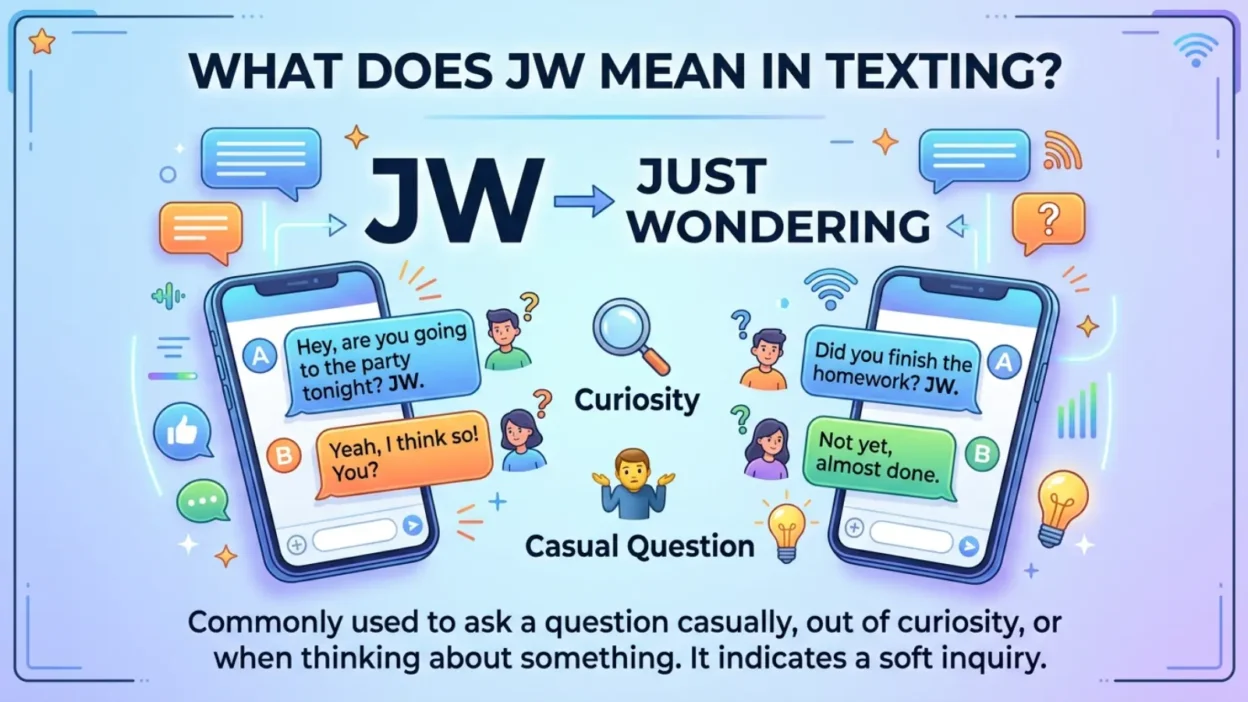
Most of the time, JW Meaning in Text “just wondering.” People use it to ask something casually, soften a question, or show curiosity without sounding demanding. In texting and online chat, “jw” works almost like a tiny social cushion: it tells the other person, “I’m asking, but I’m not trying to pressure you.”
Example:
Are you going to Sam’s party?
Alex: jw 👀
Mia: Yeah, probably around 8.
Here, “jw” simply means “just wondering.” But context matters because JW can also mean “just watched” in internet slang or “Jehovah’s Witness” in religious contexts.
That little distinction is exactly why people search for jw meaning in text. The same two letters can carry different meanings depending on the conversation, the platform, and the people involved.
Quick Definition & Meanings
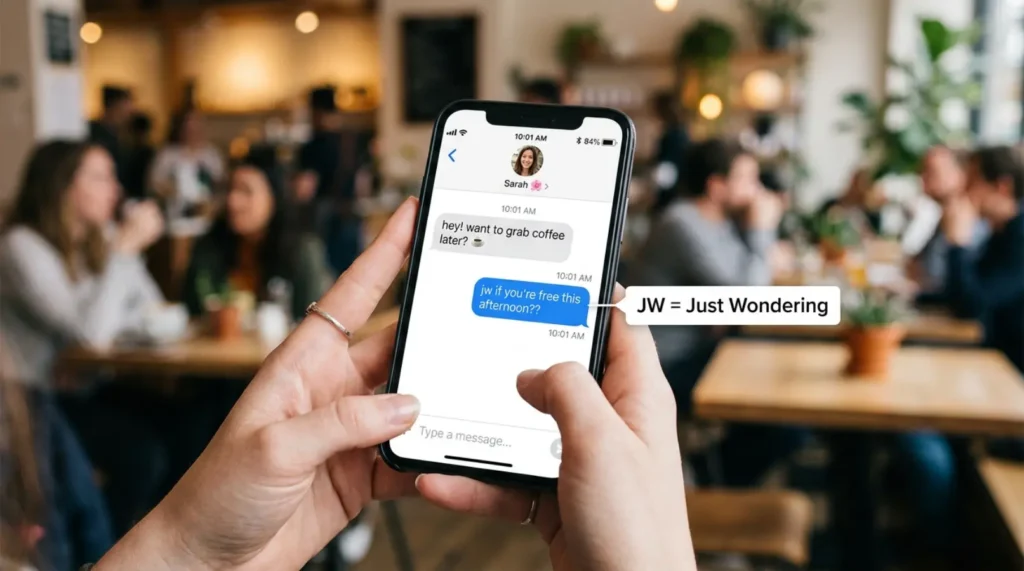
1. JW Meaning in Text = Just Wondering
This is the most common meaning when JW appears in casual texting, DMs, chats, or social media conversations. It introduces or softens a question.
For example:
“JW, did you tell her what happened?”
The sender is curious, but “jw” makes the question feel less forceful.
Instead of:
“Why did you leave?”
someone might write:
“JW why you left?”
The second version can feel lighter, even though the underlying question is basically the same.
2. JW = Just Watched
In conversations about movies, television, videos, livestreams, or other entertainment, JW can sometimes mean “just watched.” Wiktionary records “just watched” as another internet-slang expansion of JW.
Example:
“JW the finale and I’m still processing it.”
Here, “jw” does not mean “just wondering.” The surrounding topic makes “just watched” much more logical.
This is a good example of why acronyms should never be decoded in isolation.
3. JW = Jehovah’s Witness
In religious discussions, JW can refer to a Jehovah’s Witness or to Jehovah’s Witnesses. This is a different use from casual texting slang. Wiktionary lists the religious use separately from the internet-slang meanings.
Example:
“My neighbor is a JW.”
That sentence is clearly not using “JW” to mean “just wondering.”
4. JW as a Softener for an Awkward Question
Sometimes the important part of JW meaning in text is not the literal expansion but the social function.
Someone might say:
“JW… are you upset with me?”
They may already suspect the answer. “JW” gives them a little emotional distance before asking.
It can communicate curiosity while protecting the sender from sounding too invested.
5. JW Used Casually or Playfully
In informal chats, “jw” can also become part of a playful tone:
“JW 👀 who was that you were talking to?”
The abbreviation remains “just wondering,” but the emojis can make the message sound teasing, curious, or even mildly flirty.
The meaning stays stable while the emotional tone changes.
JW Meaning in Text & Messaging
Text conversations remove many of the clues people normally use to understand intent. You cannot hear someone’s voice, see their facial expression, or immediately tell whether they are joking.
That is where short expressions such as “jw” become socially useful.
In Private Texts
A friend might write:
“JW if you’re free later.”
This feels more relaxed than:
“Are you free later?”
There is not a huge difference in literal meaning. The difference is emotional framing.
“JW” suggests the sender is checking rather than demanding.

In Group Chats
In a group chat, “jw” can make a direct question feel less confrontational:
“JW, who’s actually bringing food?”
Without the abbreviation, the question might sound more urgent. With it, the sender frames it as a casual check.
In DMs
Private messages can make “jw” more emotionally loaded.
For example:
“JW why you stopped liking my posts 😭”
The words technically mean “just wondering,” but the real message may contain disappointment, insecurity, curiosity, or a desire for reassurance.
That is an important part of understanding slang: the dictionary definition is only one layer.
Read Receipts and Reply Timing
Digital communication adds another subtle layer.
Imagine someone sends:
“JW, did you see my message?”
If the message remains unread, the sender may simply be checking in.
But if the recipient has already seen the message and does not respond, the same phrase can feel more pointed:
JW why you haven’t replied?”
At that point, “jw” may function as emotional camouflage. It sounds casual on the surface, but the sender may genuinely want an answer.
Where Did JW Come From?
There is no single, well-documented moment when “JW” was officially created as internet slang.
It fits a much broader pattern in digital communication: people shorten familiar phrases into initials to type faster and maintain a casual conversational rhythm. Slang references consistently identify “just wondering” as the primary texting meaning, while other references record “just watched” and the religious abbreviation as separate context-dependent uses.
The important point is that JW did not need a single viral origin story to become recognizable. Abbreviations often spread organically through forums, instant messaging, texts, social platforms, and peer-to-peer communication.
Early online communication encouraged compact language because people were typing rapidly and often trying to keep conversations moving. As texting and social media became everyday communication channels, these shortened forms became easier for users to recognize.
Today, the same abbreviation can travel across WhatsApp, iMessage, Instagram, TikTok, Discord, comments, and other informal digital spaces.
That does not mean every user understands it identically. Internet slang remains highly dependent on community and context.
Real-Life Conversations
WhatsApp / iMessage Chat
Jordan: Are you mad at me?
Taylor: No lol
Jordan: JW because you seemed quiet earlier
Taylor: Nah, just tired
What is happening here?
“JW” lowers the emotional pressure. Jordan is clearly concerned, but the abbreviation makes the question sound less like an accusation.
Instagram DM
A: JW, where did you get that jacket? 👀
B: Thrift store haha
A: No way, it looks expensive
Here, “jw” simply introduces curiosity. The message feels casual rather than formal.
TikTok Comment
User 1: This song has been stuck in my head all day
User 2: JW did you hear the live version?
In a public thread, “jw” keeps the interaction quick and conversational.
A More Emotionally Loaded Example
Sam: JW, are you talking to someone?
Chris: Why?
Sam: No reason 😭 jw
Technically, the abbreviation still means “just wondering.” Socially, however, there may be far more behind the question.
That is why interpreting slang requires looking at the entire interaction rather than translating letters mechanically.
Why Do People Say JW Instead of “Just Wondering”?
There is a subtle psychological advantage to using an abbreviation.
It creates distance.
Compare:
“I want to know if you’re coming.”
with:
“JW if you’re coming.”
The second statement feels lighter and less exposed.
That can be useful when someone is uncertain about how their question will be received.
JW Can Signal Curiosity
The straightforward interpretation is simply:
“I’m curious.”
JW Can Reduce Social Pressure
It can suggest:
“You do not have to treat this like a serious confrontation.”
JW Can Provide Emotional Cover
If the question feels vulnerable, “jw” can make it easier to ask.
For example:
“JW if you still think about me.”
That sounds different from:
“Do you still think about me?”
The first version offers the sender a little protection.
JW Can Create Playful Distance
With emojis, punctuation, or teasing language, it can become:
“JW 👀”
That tiny addition can communicate far more personality than the two letters themselves.
When JW Sounds Flirty, Nosy, or Sarcastic
“JW” does not automatically mean flirting.
That misconception is worth clearing up.
If someone texts:
“JW, are you dating anyone?”
They could be genuinely curious, joking around, considering asking you out, or simply making conversation.
The abbreviation itself does not establish romantic intent.
Flirty JW
“JW… you seeing anyone? 👀”
The question may feel flirtier because of the subject and emoji.
Nosy JW
“JW, how much did you pay for that?”
Now it may feel intrusive.
Sarcastic JW
“JW why you thought that was a good idea 😂”
Here, the “just wondering” framing may be deliberately ironic.
The words stay the same. The relationship between the speakers changes the meaning.
Social Media vs. Private Texts
On social media, people often use shorthand because conversations move quickly.
A TikTok comment like:
“JW why everyone hates this”
is likely casual and public.
A private text saying:
“JW why you ignored me”
has a much stronger interpersonal dimension.
Public communication tends to prioritize speed and shared casualness.
Private communication can carry more emotional subtext.
Close Friends vs. Casual Acquaintances
With close friends, “jw” usually feels harmless.
“jw, you coming?”
Between acquaintances, the same phrase can seem more carefully worded.
“JW, were you at the event yesterday?”
The sender may be consciously trying not to appear intrusive.
The closer the relationship, the less likely people are to analyze the abbreviation itself. Familiar friends understand the person’s normal texting style.
Should You Use JW at Work?
Usually, avoid JW in formal emails, official documentation, academic writing, or professional communication where clarity matters more than casual shorthand.
Instead of:
“JW if you got my file.”
use:
“Just checking whether you received my file.”
“JW” is most natural in informal environments. Slang dictionaries specifically describe its use in text messages and online chat, while formal contexts benefit from complete wording.
When NOT to Use JW
Although harmless in many situations, “jw” is not always the best choice.
Avoid it when someone is discussing a serious emotional issue and you need to be direct.
For example:
“JW why did you lie to me?”
may sound passive-aggressive.
A clearer alternative would be:
“I want to understand why you lied to me.”
Likewise, avoid slang-heavy shorthand in professional communication when the reader could interpret it differently.
You should also be cautious with people unfamiliar with internet abbreviations. A short form that feels obvious to one group may look like an unexplained acronym to another.
Common Misconceptions About JW
JW Does Not Always Mean “Just Wondering”
That is the most common texting interpretation, but context can point to other meanings, including “just watched” or Jehovah’s Witness.
JW Is Not Automatically Flirty
A question such as “JW, are you single?” can sound suggestive, but the abbreviation itself is neutral.
JW Is Not Automatically Rude
“Just wondering” can soften a question. However, the question that follows may still sound intrusive.
JW Does Not Guarantee “No Pressure”
People sometimes use “just wondering” while strongly hoping for an answer.
That is why tone, timing, relationship, and wording matter.
Semantic Comparison: JW and Similar Expressions
| Expression | Primary Meaning | Tone | Best Usage Context |
|---|---|---|---|
| JW | Just wondering | Casual, curious, low-pressure | Texts, DMs, group chats |
| Just curious | I want to know | Friendly, direct | Everyday conversation |
| Wondering if… | I would like to know whether… | Neutral, softer | Texts and casual messages |
| BTW | By the way | Casual, conversational | Changing or adding a topic |
| Just asking | I am only asking | Defensive or clarifying | When a question may sound intrusive |
These phrases overlap, but they do not feel identical.
“Just curious” sounds a little more explicit. “JW” feels compressed and highly text-native. “Just asking” can sometimes sound defensive, especially after someone challenges the question.
So when people search for jw meaning in text, the simplest answer is “just wondering,” but its social function is closer to softening curiosity.
JW Variations, Derivatives & Related Terms
Texting culture regularly creates related shortcuts.
You may encounter forms such as:
- jw — just wondering
- JW… — often used to introduce a more noticeable or awkward question
- JW 👀 — playful or suggestive curiosity
- jw lol — casually downplaying the question
- jw 😂 — often signaling humor or teasing
- jwing — an informal variation referring to “wondering”
- jw2k — “just wanted to know,” listed in slang references as a related abbreviation
These forms are not equally universal. The more specialized the abbreviation becomes, the more important context is.
How to Respond to “JW”
Your response should match the emotional energy of the original message.
Casual Replies
“Haha, what’s up?”
“Yeah, why?”
“Sure, what are you wondering?”
Funny or Sarcastic Replies
“That sounds suspicious 👀”
“Just wondering or just wondering? 😂”
“You can’t drop a ‘jw’ and disappear now.”
Mature and Direct Replies
“Sure. What would you like to know?”
“Go ahead and ask.”
“I’m happy to explain if you’re asking seriously.”
These responses work because they acknowledge the abbreviation without assuming motives that may not exist.
What Does JW Mean From a Girl or Guy?
When someone asks what JW means from a girl or JW means from a guy, the answer is usually the same: “just wondering.”
The gender of the sender does not create a separate definition.
What matters is what comes after “jw.”
JW if you’re free tomorrow?”
This is probably a straightforward question.
“JW if you’re seeing anyone 👀”
That could have a flirty undertone.
The context—not the sender’s gender—determines the likely intention.
JW on TikTok, Instagram, Snapchat, and Other Platforms
On platforms such as TikTok and Instagram, slang becomes highly visible because users communicate through comments, DMs, captions, replies, and short-form posts.
“JW” works particularly well in these environments because it is compact.
A person can write:
“JW why nobody talks about this scene”
instead of typing the full phrase.
However, there is no reason to assume every social-media appearance of “JW” means exactly the same thing. Entertainment-related conversations can support “just watched,” while religious discussions can point to “Jehovah’s Witness.”
The surrounding words usually provide the answer.
Generational & Regional Perspectives
Different age groups can interpret internet shorthand differently.
Gen Z
Younger users are generally more accustomed to compressed digital language, emojis, lowercase typing, and rapidly changing abbreviations. “jw” can feel completely natural in a quick conversation.
Millennials
Millennials also frequently recognize texting abbreviations, although usage varies greatly by individual, platform, and online community.
Older Generations
Someone less familiar with internet shorthand may read “JW” literally as initials or associate it with the religious abbreviation rather than “just wondering.”
That is why context remains essential.
Global Internet Culture
Non-native English speakers encounter abbreviations like “jw” through global social platforms, gaming, entertainment content, and English-language communities.
Because internet slang travels internationally, users often learn meaning through exposure rather than traditional dictionaries.
That also explains why slang can develop slightly different interpretations across communities.
FAQs:
What does JW mean in text?
JW most commonly means “just wondering.” It is used to introduce a casual question or express curiosity without sounding too demanding.
Is JW rude?
Usually, no. JW is generally casual and neutral, but the question that follows can make it seem nosy, sarcastic, or passive-aggressive.
What does JW mean on Instagram?
On Instagram, JW usually means “just wondering” in informal DMs, comments, or replies. Context can indicate other meanings.
JW Meaning in Text on TikTok?
On TikTok, JW commonly means “just wondering” when someone asks a casual question or reacts to a post. In entertainment-related contexts, another interpretation may be possible.
Does JW mean “just watched”?
Yes. “Just watched” is a documented internet-slang meaning of JW, particularly when the conversation is clearly about movies, shows, videos, or other content.
How should I reply to JW?
Read the question that follows and respond naturally. A simple answer such as “Yeah, why?”, “Sure, what’s up?”, or “Go ahead” works well when someone uses JW to mean “just wondering.”
What does JW mean from a girl or guy?
In ordinary texting, it still most commonly means “just wondering.” The sender’s gender does not change the basic definition.
Final Thoughts: on JW Meaning in Text
The simplest answer to jw meaning in text is “just wondering.” It is a compact way to signal curiosity, soften a question, or make a message feel less intense.
But the interesting part is what happens beyond the definition.
“JW” can make a sensitive question feel safer. It can create playful distance. It can signal genuine curiosity, hide nervousness, or occasionally make a sarcastic comment sound more casual. In other settings, the same initials can mean “just watched” or refer to Jehovah’s Witnesses, showing why context matters.
Modern digital communication rarely depends on words alone. Punctuation, timing, emojis, relationship history, and even the platform can change how a two-letter abbreviation feels.
So when you see JW in a message, start with “just wondering,” then look at the conversation around it. In internet culture, context is often the real dictionary.

I am Maxwell Ford, the creator of meaningosho.com, where I explore the origins and clear definitions of everyday words. I built this platform to help readers easily decode complex vocabulary and deepen their understanding of language. Through my articles, I love sharing simple, engaging insights that make learning new words both fun and useful.