You get a message from someone you have not talked to in months: “HYB?” You stare at it for a second. Is it a question? A joke? A typo? Or some newer piece of internet slang you somehow missed?
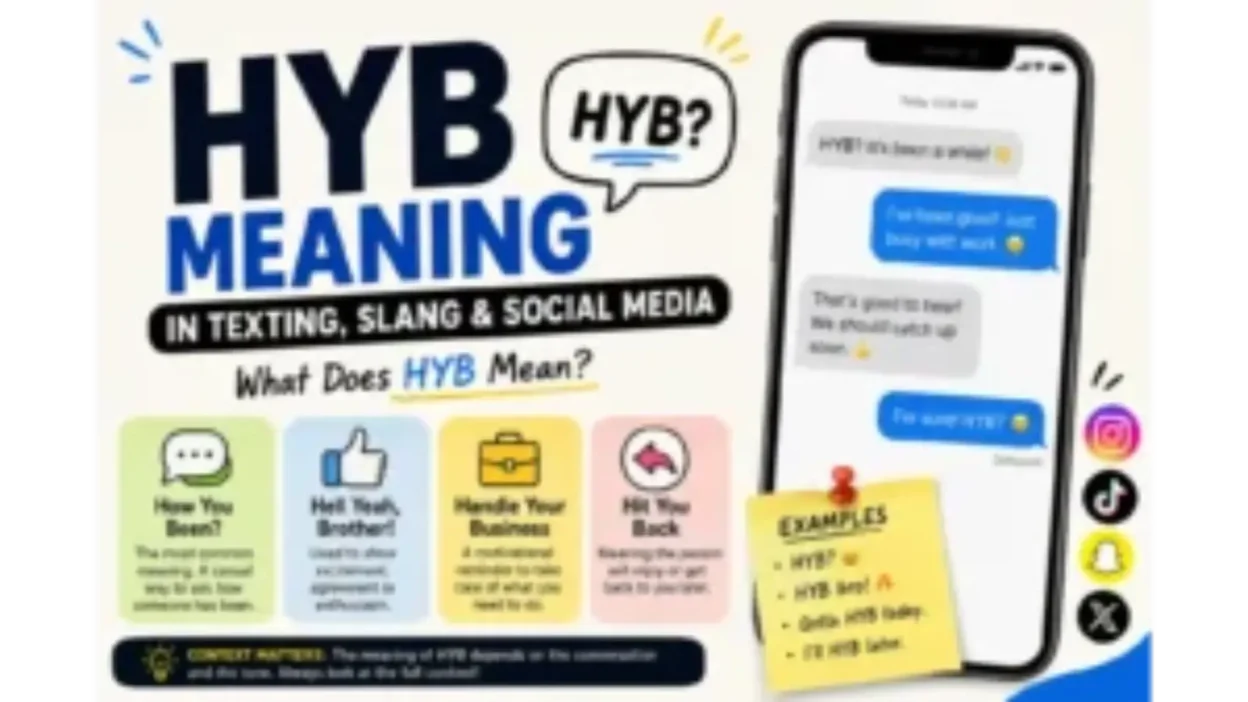
In most casual texting situations, HYB meaning is “How You Been?”—a shortened, informal way to ask how someone has been doing lately. It often appears when someone is reconnecting, checking in, or casually reopening a conversation. Text-slang references consistently list “How You Been?” as a major meaning of HYB.
A realistic example
Maya: “Girl HYB? 😭”
Tara: “I’ve been good! Busy with work. You?”
Maya: “Same honestly. We need to catch up.”
The interesting part is that HYB does not always carry exactly the same tone. Depending on who sends it, where it appears, and what comes before or after it, the abbreviation can sound friendly, flirty, playful, enthusiastic, or completely different.
That is why searching for the HYB meaning in text can be surprisingly useful. Short internet expressions often depend less on the dictionary definition and more on social context.
Quick Definition & Meanings
The most common conversational meaning is:
HYB = How You Been?
It works much like “How have you been?” but sounds shorter, more relaxed, and more native to casual digital conversation.
However, HYB has other documented or community-used meanings. Context matters, so you should not automatically assume every HYB means the same thing.
1. HYB = How You Been?
This is the main meaning in texting, DMs, Snapchat-style conversations, and casual chats.
Someone typically uses it when they want to ask about your recent life rather than simply ask, “How are you?”
Example:
“Heyyy, HYB? Haven’t talked in forever.”
Tone: Friendly, casual, familiar, sometimes slightly nostalgic.
It can also signal that the sender wants to restart a conversation without making the opening feel overly serious.
2. HYB = Hell Yeah, Brother
HYB can also mean “Hell Yeah, Brother!”, an enthusiastic expression of agreement, excitement, or encouragement. Some slang references connect this usage with Hulk Hogan’s well-known “brother” catchphrase and later internet or conversational use.
Example:
Friend: “We finally finished the project!”
You: “HYB! 🔥”
Here, HYB has nothing to do with asking how someone has been.
Tone: Energetic, celebratory, approving, masculine-coded in some communities, or intentionally humorous.
3. HYB = Handle Your Business
Another documented meaning is “Handle Your Business.” Dictionary.com and Slang.org list this as an alternative use.
Example:
“You’ve got responsibilities to take care of. HYB.”
This version is more direct and assertive.
Tone: Motivational, firm, commanding, or occasionally dismissive.
Think of it as:
“Take care of what you need to take care of.”
4. HYB = Hit You Back
Some informal slang communities use HYB to mean “Hit You Back”, essentially telling someone that the sender will reply or contact them later. This is a less universal interpretation and should be understood from the surrounding sentence.
Example:
“Can’t talk rn, I’m with my family. HYB later.”
Tone: Casual and practical.
It is similar to “I’ll text you back” or “I’ll get back to you.”
5. HYB = Other Niche Interpretations
User-generated slang sources also record additional interpretations such as “Hate You, Bye” and “Hold Your Breath,” although these are considerably less standardized.
That distinction matters.
Not every slang-site submission has equal cultural reach. A meaning can exist somewhere online without being the meaning most people expect in everyday texting.
So when you see HYB, read the sentence around it before deciding what the sender intended.
HYB Meaning in Texting & Messaging
In everyday messaging, HYB most often functions as a social check-in.
A longer version would be:
“Hey, how have you been?”
But texting culture rewards speed, rhythm, and conversational economy. “HYB?” delivers almost the same social message with three letters.
Why “HYB?” feels different from “How have you been?”
Compare:
“How have you been?”
with:
“HYB?”
The first sounds complete and deliberate. The second feels lighter. It can communicate:
“I was thinking about you.”
“I noticed we haven’t talked.”
“What’s been happening with you?”
“Let’s start talking again.”
That tiny abbreviation can therefore function as an emotional doorway.
In one-on-one texts
A person who sends “HYB?” may simply be checking in.
Alex: “Yo HYB?”
Jordan: “Pretty good, just working nonstop lol.”
The exchange feels low-pressure. The sender is not demanding an elaborate update.
In group chats
Context becomes even more important.
If somebody posts good news and another person replies:
“HYB 🔥🔥”
the sender may be using the enthusiastic “Hell Yeah, Brother” interpretation rather than “How You Been?”
That is why capitalization, punctuation, emojis, and conversation position can matter.
In DMs
A one-word or three-letter opening often tests whether the other person is receptive.
“HYB?”
leaves room for the recipient to answer briefly or turn it into a deeper conversation.
That flexibility is part of what makes internet slang effective.
Read receipts and pacing matter
Suppose someone sends:
“HYB?”
and follows it with another message five minutes later:
“You disappeared 😂”
The second message changes the emotional reading. Now HYB may feel more personal or playful.
By contrast:
“HYB?”
“Need something from the store?”
may simply be practical conversation.
Digital communication has no facial expression or vocal tone, so users rely on pacing, punctuation, emojis, capitalization, and follow-up messages to supply the missing emotional information.
Origin, Evolution & Social Media Spread
HYB does not have one universally documented origin story.
The clearest explanation for “How You Been?” is linguistic compression: people shorten familiar spoken phrases into quick text forms. Slang references have documented HYB with this meaning for years, including user-created examples dating back to the 2010s.
This is typical of internet language.
People rarely sit down and formally invent a new abbreviation. More often, an expression already exists in speech. Online communities shorten it, repeat it, remix it, and eventually make the shortened version recognizable.
Social platforms accelerate that process.
A phrase can move through:
private texting → Snapchat/DM culture → memes → comments → group chats → wider internet usage
Once enough people recognize an abbreviation, typing the full phrase can actually feel unnecessarily formal.
That does not mean every person uses HYB in exactly the same way. Internet slang is community-dependent. A gaming group, friend circle, meme community, and older texting audience may interpret the same three letters differently.
The “Hell Yeah, Brother” interpretation illustrates this particularly well. References connect that usage to Hulk Hogan’s long-standing “brother” catchphrase and its later circulation in popular and internet culture.
So HYB is better understood as a context-dependent acronym than as a single fixed word.
Real-Life Conversations
WhatsApp / iMessage Chat
Chris: “HYB? It’s been ages.”
Sam: “Honestly? Better now. Finally got the new job.”
Chris: “No way! Congrats!”
What is happening socially?
HYB acts as a soft re-entry into the relationship. It does not immediately demand a deep conversation. It simply opens the door.
Instagram DM
Nina: “HYB 😭”
Lena: “Alive lol. College is destroying me.”
Nina: “HAHA same. We need coffee soon.”
Here, the slang feels warm and familiar.
TikTok Comment
Creator: “Finally hit my fitness goal!”
Comment: “HYB 🔥”
In this context, the comment may be interpreted as “Hell Yeah, Brother!”—an enthusiastic reaction rather than “How You Been?” Context is everything.
A More Ambiguous Example
Person A: “I’m leaving this job.”
Person B: “HYB.”
This is where you should slow down.
Could it mean “Handle Your Business”? Possibly.
Could it be an enthusiastic “Hell Yeah, Brother”? Depending on the community, yes.
Could the sender have intended something else entirely? Also possible.
The safest approach is to interpret HYB through the entire conversation instead of decoding the acronym in isolation.
Why People Choose HYB Instead of Formal Language
There is a social reason people shorten ordinary sentences.
Formal language can create distance.
Slang can reduce it.
Compare:
“How have you been recently?”
with:
“HYB?”
The second expression sounds more like something typed quickly between people who already understand each other’s communication style.
Slang therefore does more than save characters. It can communicate belonging, familiarity, informality, and emotional temperature.
That is one reason internet language can feel surprisingly personal even when the message itself is tiny.
Psychological & Emotional Dynamics of HYB
HYB can signal familiarity
Sending “HYB meaning?” assumes that a relaxed conversation is possible.
It generally sounds less formal than asking:
“How have you been doing recently?”
The sender is signaling, consciously or not, that the interaction does not need corporate-level grammar.
HYB can create emotional safety
Short messages lower the pressure of replying.
Someone may not know whether an old friend wants to reconnect, but “HYB?” gives both people an easy way into the conversation.
You can answer:
“Good!”
or:
“Actually, a lot has happened. 😂”
Both responses work.
HYB can act as emotional armor
Slang can soften vulnerability.
Instead of explicitly saying:
“I miss you and I want to know what is happening in your life,”
someone can simply write:
“HYB?”
The abbreviation hides some of the emotional weight while still creating an opening.
That is a common pattern in digital communication: people often use humor, abbreviations, memes, and casual wording to approach feelings without naming them directly.
HYB can communicate confidence
Using familiar slang can make a message sound socially relaxed.
But there is an important caveat: confidence depends on shared understanding. Slang that sounds natural among friends can sound forced or confusing with strangers.
Contextual Usage Guidelines
Social Media vs. Private Texts
On social media, HYB can be ambiguous because the audience is larger and the conversation lacks private context.
In a private chat, the relationship provides clues.
For example:
Old friend: “HYB?” → probably “How You Been?”
Friend after good news: “HYB!!!” → potentially “Hell Yeah, Brother!”
Close Friends vs. Casual Acquaintances
Among close friends, HYB can feel warm and natural.
With someone you barely know, it may feel unexpectedly familiar.
Consider the difference between:
“Hello, how have you been?”
and:
“Yo HYB?”
The second assumes more casual social ground.
Professional or Formal Environments
Avoid relying on HYB in important professional communication.
A manager, client, professor, recruiter, or unfamiliar business contact may not interpret the abbreviation correctly.
Instead of:
“HYB?”
use:
“How have you been?”
or:
“I hope you’ve been doing well.”
Clarity wins when the relationship is formal.
When NOT to Use HYB & Common Misconceptions
Do not assume HYB has only one meaning
One of the biggest misconceptions is that HYB always means “How You Been?”
That is the dominant texting interpretation, but other meanings exist, including “Handle Your Business” and “Hell Yeah, Brother.”
Avoid it during tense conversations
If someone is angry or discussing something serious, an ambiguous abbreviation can make the situation worse.
For example:
Person A: “We need to talk about what happened.”
Person B: “HYB.”
If the sender intended “How You Been?”, the response might come across as completely detached.
When emotions are high, explicit language is usually safer.
Avoid forced slang
If you never use internet abbreviations, suddenly writing “HYB” to someone who knows you as highly formal may feel unnatural.
Good communication is not about using as much slang as possible.
It is about matching the communication style of the people involved.
HYB is not automatically rude
When it means “How You Been?”, it is usually neutral or friendly.
Its tone depends on context, relationship, punctuation, and the surrounding conversation.
Semantic Comparison: HYB and Similar Expressions
| Expression | Primary Meaning | Tone | Best Usage Context |
|---|---|---|---|
| HYB | How You Been? | Casual, familiar | Friends, DMs, informal chats |
| HRU? | How Are You? | Casual, quick | Everyday texting |
| WYD? | What You Doing? | Casual, conversational | Friends and active chats |
| HBU? | How About You? | Casual, responsive | After answering someone |
| How have you been? | Checking on someone’s recent life | Neutral, polished | Formal or mixed contexts |
The distinction is subtle but useful.
“How have you been?” sounds more complete.
“HRU?” generally asks about someone’s current state.
“WYD?” focuses on what they are doing now.
“HBU?” usually comes after someone has already answered.
“HYB?” is especially suited to reconnecting or asking about the period since you last spoke.
HYB Variations, Derivatives & How to Respond
Internet users often modify abbreviations according to their own style. You may see:
1 Hyb?
2 HYB?
3 HYB 😂
4 HYB girl?
yo hyb
HYB bro
HYB lately?
The lowercase version can feel more relaxed. Capitalization may add emphasis, but it does not automatically change the meaning.
Casual Replies
If someone sends HYB? meaning “How You Been?”, you could answer:
“Pretty good! You?”
“Doing okay, just busy lately.”
“I’ve been good 😂 What about you?”
“Honestly, better than before. HYB?”
Funny or Sarcastic Replies
“Still surviving somehow 💀”
“Emotionally? Let’s not discuss that 😂”
“Alive, moisturized, and confused.”
“Same character, new problems.”
These replies keep the conversation playful without making it overly serious.
Mature or Direct Replies
“Thanks for checking in. I’ve been doing well lately. How have you been?”
“I’ve had a busy few months, but things are improving.”
“I appreciate you asking. I’ve been okay—how are things with you?”
These work well when the relationship or subject matter calls for a more thoughtful answer.
Generational & Regional Perspectives
Gen Z
Younger internet users are generally comfortable with compressed language, abbreviations, emojis, and context-heavy messaging.
For them, slang can communicate social identity almost as much as literal meaning.
However, Gen Z is not one uniform linguistic group. Someone deeply involved in online communities may use abbreviations that another person of the same age rarely sees.
Millennials
Many millennials grew up during the transition from traditional texting to social media.
That means they may recognize expressions such as HYB while also being comfortable with longer, conventional wording.
The result is often a mix of internet slang and standard conversational English.
Older demographics
Older users may recognize HYB from context but may not immediately know what it means.
That does not make the acronym inherently “Gen Z.” Some slang meanings of HYB have been documented for years, and informal online communities can preserve expressions long after their peak visibility.
Global internet culture
Non-native English speakers frequently encounter slang through TikTok, Instagram, YouTube comments, gaming chats, and memes.
That creates an interesting effect: people may understand an abbreviation because they have repeatedly seen it online even before they fully understand the grammar behind it.
Digital culture spreads expressions across borders much faster than traditional regional slang could.
FAQs:
What does HYB meaning in text?
HYB usually means “How You Been?” It is a casual way to ask someone how they have been doing, particularly when reconnecting after some time.
What does HYB meaning on social media?
On social media, HYB can mean “How You Been?”, but context may point to another interpretation such as “Hell Yeah, Brother.”
Is HYB rude?
Usually, no. When HYB means “How You Been?”, it is generally casual and friendly. It can sound abrupt only when used in a situation that calls for more formal or emotionally careful language.
What does HYB meaning from a girl or guy?
The abbreviation itself does not automatically indicate flirting. Someone may use HYB simply to check in or restart a conversation. The person’s wording, relationship with you, and follow-up messages matter more than the acronym alone.
How do you reply to HYB?
A simple reply is:
“Good, you?”
You can also give a short life update or ask “HBU?” to keep the conversation going.
Can HYB mean “Handle Your Business”?
Yes. “Handle Your Business” is a documented alternative meaning, although it is less likely than “How You Been?” in an ordinary check-in message.
Can HYB mean “Hell Yeah, Brother”?
Yes. In some slang and internet contexts, HYB stands for “Hell Yeah, Brother!”, an enthusiastic expression of agreement or excitement.
Final Thoughts:
The most common HYB meaning in text is “How You Been?”—a relaxed way to check in with someone, especially when you have not talked for a while.
But HYB is a good example of why internet slang cannot always be decoded like a traditional dictionary entry. The same three letters can also mean “Hell Yeah, Brother,” “Handle Your Business,” or other niche expressions depending on the community and context.
The smartest way to interpret HYB is therefore simple: look at the sentence, the relationship, the platform, and what happens next.
Digital communication is full of tiny signals. Sometimes three letters say, “How have you been?” Sometimes they say, “Absolutely!” And sometimes they quietly reveal something more important—the sender assumes you already understand the social language between you.

I am Maxwell Ford, the creator of meaningosho.com, where I explore the origins and clear definitions of everyday words. I built this platform to help readers easily decode complex vocabulary and deepen their understanding of language. Through my articles, I love sharing simple, engaging insights that make learning new words both fun and useful.