You get a message like, “That movie was way better than I expected,” and the reply comes back: “ik.” No explanation. No emoji. Just two letters. So what does IK meaning in text actually communicate?
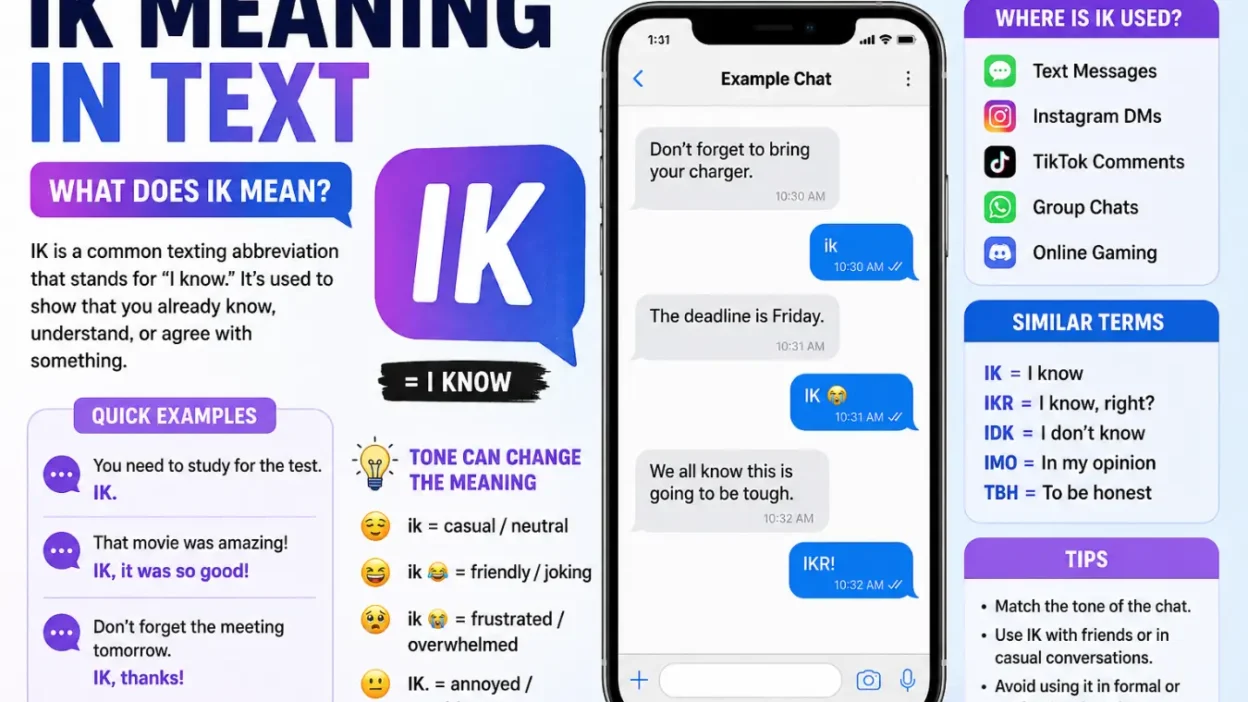
Most of the time, IK Meaning in Text “I know.” It is a common internet and texting initialism used to show that someone already knows, understands, agrees with, or recognizes what another person has said. Wiktionary records IK/ik as an internet-slang initialism for “I know,” with IDK as its opposite.
But there is a small catch: “I know” can sound warm, neutral, impatient, sarcastic, or even slightly smug depending on the conversation.
Consider this exchange:
A: “You need to submit the assignment tonight.”
B: “ik 😭”
Here, “ik” probably means, “I knowww, I’m aware, and I’m stressed about it too.”
Now compare:
A: “You should really check the instructions before you start.”
B: “IK.”
That version can feel much sharper. The capital letters and lack of softening may suggest annoyance: “Yes, I already know that.”
That difference is the real story behind IK meaning in text. Digital communication removes facial expressions, voice volume, and body language, so tiny choices such as capitalization, punctuation, timing, and emojis can dramatically change how two letters feel.
Quick Definition & Meanings
IK Meaning in Text “I Know”
The primary meaning of IK in text is simply “I know.”
People use it when they already understand the information someone has shared or when they want to acknowledge that they are aware of something.
Example:
“The meeting starts at 9.”
“ik.”
This is the straightforward use. Nothing dramatic is necessarily happening.
IK Can Mean “I Already Know”
Sometimes IK carries an extra layer of emphasis: “I already know that.”
This matters when someone gives advice, repeats information, or tells you something you have heard before.
Example:
“Don’t forget to charge your phone.”
“ik 😂”
The emoji can make the response playful rather than irritated.
Without the emoji:
“Don’t forget to charge your phone.”
“IK.”
It could sound more defensive.
IK Can Signal Agreement
Although the literal meaning is “I know,” people sometimes use IK as a quick acknowledgment that they agree with the point being made.
Example:
“That exam was ridiculously hard.”
“ik 😭”
The response is not necessarily saying, “I possessed that information already.” It can function more like, “I know exactly what you mean.”
For stronger agreement, people may use IKR, meaning “I know, right?” Cambridge Dictionary defines IKR as an informal abbreviation used on social media to show agreement with what someone has written.
IK Can Show Empathy
One of the more subtle uses appears when a person is venting.
Friend: “I’m exhausted. This week has been awful.”
You: “ik 😭”
Here, “ik” may communicate more than factual knowledge. It can mean:
1 “I understand.”
2 “I feel you.”
3 “I know what you mean.”
“That sounds rough.”
The surrounding conversation determines which interpretation makes sense.
IK Can Sound Annoyed
A short answer can become emotionally sharper when the other person keeps repeating something.
A: “I told you about this yesterday.”
B: “IK.”
In this situation, “IK” may carry the emotional meaning of, “Yes, I heard you already.”
The abbreviation itself is not automatically rude. The context creates the attitude.
IK Can Be Playful or Dramatic
Friends often exaggerate simple abbreviations for comedic effect.
“IKKKK 😭😭”
That is not a formal “I know.” It stretches the word emotionally, almost like saying:
“I KNOWWW!”
“Seriously, I know!”
“Please, you don’t have to remind me!”
This is where texting starts behaving more like speech.
IK Can Sound Sarcastic
Sarcasm usually comes from context rather than from the letters themselves.
“Wow, rain is wet.”
“IK 💀”
The response jokingly emphasizes that the information is extremely obvious.
Here, IK means “Obviously, I know that.”
IK Meaning in Text & Messaging
In private messages, IK is mostly a speed-and-tone tool.
Typing “I know” takes only a couple more characters, so the purpose is not always about saving enormous amounts of time. Instead, abbreviations help conversations feel lighter and more digitally native.
People may choose it because it feels:
- Casual
- Fast
- Familiar
- Low-pressure
- Less formal
- More conversational
Compare these responses:
“I know.”
“I know!”
1 “ik”
2 “ik 😭”
3 “IK.”
They all technically communicate the same basic idea, but they do not sound identical.
“I know.” can feel neutral or serious.
“I know!” feels energetic.
1 “ik” feels relaxed.
2 “ik 😭” often communicates humorous frustration or emotional agreement.
“IK.” can feel firm or irritated.
That is why understanding IK meaning in text requires more than memorizing a definition.
In Private DMs
In one-to-one conversations, “ik” often functions as an acknowledgment.
A: “Your favorite artist dropped a new song.”
B: “ik omg I already listened 😭”
The abbreviation helps keep the exchange flowing.
In Group Chats
Group conversations move quickly, so short replies can prevent people from interrupting the rhythm.
Sam: “Nobody warned me the homework was this long.”
Mia: “ik 😭”
Leo: “IKR, I’m only halfway done.”
Here, “ik” establishes shared frustration while “IKR” intensifies agreement.
In Gaming Chats
IK can also appear in gaming conversations where players need quick responses.
“The boss gets stronger in phase two.”
“ik”
Because gaming chats often prioritize speed, short initialisms fit naturally into the environment. Slang.net lists IK among terms used in online chat, text messaging, and online gaming.
Read Receipts and Reply Timing
Timing can also influence how “ik” is perceived.
A fast “ik 😂” immediately after a message can feel casual and friendly.
A delayed one-word “IK.” after an emotional paragraph might feel colder.
That does not mean the sender intended to sound rude. It means digital communication leaves readers to infer tone from very limited signals.
Origin, Evolution & Social Media Spread
The underlying phrase “I know” is far older than internet slang. What changed online was the way people compressed familiar speech into quick written forms.
IK became part of a wider ecosystem of texting abbreviations built around short initialisms such as:
- IDK — “I don’t know”
- IKR — “I know, right?”
- IMO — “in my opinion”
- TBH — “to be honest”
- BTW — “by the way”
- RN — “right now”
Wiktionary specifically identifies IK as an internet-slang/text-messaging initialism for “I know” and lists IDK as its antonym or contrasting form.
The related expression IKR offers a useful clue about how this vocabulary evolved. Grammarly notes that “I know, right” existed as a spoken phrase before its abbreviation became established in electronic communication, with electronic uses traceable to at least 2004.
That distinction matters. Internet slang is rarely created from nothing. Often, people take an existing phrase and reshape it for the speed, identity, and humor of digital communication.
Social media then accelerates the process.
A phrase that appears in one online community can quickly become familiar through:
- TikTok comments
- Instagram captions
- Group chats
- Memes
- Gaming communities
- X conversations
- YouTube comments
- Discord servers
Algorithms do not necessarily invent slang, but they can expose millions of people to the same expressions repeatedly. As a result, short abbreviations can travel far beyond the community where a particular style originated.
Unlike some slang terms strongly associated with a specific subculture, IK is comparatively broad. It is not best explained as an exclusively TikTok term, AAVE term, or gaming term. It functions as general internet shorthand across many casual online spaces.
Real-Life Conversations
WhatsApp / iMessage Chat
Emma: “Are you still coming over tonight?”
Josh: “ik, leaving in 10 😂”
Emma: “Okayyy just checking.”
Here, “ik” simply confirms awareness.
Another example:
Emma: “Bring a jacket. It’s freezing.”
Josh: “ik 😭”
This version adds emotional agreement.
Instagram DM
A: “That café is seriously overpriced.”
B: “IK 😭 but the desserts are so good.”
The sender uses “IK” to agree while keeping the conversation casual.
TikTok Comments
Comment: “Nobody talks about how stressful this part is.”
Reply: “ik 😭”
The commenter is essentially saying, “I know, and I feel exactly the same way.”
Public Thread
Post: “People suddenly become professional photographers when sunset hits.”
Reply: “IK 😂”
The reply acknowledges a relatable observation.
What Is the Emotional Pattern?
People often choose IK instead of “I know” because abbreviations feel socially lightweight.
A full sentence can sound deliberate.
A lowercase abbreviation can feel spontaneous.
That difference becomes especially useful online, where people often want to acknowledge something without making the exchange feel overly formal.
Psychological & Emotional Dynamics of IK
At first glance, IK appears emotionally empty. In practice, it can communicate quite a lot.
Social Alignment
When someone says:
“That show is addictive.”
and you answer:
“ik”
you are subtly aligning yourself with their perspective.
You are saying, “We agree.”
This is one reason internet slang works so well socially. Shared shorthand can create a small sense of belonging.
Emotional Efficiency
Sometimes people do not need a complete sentence. They simply need to signal recognition.
IK performs that social function quickly.
It says:
1 “I received what you said.”
2 “I understand.”
3 “I already know.”
“Same.”
The exact interpretation depends on context.
Emotional Armor
Short responses can also protect people from overexposure.
Someone might not want to write a long emotional response to a difficult situation. “ik 😭” can acknowledge a feeling without forcing them to explain everything.
That makes abbreviations useful as emotional shortcuts.
Confidence or Mild Smugness
There is another side.
Because IK literally says “I know,” it can occasionally make the sender sound as though they already knew everything.
Slang.net notes that IK can come across as smug or “know-it-all” depending on context.
That is why adding a softener can change the emotional effect:
1 “ik haha”
2 “ik 😭”
3 “ik fr”
“yeah ik”
These versions often sound warmer than a standalone:
“IK.”
Contextual Usage Guidelines
Social Media vs. Private Texts
On social media, IK usually feels harmless because casual shorthand is expected.
In a private conversation, however, emotional context matters more.
If a friend shares something vulnerable, a blunt “ik” may not provide the warmth they expect.
A better option might be:
“ik 😭 I completely get you.”
The extra words remove ambiguity.
Close Friends vs. Casual Acquaintances
With close friends, you can be much more abbreviated.
“ik 😭”
“IKR”
“ik lol”
These forms are easy to interpret because both people already understand each other’s communication style.
With a casual acquaintance, a complete phrase may sometimes feel clearer.
Professional or Formal Environments
Avoid using IK in formal business writing unless you are certain that the communication culture is extremely casual.
Instead of:
“IK, thanks.”
use:
“Yes, I’m aware. Thank you.”
Or:
“Understood, thanks.”
Professional communication usually benefits from clarity rather than ambiguity.
Match the Other Person’s Energy
A useful rule for internet communication is simple: match the environment, not just the vocabulary.
Someone may enjoy slang in a group chat but prefer straightforward language in a serious conversation.
The meaning stays similar, but the social function changes.
When NOT to Use IK & Common Misconceptions
Avoid It During a Sensitive Argument
Suppose someone says:
“I feel like you never listen to me.”
Replying:
“IK.”
may be interpreted as dismissive.
You might actually mean “I know, and I feel terrible,” but the reader cannot hear your voice.
A clearer reply would be:
“I know. I’m sorry—I understand why you feel that way.”
Avoid Assuming It Always Means Agreement
IK usually means “I know,” not automatically “I agree with everything you just said.”
For stronger agreement, people often use expressions such as IKR, “exactly,” “so true,” or “same.” IKR specifically carries the sense of agreement or shared recognition.
IK Does Not Automatically Mean “I Understand Emotionally”
“I know” can mean factual awareness without emotional empathy.
For example:
“The deadline is Friday.”
“ik” means awareness.
But:
“I’m scared about the deadline.”
“ik” may or may not communicate empathy.
The surrounding language matters.
IK Is Not the Same as IKR
This is one of the most common mix-ups.
IK = I know
IKR = I know, right?
IK acknowledges awareness.
IKR usually expresses stronger shared agreement.
Cambridge Dictionary specifically defines IKR as an informal written abbreviation used to show agreement on social media.
Semantic Comparison Table
| Expression | Primary Meaning | Tone | Best Usage Context |
| IK | I know | Casual, neutral, sometimes blunt | Texts, DMs, group chats |
| IKR | I know, right? | Strong agreement, animated | Social media, friend chats |
| IDK | I don’t know | Uncertain, casual | Texting and online chat |
| Exactly | I completely agree | Clear, direct | Casual or semi-formal conversation |
| I understand | I recognize or comprehend | Mature, clear, supportive | Serious or professional conversations |
The subtle difference is that IK primarily communicates awareness, while IKR invites or intensifies shared agreement. “Exactly” is clearer and more explicit, while “I understand” usually sounds more serious and emotionally careful.
Variations, Derivatives & How to Respond
Texting rarely follows strict grammar rules. People modify abbreviations to fit personality and emotional intensity.
Common Variations
1 Ik — relaxed, lowercase
2 IK — more noticeable or firm
3 IK! — energetic acknowledgment
IK 😭 — amused or frustrated agreement
IKKK — exaggerated “I know!”
ikr — “I know, right?”
IKR?! — highly emphatic agreement
yeah ik — casual and conversational
Casual Replies to IK
When someone says:
“ik”
You can respond with:
“fr 😭”
“same”
“literally”
“right??”
“I knew you’d say that 😂”
Funny or Sarcastic Replies
“Then why am I reminding you 😭”
“Congrats, the information has been received.”
“Okay professor 😂”
“IK”? “Groundbreaking.”
These work best among people who already understand each other’s humor.
Mature or Direct Replies
When the topic is serious:
“I know. I just wanted to make sure we’re on the same page.”
“Got it. Thanks for clarifying.”
“I understand. Let’s figure out what to do next.”
These responses reduce the ambiguity that very short slang can create.
Generational & Regional Perspectives
Gen Z
Gen Z is highly comfortable with compressed digital language, but that does not mean every Gen Z user interprets every abbreviation identically.
For many younger users, lowercase ik is simply part of ordinary online conversation. Context, emoji use, punctuation, and relationship often matter more than the dictionary definition.
Millennials
Millennials who grew up with instant messaging, SMS, forums, AIM, MSN Messenger, and early social networks are also familiar with abbreviation-based communication.
For this group, IK may feel less like a new trend and more like an evolution of older text shorthand.
Older Demographics
People less immersed in online slang may understand “I know” but still wonder what IK stands for.
That does not necessarily mean the term is difficult. It simply means slang depends heavily on exposure.
Global Internet Culture
English-language internet slang travels internationally.
Non-native English speakers may encounter IK, IDK, IKR, TBH, and similar abbreviations on international social platforms before they encounter them in formal English lessons.
That creates an interesting pathway for language learning: social media can introduce abbreviated, informal English long before someone fully understands the grammatical structure behind the original phrase.
FAQs:
What does IK meaning in text?
IK usually means “I know.” It is an internet and texting abbreviation used to show that someone already knows or recognizes what another person has said.
Is IK rude?
Not necessarily. “IK” can sound completely casual, but it may feel blunt or dismissive in a serious conversation. Tone depends on context, punctuation, timing, and the relationship between the people talking.
What does IK mean on TikTok?
On TikTok, IK generally means “I know.” In comments and replies, it may communicate agreement, recognition, or relatable frustration. Its exact emotional tone comes from the surrounding comment.
What is the difference between IK and IKR?
IK means “I know,” while IKR means “I know, right?” IKR normally communicates stronger agreement and shared reaction. Cambridge Dictionary describes IKR as an informal abbreviation used to show agreement.
How do you reply to IK?
You can reply casually with “same,” “fr,” “literally,” or “ikr.” For serious conversations, a clearer response such as “I understand” or “I know, and I agree” works better.
Does IK mean “I agree”?
Sometimes it can imply agreement, especially when someone is making an obvious or relatable statement. However, its literal meaning is “I know,” so it does not always equal complete agreement.
Conclusion
Understanding IK meaning in text is simple at the dictionary level: IK means “I know.” But digital communication rarely stops at dictionary definitions.
A lowercase “ik” can acknowledge information. “ik 😭” can express shared frustration. “IK.” can sound firm. “IKKK” can turn the same abbreviation into a dramatic joke. And IKR adds another layer by transforming simple awareness into stronger agreement.
That flexibility explains why tiny internet abbreviations remain useful. They compress language without necessarily reducing emotional meaning.
The smartest way to read IK is to look beyond the two letters. Check the message before it, the person’s relationship with you, their punctuation, their emojis, and the overall rhythm of the conversation.
In modern online communication, meaning is rarely carried by words alone. Sometimes two letters say “I know.” Sometimes they say “I feel you.” And sometimes they quietly say, “Yes, I already knew that.”

I am Maxwell Ford, the creator of meaningosho.com, where I explore the origins and clear definitions of everyday words. I built this platform to help readers easily decode complex vocabulary and deepen their understanding of language. Through my articles, I love sharing simple, engaging insights that make learning new words both fun and useful.