That is exactly why people search for WTH meaning in text.
You are texting a friend when they suddenly send: “WTH just happened?!” You understand that they are reacting emotionally, but are they angry, shocked, confused, or joking?
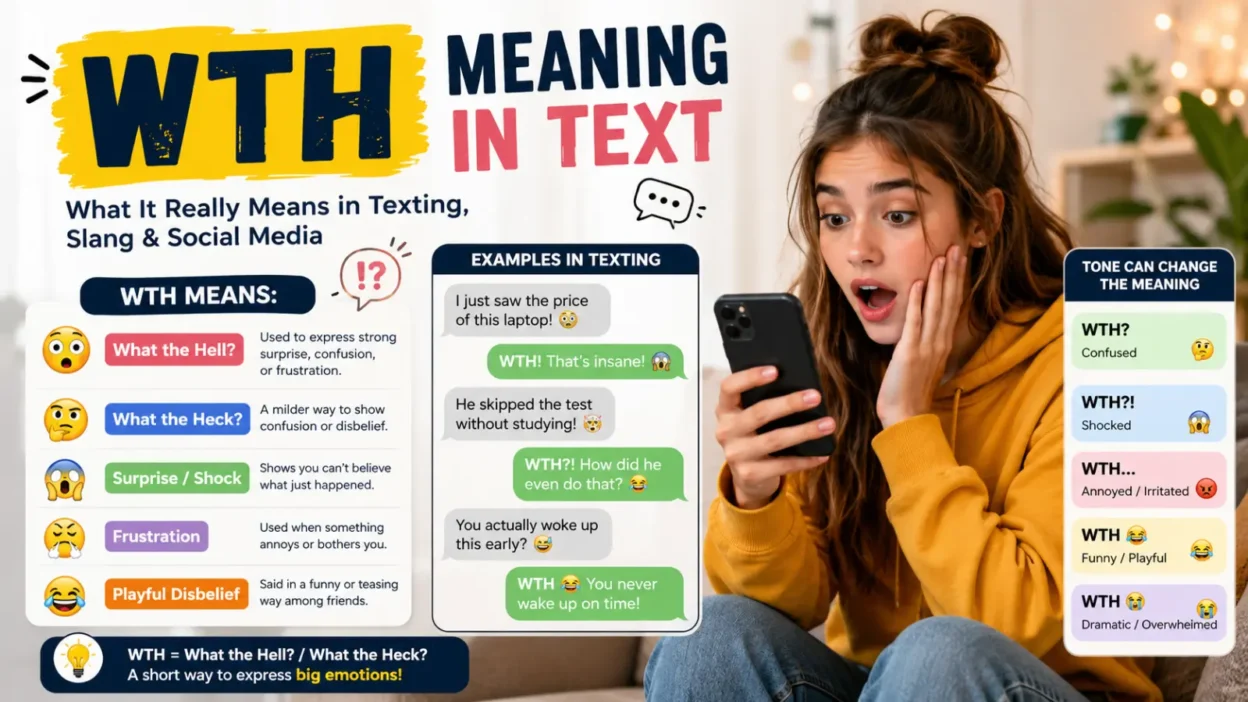
WTH usually means “What the hell?” or “What the heck?” It is an informal internet abbreviation people use to express surprise, confusion, disbelief, frustration, or sometimes playful amusement.
The exact feeling depends heavily on the conversation, punctuation, emojis, and relationship between the people talking.
Friend: “I accidentally sent the screenshot to the person we were talking about 😭”
You: “WTH 😭😂”
Here, WTH probably means something closer to “What the heck?!” with a humorous, shocked tone rather than genuine anger.
That flexibility is what makes WTH interesting. Three letters can sound mildly confused in one conversation and seriously irritated in another.
Quick Definition & Meanings
1. “What the Hell?”
This is the most direct expansion of WTH. It communicates strong surprise, disbelief, confusion, or irritation.
Example:
“WTH were they thinking?”
The speaker is probably questioning someone’s decision and may sound annoyed.
2. “What the Heck?”
WTH can also mean “What the heck?”, which carries essentially the same emotional function but sounds milder.
Example:
“WTH is going on with this app?”
This can communicate confusion without necessarily sounding aggressive.
Wiktionary records both “what the hell” and “what the heck” as internet-slang meanings of WTH.
3. Surprise or Shock
Sometimes WTH simply means “I can’t believe this.”
Example:
“WTH! You actually won the competition?”
Here, the speaker may be impressed rather than angry.
4. Confusion
WTH can function as a quick way of saying “What is happening?” or “What is going on?”
Example:
“WTH is happening in this group chat?”
The person wants an explanation and may not be particularly upset.
5. Frustration or Annoyance
When something repeatedly goes wrong, WTH can communicate irritation.
Example:
“WTH, my Wi-Fi disconnected again.”
The phrase adds emotional intensity to an otherwise ordinary complaint.
6. Playful Disbelief
Among friends, WTH can become almost comedic.
Example:
“WTH 😂 You wore that to the party?”
The speaker may be teasing rather than criticizing.
7. “Who the Hell/Heck?” or “Where the Hell/Heck?”
In some contexts, WTH can have less common interpretations such as “Who the hell?” or “Where the hell?” Cyber Definitions notes these alternate uses, although “what the hell/heck” is the dominant interpretation.
Example:
“WTH are you?”
Depending on the surrounding conversation, someone might interpret this as “Where the hell are you?” rather than “What the hell are you?”
That is why context matters.
WTH Meaning in Texting & Messaging
In private messages, WTH works as emotional shorthand.
Instead of typing:
“What the heck is happening right now? I honestly don’t understand this.”
Someone can simply write:
“WTH is happening 😭”
The abbreviation preserves the emotional punch while making the response faster.
Text conversations are full of these compressed reactions. People often communicate not only through words but through timing, punctuation, capitalization, emojis, and message length.
Compare these:
- “WTH.” — potentially irritated or serious
- “WTH?” — confused or questioning
- “WTH?!” — shocked or frustrated
- “WTH 😂” — amused disbelief
- “WTH 😭” — dramatic, humorous disbelief
- “WTHHHH” — exaggerated reaction
- “WTH bro” — casual disbelief or annoyance
The letters stay the same, but the emotional meaning changes.
WTH in Private DMs
In a one-on-one conversation, WTH can feel more personal because there is less surrounding context.
For example:
A: “I deleted your number by accident.”
B: “WTH 😭”
The emoji softens the reaction and suggests surprise or playful frustration.
Without the emoji:
B: “WTH.”
The same response may feel colder or more irritated.
WTH in Group Chats
Group chats give WTH a more performative quality.
Someone may post:
“WTH is going on here 😂”
Everyone can immediately understand that the person is reacting to the group’s chaos.
In this setting, WTH often becomes part of the group’s shared humor.
WTH and Read Receipts
Digital communication also adds another layer: timing.
A quick “WTH?!” immediately after receiving surprising information feels spontaneous. A delayed “WTH…” can feel more deliberate, suspicious, or disappointed.
The difference is subtle, but regular texters recognize these cues instinctively.
WTH Origin, Evolution & Social Media Spread
WTH comes from shortening the phrase “what the hell” and, in many modern contexts, “what the heck.” It belongs to the broader tradition of internet initialisms that compress familiar phrases into their first letters.
Unlike a word with one fixed definition, WTH developed as an emotional reaction. Early online communication favored abbreviations because people wanted to communicate quickly in chat rooms, forums, instant messaging, and later mobile texting.
As social platforms expanded, the same shorthand moved naturally between communities.
Today, WTH can appear in:
- WhatsApp conversations
- iMessage chats
- Instagram comments
- TikTok reactions
- Snapchat messages
- Discord servers
- Gaming chats
- Meme communities
- Casual social posts
The basic meaning has remained relatively stable, while the tone has become increasingly flexible.
A recent academic discussion of Instagram slang also describes WTH as a concise expression of emotional shock that can combine humor, disbelief, and strong emotional reaction in online interaction.
Why Social Media Helps Slang Spread
Social platforms reward communication that is fast, recognizable, and emotionally expressive.
A phrase such as:
“What the heck did I just watch?”
takes longer to type than:
“WTH did I just watch?”
That difference seems tiny, but internet communication happens at enormous scale. Short expressions are easy to comment, remix, quote, and repeat.
Memes and viral videos also give abbreviations repeated exposure. Once people repeatedly see WTH used in funny or surprising contexts, they learn its emotional meaning without needing a formal definition.
Real-Life Conversations
WhatsApp / iMessage Chat
Alex: “Guess what? I accidentally booked the flight for the wrong month.”
Sam: “WTH 😭 How did you manage that?”
Alex: “Don’t ask.”
Here, WTH expresses shock mixed with humor.
Instagram DM
Mia: “Did you see her new haircut?”
Zoe: “WTH 😂 I almost didn’t recognize her.”
The phrase is playful. The emoji makes it clear that the reaction is not necessarily hostile.
TikTok Comment
“WTH did I just watch 😭”
This is classic public-reaction language. The commenter is probably expressing confusion, surprise, and humor simultaneously.
Gaming Chat
Player 1: “Why did the game spawn me outside the map?”
Player 2: “WTH 😭”
Here, WTH communicates immediate disbelief about an unexpected game event.
Public Thread
“WTH is this comment section today?”
This may be less about one particular person and more about reacting to the overall chaos.
Why People Choose WTH Instead of Formal Language
The appeal is emotional efficiency.
“I am surprised and confused by what just happened” sounds formal.
“WTH?!” sounds immediate.
Internet slang often works because it communicates emotion and information simultaneously. The abbreviation does not merely tell someone that you are confused; it shows them how strongly you are reacting.
Psychological & Emotional Dynamics Behind WTH
WTH may look like three ordinary letters, but it can perform several social functions.
It Shows Immediate Reaction
People often use WTH before they have fully processed something.
It is almost a digital gasp.
“WTH?!”
The message communicates: “Wait. What just happened?”
It Creates Emotional Distance
Using an abbreviation can make a strong reaction feel less heavy.
Compare:
“What the hell are you doing?”
with:
“WTH are you doing 😂”
The second can still sound confrontational, but the abbreviation and emoji may create enough distance to make it playful.
It Signals Informality
WTH tells the other person that the conversation is casual.
That makes it comfortable among friends but potentially inappropriate in formal environments.
It Builds Group Belonging
Internet slang also works as social shorthand. When people share the same expressions, they demonstrate familiarity with the communication style of their community.
You do not need to explain what WTH means to someone who already uses it.
It Can Act as Emotional Armor
Abbreviations sometimes make vulnerable reactions easier to express.
Instead of saying:
“I’m genuinely shocked and don’t know how to respond.”
Someone can simply say:
“WTH 😭”
The slang makes the emotional reaction lighter and less exposed.
Contextual Usage Guidelines
Social Media vs. Private Texts
On social media, WTH is often exaggerated for entertainment.
“WTH 😭 this video took me OUT.”
In private texting, it may be more direct:
“WTH happened?”
Both are informal, but the social-media version often performs emotion for an audience.
Close Friends vs. Casual Acquaintances
With close friends, WTH can be playful, sarcastic, or dramatic.
With someone you barely know, it can sound more confrontational.
For example:
“WTH 😂 you actually did it!”
sounds friendly between close friends.
But:
“WTH are you doing?”
from someone you barely know may sound hostile.
Professional or Formal Environments
WTH generally belongs in informal communication.
Avoid it in:
- Client emails
- Job applications
- Formal reports
- Academic writing
- Official complaints
- Professional presentations
Instead of:
“WTH happened to the report?”
write:
“Could you clarify what happened to the report?”
The second version communicates the same basic concern without unnecessary emotional intensity.
When NOT to Use WTH & Common Misconceptions
Don’t Use It During a Serious Conflict Without Considering Tone
During an argument, WTH can escalate the situation.
“WTH is wrong with you?”
doesn’t sound like harmless slang. It can sound insulting.
Don’t Assume WTH Is Always Funny
The same abbreviation can be playful or aggressive.
Context determines the emotional reading.
Don’t Assume It Always Means “What the Hell”
Although that is a very common interpretation, “what the heck” is also established. Some users choose the softer expansion intentionally, while others simply use WTH without mentally expanding every letter.
Don’t Confuse It With WTF
WTH and WTF have similar functions, but WTF is generally more vulgar and can carry stronger emotional force.
WTH is often chosen when someone wants intensity without using a stronger profanity.
Semantic Comparison: WTH and Similar Expressions
| Expression | Primary Meaning | Tone | Best Usage Context |
| WTH | What the hell / what the heck | Surprised, confused, mildly frustrated | Casual texts, DMs, social media |
| WTF | What the f*** | Strong shock, disbelief, anger | Very casual conversations |
| SMH | Shaking my head | Disapproval, disappointment, disbelief | Texts, comments, memes |
| Seriously? | Are you serious? | Skeptical, surprised, annoyed | Casual and semi-casual conversations |
| What on earth? | Strong surprise or confusion | Milder, cleaner disbelief | General conversation |
The biggest distinction is emotional intensity. WTH sits in a useful middle ground: stronger than a simple “What?” but usually less vulgar than WTF.
SMH focuses more on disappointment or disapproval, while “seriously?” directly questions whether something can be believed. “What on earth?” expresses surprise without the same slang-heavy feel.
WTH Variations, Derivatives & How to Respond
Internet users rarely leave slang untouched. They stretch letters, add punctuation, and combine abbreviations with emojis to create different emotional flavors.
Common variations include:
- WTH?
- WTH?!
- WTHHH
- WTH 😂
- WTH 😭
- WTH bro
- WTH man
- WTH is going on?
- WTH did I just see?
Casual Replies
If someone sends:
“WTH just happened?”
You could answer:
“Honestly, I have no idea 😂”
Or:
“Right?! I was confused too.”
Funny/Sarcastic Replies
If someone says:
“WTH are you wearing?”
You might reply:
“Fashion. You wouldn’t understand 😌”
Or:
“Don’t question the vision 😂”
Mature/Direct Replies
If the situation is serious:
“I know it looks strange. Let me explain.”
Or:
“I understand why you’re confused. Here’s what happened.”
These responses acknowledge the emotion behind WTH rather than automatically treating it as an insult.
Generational & Regional Perspectives
Gen Z
Gen Z tends to be highly comfortable with abbreviated digital language. WTH can appear alongside emojis, reaction phrases, meme language, and intentionally exaggerated spelling.
For younger users, the expression may be less about literally expanding the letters and more about signaling a recognizable emotional reaction.
Millennials
Millennials encountered many internet abbreviations during the rise of forums, AIM, MSN Messenger, SMS, and early social media. WTH therefore fits comfortably within a broader vocabulary of online shorthand.
Its use may feel casual rather than particularly new.
Older Demographics
Older users may recognize WTH but interpret it more literally or may prefer the complete phrase.
Because digital slang changes quickly, unfamiliarity does not necessarily indicate age; people simply develop different online vocabularies depending on which communities and platforms they use.
Global Internet Culture
WTH also appears in international online communities where English serves as a shared digital language.
Non-native English speakers often learn expressions such as WTH through memes, gaming, TikTok, Instagram, YouTube comments, and messaging rather than traditional language instruction.
That creates an interesting form of language learning: people learn the emotional function of a phrase before they learn its formal linguistic explanation.
FAQs:
What does WTH mean in text?
WTH usually means “What the hell?” or “What the heck?” It commonly expresses surprise, confusion, disbelief, or frustration.
Is WTH rude?
WTH can be mildly rude or informal, especially when it expands to “what the hell.” However, it is generally less vulgar than WTF and can be playful among friends.
What does WTH mean on TikTok?
On TikTok, WTH usually expresses surprise, confusion, disbelief, or humorous shock in response to a video, comment, or unexpected moment.
What does WTH mean on Instagram?
On Instagram, WTH is commonly used in comments and DMs as a quick reaction to something surprising, strange, funny, or confusing.
Is WTH the same as WTF?
Not exactly. Both express surprise or disbelief, but WTF is more vulgar and usually stronger, while WTH is comparatively milder.
How do you reply to WTH?
Match the context. For a playful message, reply with humor such as “I know 😂”. For genuine confusion, explain what happened. If the sender sounds angry, respond calmly rather than escalating.
Final Thoughts:
WTH meaning in text is simple on the surface: it most commonly means “What the hell?” or “What the heck?” But the real meaning depends on what surrounds those three letters.
A WTH followed by 😂 can communicate playful disbelief.
A WTH?! can signal genuine shock.
A WTH. may feel irritated or cold.
A WTH 😭 can turn confusion into comedy.
That is the fascinating part of internet slang. Digital communication is not only about dictionary definitions. It is about timing, relationship, punctuation, emojis, platform culture, and emotional intent.
WTH works because it compresses a surprisingly complicated reaction into three letters. It says, in effect, “Something about this situation is so unexpected that I need to react right now.”
And in the fast-moving world of online conversation, that kind of emotional shorthand is often exactly what people want.

I am Maxwell Ford, the creator of meaningosho.com, where I explore the origins and clear definitions of everyday words. I built this platform to help readers easily decode complex vocabulary and deepen their understanding of language. Through my articles, I love sharing simple, engaging insights that make learning new words both fun and useful.