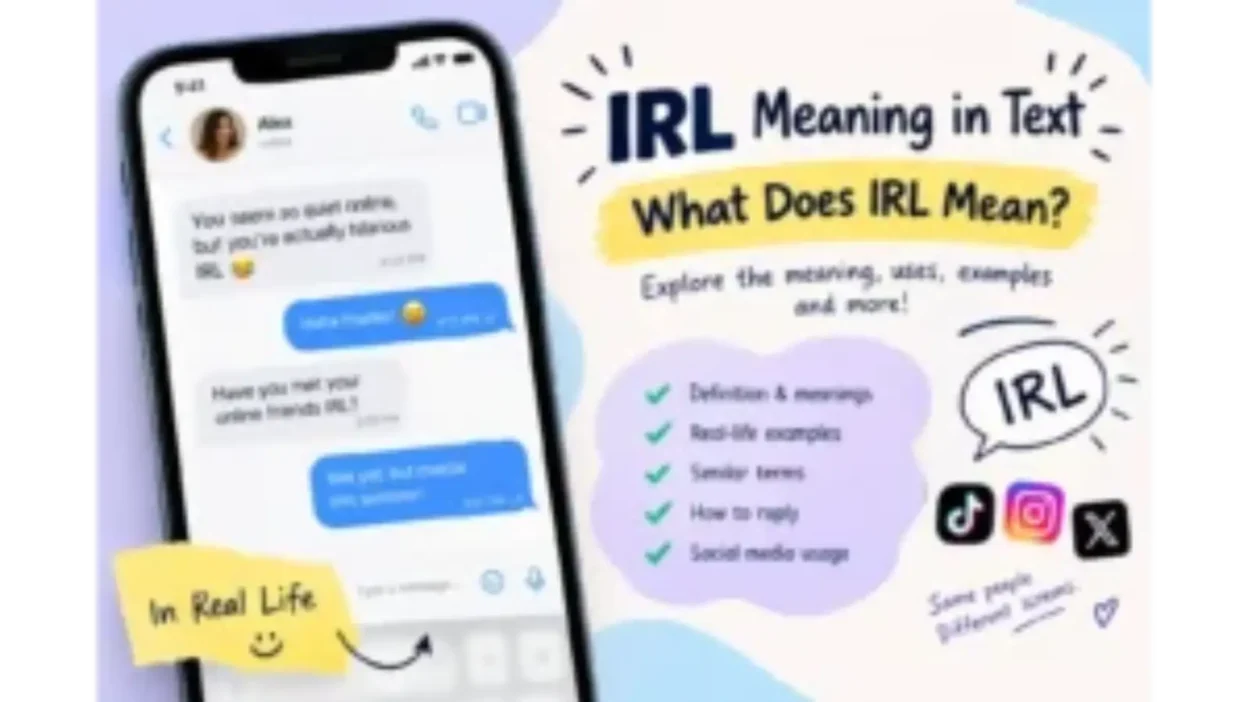
You see it in a message like, “You seem so quiet online, but you’re actually hilarious IRL,” and suddenly the question is obvious: what does IRL meaning in text actually imply?
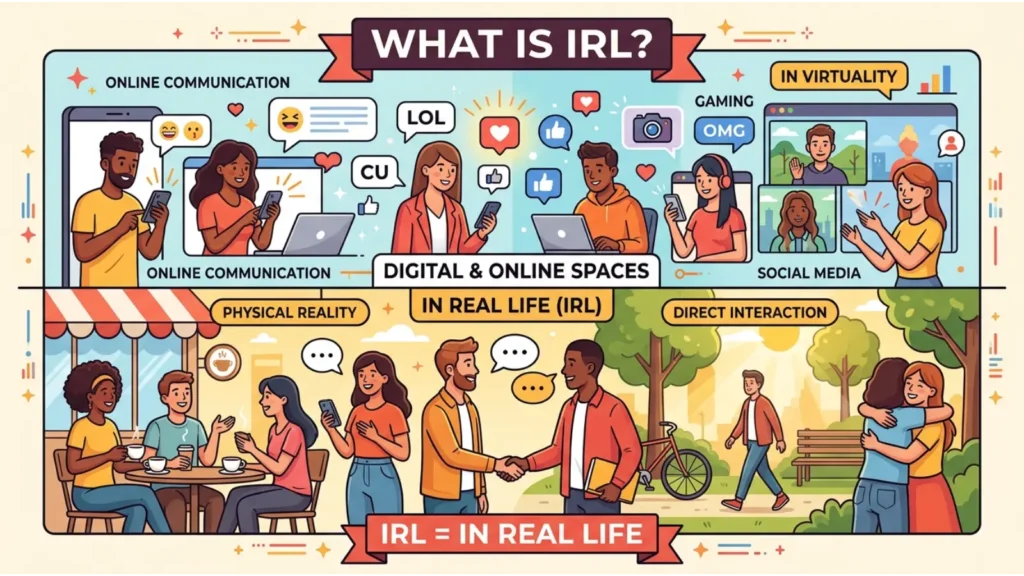
IRL stands for “in real life.” People use it when they want to distinguish something that happens offline, face-to-face, or outside a digital environment from what happens online. Cambridge Dictionary defines IRL as an abbreviation for “in real life” used in email, social media, and similar digital communication.
For example:
Alex: “We’ve been gaming together for months.”
Sam: “Have you guys ever met IRL?”
Alex: “Nope, but maybe this summer 😂”
Here, IRL simply means face-to-face or offline in the physical world.
But that basic definition does not explain everything. In modern internet language, IRL can quietly carry extra meaning. Someone may use it to emphasize authenticity, compare an online persona with a person’s offline personality, describe an offline event, or make a joke about how something looks outside the internet.
That is why understanding the sentence around IRL matters more than memorizing the acronym itself.
Quick Definition & Meanings
The simplest answer is:
IRL = In Real Life
It usually describes something happening in the physical world rather than online, in a game, on social media, in a fictional story, or inside a digital community. Dictionary.com similarly defines IRL as “in real life,” particularly in contrast with online communication or interaction.
Although IRL technically has one dominant meaning in texting, its social nuance changes depending on how someone uses it.
1. IRL Meaning: Face-to-Face
The most literal use refers to meeting someone physically.
Example:
“Are you going to meet your Discord friends IRL?”
Meaning:
Are you going to meet them in person?
This use became especially natural in online friendships, gaming communities, fandom spaces, and social platforms where people can know each other for months or years without physically meeting.
2. IRL Meaning: Offline Life
IRL can also describe what happens away from screens.
Example:
“I’ve been busy IRL, so I haven’t posted lately.”
The speaker is not necessarily talking about a physical meeting. They are saying their offline responsibilities or experiences have taken priority.
In this context, IRL can mean:
- offline life
- everyday life
- personal life
- things happening away from the internet
- real-world responsibilities
3. IRL Meaning: The Real-World Version of Something
People often use IRL to compare a digital representation with its physical counterpart.
Example:
“That character looks amazing online, but the costume is even better IRL.”
Here, IRL means when seen physically rather than through a screen.
The term is common when discussing art, fashion, products, collectibles, events, photos, or experiences that look different in person.
4. IRL Meaning: Someone’s Offline Personality
IRL can also highlight the difference between someone’s online identity and their everyday personality.
Example:
“He acts super confident online, but he’s shy IRL.”
The sentence suggests that the person behaves differently in face-to-face situations.
This is one reason IRL can carry psychological nuance. It does not automatically mean the online version is fake. It simply marks the difference between two social environments.
5. IRL Meaning: Authentic or Unfiltered Experience
Sometimes people use IRL to emphasize something that feels more direct, spontaneous, or less digitally filtered.
Example:
“Talking to her IRL is totally different from texting her.”
The emotional meaning may be:
Her real-world presence communicates things that messages cannot.
In this usage, IRL is almost a shorthand for human presence beyond the screen.
6. IRL Meaning in Memes and Jokes
Internet culture frequently uses IRL as a punchline.
Example:
“Me pretending I understand the assignment online / me IRL: 😐”
Or:
“Bro is confident in the comments and silent IRL.”
Here, IRL creates a contrast between an online joke and an imagined real-world reaction.
The humor usually comes from the gap between how people present themselves digitally and how they might behave offline.
What Does IRL Meaning in Text and Messaging?
In private messages, IRL functions as a compact context marker.
Instead of writing:
“When you are actually outside of the internet and physically around other people…”
someone can simply say:
“He’s way funnier IRL.”
That efficiency is exactly why abbreviations thrive in messaging. They communicate an entire concept without interrupting the casual rhythm of a conversation.

In private DMs
IRL often appears when two people discuss meeting, personalities, appearances, or everyday life.
Example:
“You’re fun to text.”
“Haha thanks.”
“I bet you’re even funnier IRL.”
That last line can feel warmer than a purely informational statement. Depending on the relationship, it may signal friendliness, curiosity, admiration, or even mild flirting.
In group chats
IRL can help separate digital behavior from everyday behavior.
“Everyone here is so chaotic.”
“Imagine us all hanging out IRL 💀”
The abbreviation lets the group imagine moving from a virtual space into a physical one.
In gaming communities
IRL often distinguishes the player from the avatar, game identity, or online community.
“I mainly support myself online, but IRL I can barely organize my own schedule.”
The joke works because the speaker contrasts a digital role with everyday life.
With read receipts and message pacing
Even the placement of IRL can influence tone.
Compare:
“You’re different IRL.”
with:
“You’re sooo different IRL 😂”
The first sounds more serious. The second feels playful.
Likewise:
“We should meet IRL.”
can sound straightforward, while:
“We should actually meet IRL sometime 👀”
can imply curiosity or flirtation depending on the relationship.
The acronym itself does not determine the emotional meaning. Context, punctuation, emojis, timing, and relationship history do.
Origin, Evolution & Social Media Spread
IRL developed as part of internet and digital communication. Dictionary.com lists its origin as coming from digital communications, while Cambridge recognizes it as an established abbreviation used in email and social media.
Its rise makes sense because the early internet created a practical linguistic problem: people needed a quick way to distinguish the physical world from online spaces.
As online communities grew, users began spending more time communicating through forums, chats, gaming platforms, social networks, and messaging systems. A short label for offline reality became increasingly useful.
The phrase also became culturally important because the boundary between “online life” and “real life” became less obvious.
Someone could:
- have online friends,
- build an audience online,
- work remotely,
- maintain a digital identity,
- participate in virtual communities,
- play competitive games,
- communicate through video calls,
- and still have a separate offline routine.
So IRL became more than a technical contrast. It became a social shorthand.
Today, the word also appears in mainstream contexts. Dictionary.com’s current examples show IRL being used for offline events, relationships, and experiences across contemporary media discussions, showing how deeply the abbreviation has moved beyond niche internet slang.
Social platforms accelerated this spread because users constantly switch between digital content and offline experiences. A creator may post online about an event that happened IRL. A gamer may finally meet an online teammate IRL. A meme may compare online confidence with real-world awkwardness.
Slang evolves this way naturally: first it solves a communication need, then it becomes recognizable cultural language.
Real-Life Conversations
WhatsApp / iMessage Chat
Maya: “You’ve known her since college?”
Lena: “No, we met through Instagram.”
Maya: “Oh wow. Have you met IRL?”
Lena: “Yeah, twice. She’s exactly the same 😂”
What IRL means here:
They are asking whether an online connection has become an offline, face-to-face relationship.
The interesting part is the phrase “exactly the same.” It connects IRL with authenticity and consistency between digital and offline personalities.
Instagram DM
Jay: “That jacket looks expensive.”
Chris: “It looks even better IRL.”
Jay: “Now I want one 😭”
Here, IRL means in person or when physically seen.
The speaker is implying that a photo does not fully capture the item.
TikTok Comments / Public Threads
“Bro is fearless in the comments but IRL he says nothing 💀”
This is a classic contrast joke.
The commenter is not necessarily making a serious accusation. They are playing with the familiar internet stereotype that people may behave more confidently behind a screen than they do face-to-face.
Another everyday example
“This café looked tiny on TikTok, but it’s actually huge IRL.”
Here, IRL functions almost like “in person.”
That makes it especially useful for travel, food, shopping, fashion, events, and entertainment content.
Why choose IRL instead of “in real life”?
Because IRL feels faster, lighter, and more native to digital conversation.
Compare:
“You’re hilarious in real life.”
with:
“You’re hilarious IRL 😂”
The second sentence feels more casual and internet-aware.
That difference is small, but digital communication depends heavily on small differences.
The Psychological & Emotional Dynamics of IRL
Language online is rarely only about information. People also use words to manage distance, identity, emotion, and belonging.
IRL can signal several things at once.
It can signal confidence
Using familiar internet shorthand suggests comfort with digital culture.
Someone who writes:
“I’ll tell you IRL.”
may assume the other person understands the abbreviation without explanation.
It can create emotional distance
Sometimes IRL separates online interaction from more personal offline interaction.
For example:
“I’d rather talk about this IRL.”
That can communicate:
This conversation feels too important, personal, or complicated for text.
In that case, IRL becomes a boundary-setting tool.
It can suggest authenticity
If someone says:
“She’s nicer IRL.”
they are effectively saying that the offline person differs from the impression created online.
That does not necessarily mean deception. Online platforms naturally compress personality into posts, comments, profile photos, videos, and captions.
It can build belonging
Slang often functions as social shorthand. Cambridge describes slang as a highly informal language associated with particular groups and social contexts.
IRL can therefore work as a tiny signal of shared internet literacy.
Using the expected shorthand tells the other person:
“We understand the same digital language.”
Contextual Usage Guidelines
Social Media vs. Private Texts
On social media, IRL often appears in captions, comments, memes, and comparisons.
Example:
“Me online vs. me IRL.”
In private texts, it is more likely to describe people, plans, meetings, or personal experiences.
Example:
“Do you want to grab coffee IRL this weekend?”
Close Friends vs. Casual Acquaintances
With close friends, IRL can sound playful.
“You act tough online but you’re soft IRL 😂”
With acquaintances, the same statement might feel more pointed.
Tone depends on relationship history.
Professional or Formal Environments
IRL is understandable to many English speakers, but it remains informal.
In formal reports, business correspondence, academic writing, or official communication, phrases such as “in person,” “offline,” “face-to-face,” or “in the physical world” may sound more appropriate.
For example:
Casual:
“Let’s discuss this IRL.”
Professional:
“Let’s discuss this in person.”
The meaning stays the same. The register changes.
When NOT to Use IRL & Common Misconceptions
IRL is generally harmless, but context still matters.
Avoid forcing slang into formal communication
A message like:
“Please confirm IRL.”
could look unnecessarily casual in a formal workplace context.
Be careful during serious arguments
If someone is discussing a sensitive problem and you respond with:
“Let’s talk IRL 😂”
the emoji may completely change the tone.
In serious conversations, clarity often matters more than slang.
Do not assume IRL means “truth”
One common misunderstanding is treating IRL as automatically meaning “the authentic or honest version.”
That is not strictly what it means.
IRL simply identifies the offline or physical context.
Someone can be genuine online and genuine offline.
IRL does not mean “better”
Likewise, IRL does not automatically imply that real-world experiences are superior to digital ones.
For many people, online friendships, gaming communities, creative spaces, and social networks are meaningful parts of everyday life.
The word is primarily a contextual distinction, not a judgment.
IRL vs. Similar Expressions
| Expression | Primary Meaning | Tone | Best Usage Context |
| IRL | In real life; offline/in person | Casual, internet-native | Texts, social media, gaming |
| In person | Face-to-face physically | Neutral | Everyday and professional communication |
| Offline | Away from the internet | Neutral/casual | Technology, social media, work |
| Face-to-face | Direct physical interaction | Neutral | Personal, business, serious conversations |
| In real life | The physical/non-fictional world | Conversational | General everyday speech |
These expressions overlap, but they are not identical in feel.
IRL sounds the most digital.
In person emphasizes physical presence.
Offline emphasizes disconnection from digital systems.
Face-to-face highlights direct interpersonal interaction.
And in real life is the full phrase behind the abbreviation.
Similar Terms and Related Internet Expressions
If you are learning online slang, these expressions often appear around the same conversations:
Online — referring to digital activity or communication.
Offline — referring to activity away from the internet.
AFK — “away from keyboard,” especially common in gaming and chat environments.
DM — direct message.
POV — point of view, commonly used in social media captions and memes.
IRL bestie — an offline friend contrasted with an online friendship.
Online friend — someone primarily known through digital interaction.
Real-world — a broader phrase referring to physical or practical life outside a digital environment.
These terms are related because internet vocabulary often needs to distinguish different layers of social experience.
Variations, Derivatives & Playful Forms
IRL itself usually remains unchanged because it is an abbreviation rather than a conventional verb.
Still, users combine it creatively with other words.
Common examples include:
IRL friend
“She’s not just an online friend anymore. She’s an IRL friend.”
Meaning: a friend you know or regularly interact with offline.
IRL bestie
“Finally met my online bestie IRL!”
This usually celebrates an online friendship becoming an offline meeting.
IRL event
“The community is hosting its first IRL event.”
Meaning: a physical event rather than a virtual one.
IRL version
“The IRL version looks even cooler.”
Meaning: the physical version of something seen online.
Me IRL
This is especially common in memes.
“When someone says ‘let’s introduce ourselves’ — me IRL: 🫥”
It means:
“This is basically how I behave in real life.”
The joke often contrasts an exaggerated online persona with an awkward, shy, tired, chaotic, or relatable offline self.
How to Respond When Someone Uses IRL
Casual Replies
“Yeah, we should hang out IRL sometime.”
“Honestly, you’re way funnier IRL 😂”
“I’d be down to meet IRL.”
These replies keep the conversation relaxed and natural.
Funny or Sarcastic Replies
“IRL me has zero social skills 😭”
“You think I’m confident online? Wait till you meet me IRL 💀”
“That sounds brave. Let’s see who survives IRL 😂”
These work best with friends who already understand your humor.
Mature or Direct Replies
“Sure, I’d rather talk about it IRL.”
“I’m comfortable keeping this online for now.”
“We can meet in person when the timing makes sense.”
These responses are useful when the conversation requires clearer boundaries.
Generational & Regional Perspectives
Gen Z
Gen Z is generally comfortable with digital abbreviations and may use IRL casually in memes, comments, gaming conversations, and chats.
For younger users, the distinction between online and offline life can feel less dramatic because social interaction often moves constantly between both environments.
Millennials
Millennials also widely recognize IRL, especially because the abbreviation became common during the growth of forums, instant messaging, gaming communities, blogs, and early social networks.
For many Millennials, IRL may feel less like new slang and more like established internet vocabulary.
Older Generations
Older users may understand IRL but may be less likely to use it naturally.
A person who does not spend much time in online communities may prefer:
“in person”
instead of:
“IRL”
This does not make one version more correct. It simply reflects differences in digital language exposure.
Global Internet Culture
IRL is also easy for non-native English speakers to encounter because it appears across international social platforms, gaming communities, entertainment sites, and messaging services.
Because the abbreviation is short and frequently repeated alongside English-language internet content, users may recognize it even when English is not their first language.
Cambridge’s dictionary entries also provide translations and examples for IRL in languages including Chinese, Spanish, and Portuguese, reflecting how the term travels across language communities.
FAQs:
What does IRL mean in text?
IRL means “in real life.” People use it to refer to offline, physical, or face-to-face experiences rather than online activity.
What does IRL mean on TikTok?
On TikTok, IRL usually means “in real life.” It may be used to compare someone’s online behavior with how they actually act offline, or to describe something experienced physically rather than through a video.
Is IRL slang?
IRL is best described as an internet abbreviation or informal digital shorthand. It is widely recognized and appears in dictionaries, but it remains much more casual than “in person” or “in real life” in formal writing.
What does “me IRL” mean?
“Me IRL” means “me in real life.” It is frequently used in memes and captions to show a relatable real-world reaction, habit, personality trait, or awkward situation.
What does “IRL friend” mean?
An IRL friend is someone you know and interact with in the physical world rather than only through the internet.
Is IRL rude?
Usually, no. IRL is not inherently rude. The tone depends on the sentence, relationship, and surrounding message. A serious sentence such as “Let’s talk IRL” may sound very different from “You’re chaotic IRL 😂.”
How do you reply to IRL?
You can reply naturally based on context:
“Yeah, definitely.”
“Haha, I’m different IRL.”
“We should meet IRL sometime.”
“I’d rather keep it online for now.”
The best response matches the other person’s tone and your level of comfort.
Final Thoughts:
The simplest definition of IRL meaning in text is “in real life.” It points to what happens offline, face-to-face, or beyond a digital environment.
But modern communication gives that tiny acronym more social flexibility.
IRL can describe meeting an online friend, experiencing a product in person, contrasting online and offline personalities, joking about your behavior, or emphasizing the difference between a screen-based impression and physical presence.
That is why the surrounding words matter.
When someone writes “you’re funnier IRL,” they are not simply giving a definition of where the joke happens. They may also be commenting on personality.
When someone writes “let’s talk IRL,” they may be signaling that a conversation feels too important for text.
And when someone posts “me IRL,” they are usually turning an everyday reaction into a piece of internet humor.

I am Maxwell Ford, the creator of meaningosho.com, where I explore the origins and clear definitions of everyday words. I built this platform to help readers easily decode complex vocabulary and deepen their understanding of language. Through my articles, I love sharing simple, engaging insights that make learning new words both fun and useful.