
If you have seen SMFH in a text, comment, or social media post and wondered what those letters mean, you are not alone.
Slang like this can be confusing because the meaning often depends on the situation and the relationship between the people talking.
SMFH is usually a stronger version of SMH, which means “shaking my head.” The added F makes it more intense and often signals stronger annoyance, disbelief, frustration, or disappointment.
You will mostly see SMFH in casual online conversations, messages, comments, and social media posts.
It is not normally something you would use in a formal email or professional conversation. Understanding the tone behind it is just as important as knowing the words it represents.
Quick Answer
SMFH usually means “shaking my f*ing head.”** It is used to show strong frustration, disbelief, annoyance, or disappointment about something someone said or did.
It is basically a more intense version of SMH. Because it contains profanity, SMFH is best kept for casual conversations and informal online spaces.

What Does SMFH Mean?
1. Shaking My F***ing Head — Most Common Meaning
The most common meaning of SMFH is “shaking my f*ing head.”** The F-word adds emphasis to the familiar expression SMH, making the reaction stronger.
People may use SMFH when something seems ridiculous, frustrating, careless, or hard to believe.
Example:
“He forgot his own birthday party was today. SMFH.”
Here, the person is not literally shaking their head. They are using SMFH to express a strong reaction to the situation.
Tone: Frustrated, annoyed, disappointed, or incredulous.
Who uses it: People having casual conversations online or through text.
2. A Stronger Version of SMH
Sometimes people use SMFH almost like an intensified form of SMH, without focusing on the exact expansion of the letters.
For example:
“You really spent all your money on that? SMFH.”
The main message is something like, “I cannot believe you did that.”
In this use, the exact words behind the abbreviation matter less than the tone. The F-word simply makes the reaction more forceful.
Tone: Strong disbelief or frustration.
Example:
“He had one job and still messed it up. SMFH.”
SMFH vs. Similar Slang Terms
SMH
SMH means “shaking my head.” It expresses disbelief, disappointment, annoyance, or disapproval.
Compared with SMFH, it is less intense and does not contain profanity.
“You forgot the tickets? SMH.”
WTF
WTF is commonly used to express strong surprise, confusion, anger, or disbelief. It can be more direct and han SMFH.
“WTF, how did that happen?”
SMFH usually focuses more on a person’s reaction to something ridiculous or frustrating.
OMG
OMG means “oh my God.” It can express surprise, excitement, shock, or disbelief.
“OMG, you actually won!”
Unlike SMFH, OMG is not automatically negative or frustrated.
Facepalm
Facepalm describes the reaction of putting your hand over your face because something is embarrassing, foolish, or frustrating.
“He tried to charge his phone with a headphone cable. Facepalm.”
It has a similar feeling to SMFH but is less aggressive and does not contain profanity.
Seriously?
Seriously? is a simple way to question something that seems unbelievable, annoying, or ridiculous.
“You deleted the whole file? Seriously?”
It can communicate a similar reaction without using slang or profanity.
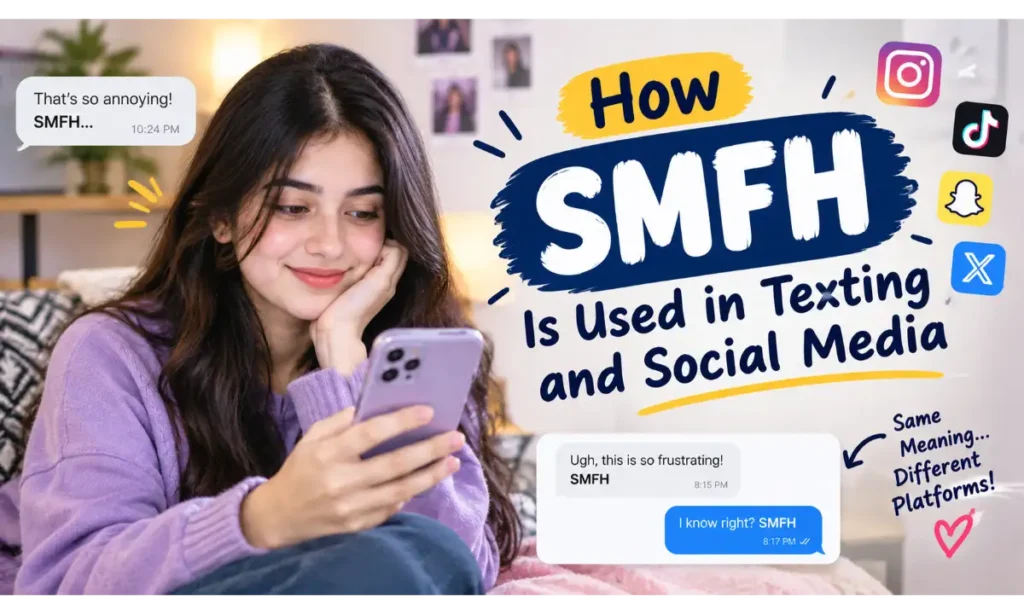
How SMFH Is Used in Texting and Social Media
SMFH is mainly used in informal digital communication.
You may see it in:
- Text messages
- Group chats
- Social media comments
- Direct messages
- Online discussions
- Memes and reaction posts
It is usually written in capital letters, although people can also write it as smfh in lowercase.
For example:
“He told everyone he wasn’t hungry and then ate half my food. SMFH.”
Or:
“Smfh, why would you do that?”
The meaning stays basically the same whether it is uppercase or lowercase.
Because SMFH contains profanity, some people avoid using it around people they do not know well. Others may use it casually because internet slang often has a more relaxed tone.
SMFH in Different Contexts
With Friends
This is where SMFH fits most naturally. Friends may use it when joking about a silly mistake or complaining about something frustrating.
“You left your keys inside again? SMFH 😂”
Depending on the conversation, this may be more playful than genuinely angry.
In Dating or Relationships
SMFH can appear in conversations between people who are dating or in a relationship, but the meaning depends heavily on the situation.
“You said you weren’t hungry and then ordered fries after I got mine. SMFH 😂”
Here, it could be teasing rather than serious anger.
However, if someone sends SMFH during an argument, it can sound much harsher. Context and the surrounding messages matter.
At Work
SMFH is generally not a good choice for professional communication.
Even if you are frustrated, using profanity in a workplace message can come across as disrespectful or too casual.
Instead of:
“SMFH, they changed the deadline again.”
You could write:
“I’m frustrated that the deadline changed again.”
That communicates the same basic feeling in a more professional way.
Real Examples of SMFH in Conversations
Example 1: Forgetting Something
Alex: “I left my wallet at home.”
Sam: “Again? SMFH 😂”
Here, SMFH shows frustration mixed with humor.
Example 2: A Silly Mistake
Mia: “I just realized I sent the email to the wrong person.”
Lena: “SMFH 😭”
The response shows disbelief and sympathy.
Example 3: Broken Promise
Tom: “He said he’d help me, but he never showed up.”
Chris: “SMFH. That’s messed up.”
Here, SMFH expresses disappointment.
Example 4: Something Ridiculous
Jake: “Someone tried to microwave a metal spoon.”
Ryan: “SMFH 💀”
The slang shows disbelief at what happened.
Example 5: Playful Teasing
Sara: “I bought another pair of shoes.”
Nina: “SMFH 😂 How many pairs do you need?”
This does not necessarily mean Nina is seriously angry. It can simply be playful teasing.
Example 6: Online Comment
Person 1: “They raised the price again.”
Person 2: “SMFH. Seriously?”
Here, SMFH emphasizes frustration about the situation.
When Should You Not Use SMFH?
The biggest issue with SMFH is the profanity. Even though people often use it casually, it is still an informal expression.
Avoid it in situations such as:
- Formal emails
- Job applications
- School assignments
- Business reports
- Customer-service messages
- Professional meetings
- Conversations with someone you do not know well
Instead, use plain-English alternatives such as:
- “I can’t believe this.”
- “That’s really frustrating.”
- “Seriously?”
- “I’m disappointed.”
- “I don’t understand why they did that.”
- “This is ridiculous.”
These alternatives let you express the same reaction without profanity.
Common Mistakes About SMFH
1. Thinking SMFH and SMH are exactly the same
They are closely related, but SMFH is usually stronger because it adds profanity for emphasis.
2. Assuming SMFH always means serious anger
Not necessarily. Friends may use it jokingly or playfully, especially with laughing or crying emojis.
3. Thinking it means someone is literally shaking their head
Like SMH, SMFH is normally figurative. It describes a reaction rather than an actual physical action.
4. Using it in every conversation
SMFH is casual slang. It may sound inappropriate or unprofessional in formal situations.
How Can You Reply to SMFH?
Your response depends on what the person meant.
If they are joking, you can reply casually:
“😂 I know, right?”
“I messed up, okay? 😂”
If they are genuinely frustrated:
“Yeah, I understand. That was frustrating.”
“I know. I should have handled it differently.”
If you are not sure what they mean, you can simply ask:
“What happened?”
You do not need to use slang just because the other person did.
FAQs About SMFH
What does SMFH mean in texting?
SMFH usually means “shaking my f*ing head.”** It is an intensified version of SMH and expresses frustration, disbelief, annoyance, or disappointment.
Is SMFH a bad word?
SMFH contains a censored form of the F-word, so it is considered profanity. It is generally better suited to casual conversations.
What is the difference between SMH and SMFH?
Both express reactions such as disbelief or frustration. SMFH is usually stronger because the added F-word gives the expression more emphasis.
Can SMFH be used as a joke?
Yes. Friends sometimes use SMFH playfully when teasing each other about silly mistakes or funny situations.
Is SMFH rude?
It can be. The slang itself contains profanity, and the tone can sound rude or aggressive in some conversations. However, friends may use it casually without intending serious offense.
Can I use SMFH at work?
It is usually better to avoid it in professional communication. A phrase such as “That’s frustrating” is safer and more appropriate.
What does lowercase smfh mean?
smfh means the same thing as SMFH. Using lowercase letters does not normally change its meaning.
Key Takeaways
- SMFH usually means “shaking my f*ing head.”**
- It is generally a stronger version of SMH.
- People use it to show frustration, disbelief, annoyance, or disappointment.
- The expression can sometimes be playful, especially between friends.
- Because it contains profanity, it is mainly used in informal conversations.
- In professional situations, a plain-English alternative is usually more appropriate.
Conclusion
SMFH meaning in text is usually “shaking my f***ing head,” an informal expression used when someone feels frustrated, disappointed, annoyed, or simply cannot believe what happened. It works much like SMH, but the added profanity makes the reaction stronger.
The exact tone still depends on the conversation. A friend might say “SMFH 😂” while joking about a silly mistake, while the same expression during an argument could sound genuinely angry.
If you see SMFH in a message, look at the surrounding words and emojis before deciding how serious the person is being. And if you want to use it yourself, remember that it is casual slang and contains profanity, so it is best saved for informal situations.

I am Maxwell Ford, the creator of meaningosho.com, where I explore the origins and clear definitions of everyday words. I built this platform to help readers easily decode complex vocabulary and deepen their understanding of language. Through my articles, I love sharing simple, engaging insights that make learning new words both fun and useful.