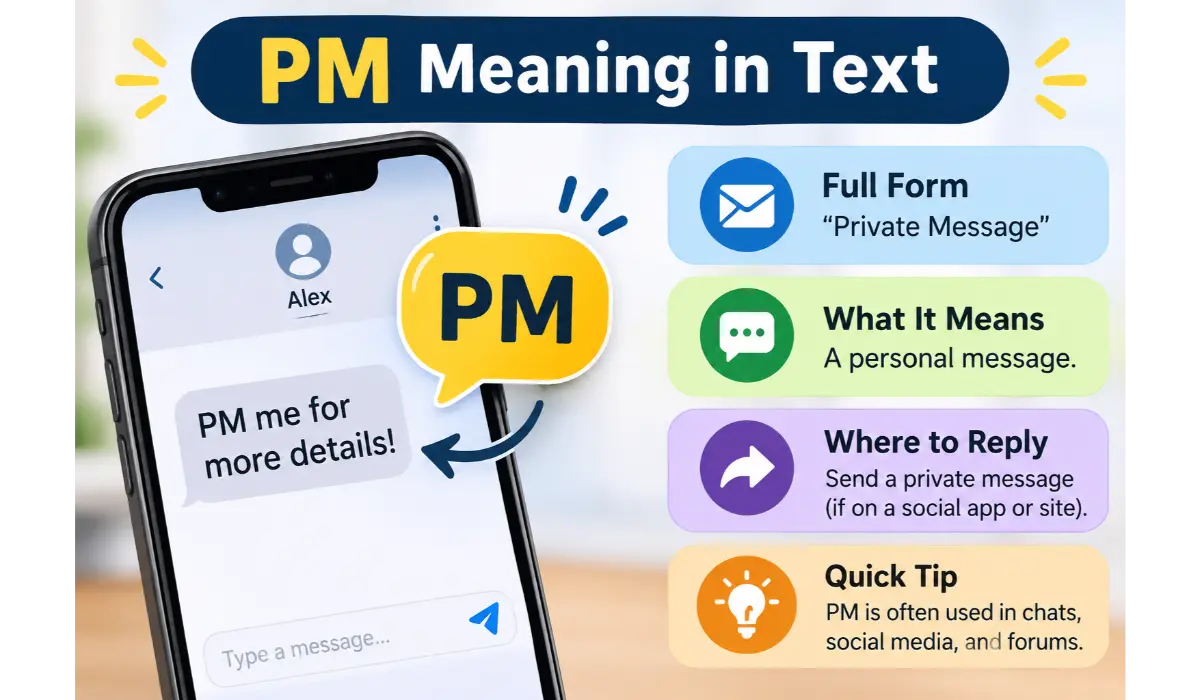
Have you ever received a message saying, “PM me for more details”? You may wonder what PM means and where to send the reply. PM meaning in text is usually “Private Message.”
It refers to a message sent directly to someone instead of sharing it in a public post or comment.
People use PM in online chats, social media, forums, and everyday conversations. However, PM can have other meanings depending on the topic.
It can also mean “Post Meridiem” when used with a time, or “Prime Minister” in a political discussion. The words around PM help you understand its meaning.
Quick Answer: What Does PM Mean in Text?
PM usually means Private Message in texting and online conversations. It tells you to contact someone privately rather than reply in a public comment or group discussion.
For example, “PM me the details” means “Send me the details in a private message.” The abbreviation can also mean other things when the conversation is about time, politics, or work.
All Meanings of PM
PM has several established meanings, but the conversation tells you which one someone intends. Here are the main meanings you may come across.
| Meaning | Full Form | Where You See It |
|---|---|---|
| Private message | Private Message | Social media, forums, online chats |
| Time abbreviation | Post Meridiem | Texts, schedules, appointments |
| Political title | Prime Minister | News, politics, public discussions |
| Work title | Project Manager | Office chats, emails, team projects |
The first meaning is the most relevant when someone asks you to send or check a PM. The other meanings are also established English uses, not extra texting definitions.
What Does PM Mean in a Text Message?
PM means a private message when someone uses it to talk about online communication. It is a way to contact one person without putting your message in a public space.
For example, someone may comment on your Instagram post and ask you to PM them. They want you to continue the conversation privately.
A PM can include:
- A personal question.
- Contact details.
- Information about a product or service.
- A private reply to a public comment.
- Details that do not belong in a group discussion.
Example:
- Person A: “Can you share the price?”
- Person B: “Sure, I’ll PM you the details.”
Here, Person B wants to send the price directly to Person A.
According to Oxford Learner’s Dictionaries, PM can refer to a private message on social media or an online forum.
What Does PM Me Mean?
“PM me” means “send me a private message.” It is a simple request to contact someone directly.
You may see this phrase after someone shares a public post or offers help online. Instead of discussing everything in the comments, they ask you to start a private conversation.
Here are some examples:
| Message | Plain-English Meaning |
|---|---|
| PM me | Send me a private message. |
| PM me later | Contact me privately later. |
| PM me the link | Send the link in a private message. |
| Check your PM | Look at your private messages. |
| I’ll PM you | I’ll send you a private message. |
| Send me a PM | Contact me directly. |
Example conversation:
- Friend: “I found the jacket you wanted.”
- You: “Really? Where?”
- Friend: “I’ll PM you the store link.”
The last message means the friend will send the link privately.
Is PM the Same as DM?
PM and DM have similar meanings, but their full forms are different. PM means Private Message, while DM means Direct Message.
Both refer to sending someone a message outside a public discussion. The exact label depends on the website or messaging service.
| Abbreviation | Full Form | Meaning |
|---|---|---|
| PM | Private Message | A message sent privately |
| DM | Direct Message | A message sent directly to someone |
| IM | Instant Message | A message sent through an instant messaging service |
For example:
- “PM me your question.”
- “DM me your question.”
Both sentences ask someone to send a private message.
You do not need to treat PM and DM as completely different types of communication. Their practical meanings often overlap.
How Is PM Used in Everyday Text Conversations?
PM is used when someone wants to move a conversation from a public space to a private one. It can make online communication easier and more direct.
Here are some fictional examples of how people may use it.
Example 1: Asking for information
- Alex: “Do you know where I can buy this?”
- Sam: “Yes, PM me.”
- Alex: “Okay, I’ll message you.”
2 Example: Sharing a link
- Mia: “Can you send me the website?”
- Noah: “I’ll PM it to you.”
3 Example: Online shopping
- Customer: “Is this jacket still available?”
- Seller: “Yes. PM me for the price.”
4 Example: Social media discussion
- User A: “Can you explain how you made this?”
- User B: “Sure, send me a PM.”
5 Example: Asking for help
- Chris: “I need help with my computer.”
- Jordan: “PM me what happened.”
In each example, PM tells the reader to continue the conversation privately.
What Tone Does PM Have in a Message?
PM usually has a neutral, casual, and practical tone. It does not automatically show anger, affection, excitement, or flirting.
The sender’s other words help you understand their attitude.
Friendly PM
A friendly PM request sounds warm and helpful.
Example: “PM me if you need anything!”
This suggests that the sender is willing to help.
Casual PM
A casual request is short and direct.
Example: “Just PM me later.”
It sounds like a normal conversation between people who know each other.
Professional PM
PM can also appear in work-related communication.
Example: “Please PM me the updated file.”
This is a direct request, but it does not sound rude.
Private or Personal PM
Sometimes, someone wants to discuss a subject away from a public conversation.
Example: “I’d rather explain it in a PM.”
This means the sender prefers a private discussion.
Does PM Mean Someone Is Flirting?
No, PM does not automatically mean flirting. Someone may ask you to send a private message for many ordinary reasons.
Look at the full conversation before deciding whether the request has a romantic meaning.
What Does PM Mean on Instagram, Snapchat, and TikTok?
PM generally refers to a private message across online communities, but individual platforms may use different names for their messaging features.
On Instagram, PM can mean a private message. People may use it when asking someone to contact them privately about a post, product, or question.
Example: “PM me for the details.”
Instagram also uses the term Direct Message, commonly shortened to DM.
Snapchat
On Snapchat, someone may use PM to ask another person to continue a conversation privately. However, Snapchat’s own communication features and labels may differ.
Example: “PM me if you want to talk.”
TikTok
On TikTok, PM may appear in comments when someone wants another user to contact them privately.
Example: “PM me for the full information.”
TikTok also has direct messaging features, so DM may be a more familiar platform-related term.
Discord
On Discord, users often refer to private conversations as DMs. PM may also be understood as private message.
Example: “Send me a PM with your question.”
Remember that these are examples of general language use, not official names for every platform’s messaging feature.
When Should You Use PM in a Conversation?
Use PM when you want someone to contact you privately or when you need to send information directly. It is most suitable for casual online conversations and familiar digital settings.
Here are some situations where it makes sense:
- Social media: Ask someone to contact you privately about a post.
- Online shopping: Discuss a product’s price or availability.
- Online forums: Send a private question to another member.
- Gaming communities: Share information without posting it publicly.
- Personal conversations: Discuss something that does not need a public reply.
- Work chats: Send a private note when the subject is suitable for a one-to-one conversation.
Avoid using PM when a public answer would help everyone or when your workplace requires information to stay in an official, shared channel.
How Do You Reply When Someone Says PM Me?
You can reply by sending a private message or by asking what information they need. Your response should match the conversation.
Here are some natural replies:
| Situation | Possible Reply |
|---|---|
| You agree | “Sure, I’ll PM you.” |
| You need more details | “Okay, what should I ask you about?” |
| You want to message later | “I’ll send you a PM later.” |
| You are confused | “Do you mean a private message?” |
| You prefer public information | “Can you share it here instead?” |
| You are not interested | “Thanks, but I don’t need a private message.” |
Example conversation:
- Taylor: “PM me for the event details.”
- Morgan: “Sure, I’ll send you a message.”
You do not need a special reply. A simple response is enough.
What Are the Other Meanings of PM?
PM can mean different things outside private messaging. The subject of the conversation helps you identify the correct meaning.
PM Means Post Meridiem
PM means Post Meridiem when it appears after a time. The Latin phrase means after midday and refers to the period from noon to midnight.
Examples:
- “The movie starts at 7 PM.”
- “Our meeting is at 3:30 PM.”
- “The store closes at 9 PM.”
In these sentences, PM does not mean Private Message. It tells you the time of day.
According to Cambridge Dictionary, p.m. is used for times in the afternoon, evening, or night.
PM Means Prime Minister
PM stands for Prime Minister in political discussions. A prime minister is the head of government in countries that use this title.
Examples:
- “The PM gave a speech today.”
- “I watched an interview with the PM.”
Oxford also lists Prime Minister as a meaning of PM, especially in British English.
PM Means Project Manager
PM can stand for Project Manager in a business or workplace conversation. A project manager helps plan and manage a project.
Examples:
- “Ask the PM about the deadline.”
- “Our PM will share the new schedule.”
Cambridge Dictionary lists Project Manager as another informal meaning of PM in business.
These meanings are not interchangeable. A message about a work deadline is more likely to use PM for Project Manager than Private Message.
How Can You Tell Which PM Meaning Someone Intends?
You can understand PM by checking the words around it. The same two letters can have different meanings in different situations.
Use these simple clues:
| Message | Likely Meaning | Reason |
|---|---|---|
| “PM me the details.” | Private Message | The sender asks for direct contact. |
| “See you at 8 PM.” | Post Meridiem | PM follows a clock time. |
| “The PM announced a new plan.” | Prime Minister | The subject is politics. |
| “Ask the PM about the project.” | Project Manager | The subject is workplace planning. |
If the meaning is still unclear, read the earlier messages. You can also ask the sender what they mean.
Should You Write PM, Pm, or pm?
PM, Pm, and pm can all appear in informal writing, but capitalization often helps show the intended meaning.
For private messages, PM and pm are both used. For times, p.m., PM, and pm are common forms.
Examples:
- “Please PM me.”
- “I sent you a pm.”
- “The call starts at 6 p.m.”
- “We will meet at 7 PM.”
For a formal document, follow the style guide used by your school, workplace, or publication. Keep the format consistent throughout the same document.
Where Did the Abbreviation PM Come From?
PM comes from the first letters of the words Private Message when used in online communication. The exact origin of this online abbreviation is unclear.
It is established in online dictionaries as both a noun and a verb. For example, you can receive a PM or PM someone.
Dictionary.com also lists PM as a verb meaning to send a private message. Its entry records the online-message noun from 2000–05, but that does not establish the first person or platform to use it.
You should not assume that PM started on a particular social media app. The available dictionary evidence supports its meaning, but not a precise creator or launch date.
What Are Common Mistakes People Make With PM?
The most common mistake is assuming PM always means Private Message. Its meaning changes with the subject and sentence.
Watch out for these mistakes:
1. Confusing PM with a time abbreviation
Incorrect interpretation: “The meeting is at 8 PM” means someone should send a private message.
Correct interpretation: The meeting starts at 8 in the evening.
2. Treating PM and DM as unrelated
PM and DM have different full forms, but both can refer to private online communication.
3. Assuming PM is romantic
A request to PM someone does not prove romantic interest. It may simply be about sharing information.
4. Thinking PM is always an official app feature
PM is a general term. Different services may use names such as messages, chats, or DMs.
5. Ignoring the conversation
Always read the complete sentence before choosing a meaning.
What Is the Difference Between PM and Similar Abbreviations?
PM has a few related abbreviations that people use for online communication. Knowing their differences can make messages easier to understand.
| Expression | Full Form | Meaning | Best Use |
|---|---|---|---|
| PM | Private Message | A private online message | Asking someone to contact you privately |
| DM | Direct Message | A direct message to another user | Social media conversations |
| IM | Instant Message | A message sent through an instant messaging service | Online chats |
| SMS | Short Message Service | A text messaging service | Mobile text messages |
| GM | Good Morning | A morning greeting | Starting a conversation |
PM and DM are the closest in meaning. IM describes a type of instant messaging, while SMS refers to a mobile text messaging service.
Do Different Age Groups Use PM Differently?
PM has a clear meaning across age groups, but individual communication habits can differ. You should not assume someone’s age from their use of this abbreviation.
- Gen Z: May use PM or DM depending on the platform and conversation.
- Millennials: May recognize PM from forums, social media, and online discussions.
- Older adults: May use PM when communicating through online communities or social platforms.
These are general examples, not research-based claims about how often each age group uses PM.
The main point is simple: anyone can use PM when asking someone to send a private message.
Is PM Used Differently in the USA and UK?
The meaning of PM as Private Message is understood in both the USA and UK. However, the abbreviation can have other meanings depending on the subject.
In the USA, PM may refer to private messaging, a time after noon, or a prime minister in international news.
In the UK, PM is also commonly used for Prime Minister, particularly in political news. The time abbreviation p.m. is used in both countries.
The basic meaning of a private message does not change between American and British English.
Frequently Asked Questions About PM Meaning in Text
1. What does PM mean in texting?
PM usually means Private Message in texting. It asks someone to communicate privately instead of posting a public reply.
2. What does PM mean from a girl?
PM from a girl usually means Private Message if she is discussing online communication. It does not automatically mean she is flirting or interested romantically.
3. What does PM mean from a guy?
PM from a guy generally means Private Message in an online conversation. Check the surrounding words to understand why he wants to contact you privately.
4. Does PM mean private message or personal message?
PM usually means Private Message in standard online dictionary definitions. Some people may say personal message informally, but Private Message is the established expansion supported by the dictionaries used here.
5. What does PM me mean on social media?
PM me means send me a private message. It is a request to start a direct conversation rather than continue in public comments.
6. Is PM the same as DM?
PM and DM often have the same practical meaning. PM stands for Private Message, while DM stands for Direct Message.
The Short Version
PM usually means Private Message when used in texts and online conversations. If you want to understand other messaging abbreviations, read our guides on IMSG meaning in text and HMB meaning in text. When PM appears with a clock time, it means Post Meridiem; you can also learn about time-related abbreviations in our guide to GMT meaning in texting.
Written by [Maxwell Ford]

I am Maxwell Ford, the creator of meaningosho.com, where I explore the origins and clear definitions of everyday words. I built this platform to help readers easily decode complex vocabulary and deepen their understanding of language. Through my articles, I love sharing simple, engaging insights that make learning new words both fun and useful.