
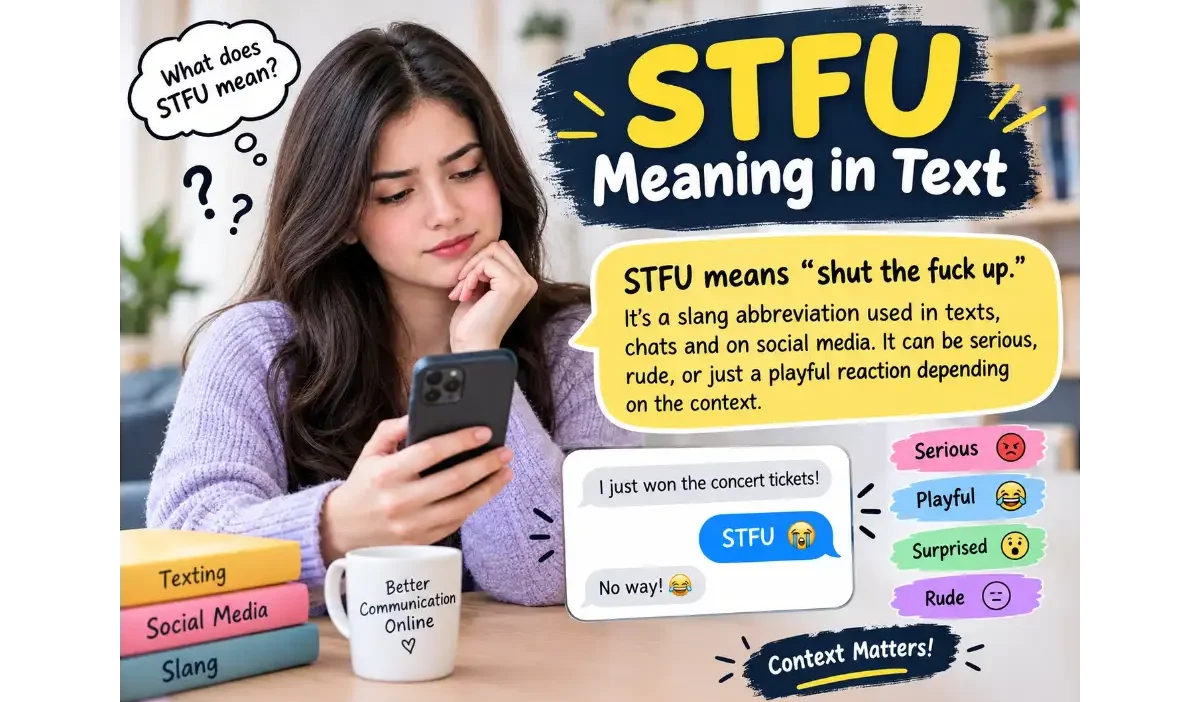
The most common meaning of STFU is “shut the fuck up.” It is a blunt and often rude way to tell someone to stop talking. However, friends sometimes use it jokingly when they are surprised, impressed, or teasing each other.
That is why context matters. A friend saying “STFU 😂” after you share surprising news may not be seriously telling you to be quiet. The same abbreviation from a stranger or during an argument can sound much more aggressive.
Quick Answer
STFU means “shut the fuck up.” It is used online and in texting to tell someone to stop talking or, depending on the context, to show strong surprise or disbelief.
It is usually informal and can be offensive because it contains a swear word. Friends may use it playfully, but you should be careful about using it with people you do not know well.
What Does STFU Mean?
1. “Shut the Fuck Up” — The Main Meaning
The overwhelming common meaning of STFU is “shut the fuck up.”
It is an abbreviation of a profanity-based phrase telling someone to stop talking. Because of the wording, STFU can sound angry, disrespectful, or aggressive.
For example:
Person 1: “You need to stop making excuses.”
Person 2: “STFU.”
Here, the person is clearly telling the other person to stop talking.
Tone: Rude, blunt, aggressive
Who uses it: Mostly people communicating casually online or through text
Example: “STFU and let me explain.”
The exact tone depends on the relationship between the people. Close friends may use it as a joke, while the same message from a stranger can feel insulting.
2. STFU Used as a Joke or Reaction
STFU is also commonly used between friends as an exaggerated reaction.
In this use, the person may not literally want you to stop talking. Instead, they may be expressing surprise, disbelief, excitement, or amusement.
For example:
Friend: “I just found out I won the concert tickets.”
You: “STFU 😭 No way!”
Here, STFU can mean something closer to “Seriously?!”, “No way!”, or “I can’t believe it!”
The meaning comes from the situation, punctuation, emojis, and relationship between the people.
Tone: Playful, surprised, teasing
Who uses it: Usually friends or people who already have a casual relationship
Example: “STFU 😂 You actually did it?”
This does not create a completely different dictionary meaning. It is still based on the original phrase, but the phrase is being used humorously rather than as a serious command.
Similar Terms to STFU
Shut up
“Shut up” is the non-abbreviated version without the extra swear word.
It can still sound rude, but the intensity depends heavily on the situation.
Example: “Shut up, you’re making me laugh.”
Between friends, this can be playful. During an argument, it can be disrespectful.
Be quiet
“Be quiet” is much more neutral.
It is appropriate in situations where someone genuinely needs to stop talking, although the tone can still sound firm.
Example: “Please be quiet while the movie is playing.”
Stop talking
“Stop talking” is direct but does not contain profanity.
It sounds more serious than “be quiet” but is generally less offensive than STFU.
Example: “Can you stop talking for a minute?”
GTFO
GTFO usually means “get the fuck out.”
It is different from STFU because it generally tells someone to leave or expresses strong disbelief.
For example, a friend might say:
“GTFO, you actually met him?”
In that context, it can be an exaggerated reaction rather than a literal demand to leave.
WTF
WTF usually means “what the fuck.”
It is generally used to express confusion, surprise, frustration, or disbelief.
For example:
“WTF just happened?”
Unlike STFU, it is not normally telling another person to stop talking.
STFU in Texting and Social Media
STFU is mainly seen in informal online communication.
You may come across it in:
- Text messages
- Group chats
- DMs
- Social media comments
- Online communities
- Gaming chats
People often write it in capital letters as STFU, but lowercase stfu is also common.
Emojis can change how the message feels. For example:
“STFU 😂” can sound playful.
“STFU.” can sound much more serious or hostile.
That does not mean an emoji automatically makes the phrase friendly. The surrounding conversation still matters.
How STFU Can Change With Context
With Friends
Among close friends, STFU can be used as teasing.
Friend: “I ate the whole pizza myself.”
You: “STFU 😂”
The speaker may be joking rather than genuinely demanding silence.
During an Argument
During an argument, STFU is much more likely to be understood literally.
Person 1: “You keep changing your story.”
Person 2: “STFU.”
In this setting, the phrase is confrontational.
At Work
STFU is generally not suitable for professional communication.
Even if you are joking with a coworker, the profanity can easily be misunderstood. A safer phrase would be “Could you please let me finish?” or “Please give me a moment to explain.”
In Dating or Personal Chats
The meaning depends on the relationship and conversation. There is no reason to assume STFU is automatically romantic, flirty, or insulting.
For example, someone might write:
“STFU 😂 You look amazing in that picture.”
Between people who already joke this way, it could be playful. With someone you barely know, it could easily come across as rude.
Real Examples of STFU in Conversations
Example 1: Genuine Anger
Alex: “You never listen to me.”
Sam: “STFU. I’m trying to explain.”
Here, STFU is being used aggressively.
Example 2: Surprise
Alex: “I got the job!”
Sam: “STFU 😭 Are you serious?”
Here, Sam is expressing surprise rather than literally demanding silence.
Example 3: Friendly Teasing
Alex: “I finished the whole assignment in 20 minutes.”
Sam: “STFU 😂”
The response is probably playful teasing if that matches their normal communication style.
Example 4: Disbelief
Alex: “She just bought a new car.”
Sam: “STFU. With what money?”
The phrase shows strong disbelief or surprise.
Example 5: Argument
Alex: “You’re the one who started this.”
Sam: “STFU and listen.”
This use is direct and hostile.
Example 6: Funny Story
Alex: “Then I accidentally sent the message to my boss instead of you.”
Sam: “STFU 😭😭”
The person is probably reacting with shock and amusement.
When You Should Not Use STFU
Avoid STFU in formal or professional situations.
That includes:
- Work emails
- Messages to your manager
- School assignments
- Customer service conversations
- Job applications
- Professional networking
- Messages to people you do not know well
Even if you intend it as a joke, the other person may read it as disrespectful.
Instead of:
“STFU, let me finish.”
You could say:
“Please let me finish.”
Or:
“Give me a moment to explain.”
These alternatives communicate the same basic idea without the profanity.
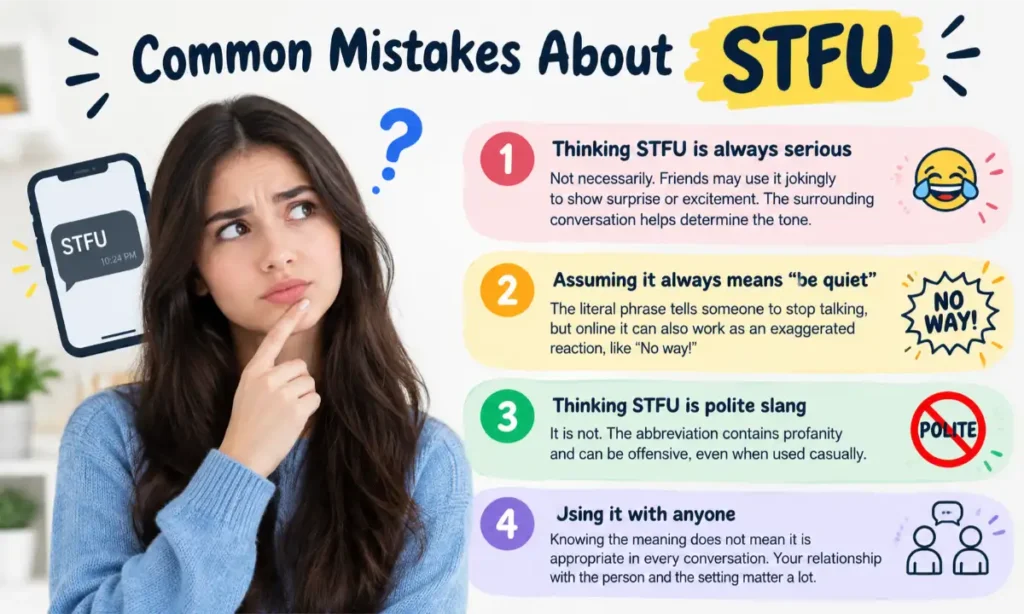
Common Mistakes About STFU
Mistake 1: Thinking STFU is always serious
Not necessarily. Friends may use it jokingly to show surprise or excitement.
The surrounding conversation helps determine the tone.
Mistake 2: Assuming it always means “be quiet”
The literal phrase tells someone to stop talking, but online it can also work as an exaggerated reaction.
For example, “STFU 😂” after surprising news may mean “No way!”
Mistake 3: Thinking STFU is polite slang
It is not. The abbreviation contains profanity and can be offensive.
Even when used casually, it is still a strong expression.
Mistake 4: Using it with anyone
Knowing the meaning does not mean it is appropriate in every conversation.
Your relationship with the person and the setting matter a lot.
How to Reply to STFU
Your response should depend on how the person used it.
If they are joking
You can respond casually:
- “😂 Why?”
- “You know I’m right.”
- “I knew you’d say that.”
- “Haha, seriously!”
If you are not sure what they mean
You can simply ask:
- “Are you joking?”
- “What do you mean by that?”
- “Why are you telling me to shut up?”
If they are being rude
You can stay direct without escalating:
- “You don’t have to talk to me like that.”
- “If you disagree, just say that.”
- “Let’s talk about it without being rude.”
FAQs About STFU Meaning in Text
What does STFU mean in texting?
STFU usually means “shut the fuck up.” It is an informal and sometimes rude way to tell someone to stop talking.
Is STFU rude?
Yes, it can be rude because it contains profanity. However, friends sometimes use it jokingly or as an exaggerated reaction.
Does STFU always mean shut up?
The phrase comes from “shut the fuck up,” but its use can be playful. In some conversations, it expresses surprise or disbelief rather than a literal command.
What does STFU mean from a girl or guy?
The meaning does not depend on whether the sender is a girl or a guy. Look at the conversation, relationship, and tone instead.
What does STFU 😂 mean?
“STFU 😂” often suggests a joking or surprised reaction, especially between friends. It can be similar to saying “No way!” or “Seriously?”
Is STFU a bad word?
STFU is an abbreviation containing the profanity “fuck.” It is therefore not suitable for many formal or professional situations.
What is a polite alternative to STFU?
You can say “please be quiet,” “please let me finish,” or “could you stop talking for a moment?” depending on what you mean.
Key Takeaways
- STFU most commonly means “shut the fuck up.”
- It can be serious, rude, playful, or sarcastic depending on context.
- Friends may use STFU to express surprise or disbelief.
- STFU is informal and contains profanity.
- Avoid it in professional or formal communication.
- The relationship and surrounding conversation often reveal the intended tone.
Conclusion
STFU is one of those internet abbreviations where the literal meaning and the intended meaning are not always exactly the same.
Its main meaning is “shut the fuck up,” but people also use it jokingly to react to surprising, funny, or unbelievable news. That is why looking at the full conversation matters.
If a close friend sends “STFU 😂,” they may simply be teasing you or saying they cannot believe what they just heard.
If someone sends “STFU” during an argument, the message is more likely to be a direct and rude command. Because it contains profanity, STFU is best kept to casual conversations where you know the tone will be understood.

I am Maxwell Ford, the creator of meaningosho.com, where I explore the origins and clear definitions of everyday words. I built this platform to help readers easily decode complex vocabulary and deepen their understanding of language. Through my articles, I love sharing simple, engaging insights that make learning new words both fun and useful.