
If you have seen AWL in a text, comment, or DM, it can be confusing because it is not one of the universally understood abbreviations like LOL, BRB, or IDK.
Current online references give several interpretations, including “all” as a spelling variation, “A Whole Lot,” and “Always With Love.” The important part is the sentence around it.
There is also a normal English word awl, meaning a small pointed tool used for making or starting holes. So before treating AWL as slang, check the context.
If someone writes “awl my friends,” they most likely mean “all my friends.” If they write “That means AWL to me,” they may be using it for “a whole lot.” AWL does not have one fixed meaning in texting.
Quick Answer
In casual texting, AWL does not have one universally accepted meaning. It may be a casual spelling of “all,” or in some online slang references, it can mean “A Whole Lot” or “Always With Love.” The sentence and conversation are the best clues.
What Does AWL Mean in Text?
Here are the meanings worth knowing, ranked by how safely they can be interpreted from context.
1. AWL = “All” — Usually a Spelling Variation
When awl appears where all would normally fit, it is usually best understood as a spelling variation or typo rather than a special acronym.
For example:
“AWL my friends are coming tonight.”
This naturally reads as:
“All my friends are coming tonight.”
Another example:
“I love awl of you.”
Here, awl almost certainly means all.
This happens because awl and all sound the same in ordinary English pronunciation. The word “awl” itself is real English, but in a casual message, the intended word may simply be “all.”
Tone: Casual
Who uses it: Anyone who types informally, though it is not standard spelling
Best clue: Replace “awl” with “all.” If the sentence suddenly makes perfect sense, that is probably what the sender meant.
2. AWL = “A Whole Lot”
Some texting references use AWL as shorthand for “A Whole Lot.” This meaning works best when the sentence is about quantity, intensity, or how strongly someone feels about something.
For example:
“That helped me AWL.”
Meaning:
“That helped me a whole lot.”
Or:
“I miss you AWL.”
Meaning:
“I miss you a whole lot.”
This use is informal, and it is not something every texter will recognize automatically.
Tone: Casual and sometimes emotional
Who uses it: People who already know or use the abbreviation
Best clue: If replacing AWL with “a whole lot” makes the sentence sound natural, this may be the intended meaning.
3. AWL = “Always With Love”
Another interpretation found in current online texting references is “Always With Love.” It is generally presented as a warm sign-off or affectionate phrase.
For example:
“Take care of yourself. AWL ❤️”
The sender may mean:
“Take care of yourself. Always with love.”
However, this meaning should not automatically be assumed whenever someone sends AWL. It is less universal than common abbreviations, and many people may not recognize it.
Tone: Warm and affectionate
Who uses it: People using personal or expressive shorthand
Best clue: It often appears near the end of a caring message.
4. “Awl” as a Normal English Word
There is one more important meaning that has nothing to do with texting slang.
An awl is a pointed hand tool used to pierce or start holes in materials such as leather, wood, or fabric.
For example:
“I need an awl to make a hole in this leather.”
Here, there is no slang involved.
So if the conversation is about crafting, leatherworking, woodworking, sewing, or tools, “awl” may simply be the ordinary English noun.
Similar Terms to AWL
Because AWL is unclear, it helps to compare it with more familiar expressions.
All
All is the normal English word for referring to the whole group or amount.
“All my friends are here.”
If someone writes “awl my friends,” they probably intended this word.
A Whole Lot
This is a normal phrase meaning a lot or to a great extent.
“That means a whole lot to me.”
It is clearer than using AWL because everyone understands the full phrase.
Always With Love
This is a warm phrase used as a sign-off.
“Take care. Always with love.”
It sounds more personal than simply saying “take care.”
Aww
Aww is a common reaction to something cute, sweet, touching, or sympathetic.
“Aww, that’s so sweet!”
Do not automatically assume that AWL means “aww.” Some online references suggest stylized spellings such as this, but the meaning is not standardized.
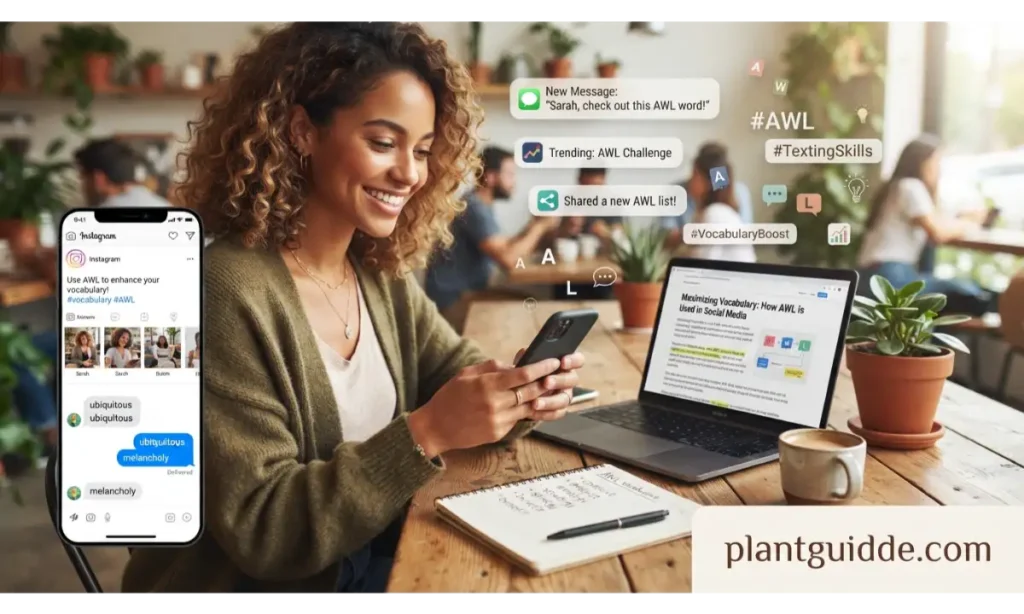
How AWL Is Used in Texting and Social Media
AWL is not as universally recognized as LOL, OMG, BRB, IDK, or TBH. Current online references disagree about its primary texting meaning, which is a good reason to rely on context rather than treating AWL as a fixed piece of slang.
You may come across it in:
- Private text messages
- Group chats
- Instagram DMs or comments
- Snapchat conversations
- Other casual online chats
The important thing is that capital letters do not automatically create a different meaning. “AWL” and “awl” can require completely different interpretations depending on the sentence.
AWL Meaning in Different Contexts
With Friends
If a friend writes:
“AWL my friends are coming.”
The most likely reading is “all my friends.”
If they write:
“That helped me AWL.”
They may mean “a whole lot.”
In Dating or Personal Chats
Context becomes even more important in personal conversations.
For example:
“I miss you AWL.”
This could be intended as “I miss you a whole lot.”
But you should not assume that AWL automatically proves romantic interest. The full conversation matters more than three letters.
At Work
AWL is generally not a good choice when you need to communicate clearly at work. If you mean “all,” “a whole lot,” or “always with love,” simply write the phrase out.
AWL Meaning in Real Text Conversations
Example 1: Likely “All”
Sam: “Are awl of you coming tonight?”
Alex: “Yep, we’ll be there at 8.”
Here, awl = all.
Example 2: “A Whole Lot”
Mia: “Did the advice help?”
Sara: “Yes, AWL. I really needed that.”
Here, AWL may mean “a whole lot.”
Example 3: “All”
Jake: “I miss awl my old school friends.”
Tom: “Same. Those were good days.”
Again, awl is best understood as a spelling variation of all.
Example 4: “Always With Love”
A: “Hope everything goes well tomorrow. AWL ❤️”
B: “Thank you. That means a lot.”
Here, AWL could mean “Always With Love.”
Example 5: Tool
A: “What are you working on?”
B: “A leather project. I need an awl.”
Here, awl is the actual hand tool, not texting slang.
Example 6: Asking for Clarification
A: “AWL?”
B: “Do you mean ‘all’ or ‘a whole lot’?”
This is a perfectly reasonable response when the context does not make the meaning clear.
When Not to Use AWL
Avoid AWL when you are writing something formal or when you need your meaning to be immediately clear.
For example, do not write:
“AWL employees must attend.”
Instead, write:
“All employees must attend.”
Likewise, instead of:
“That helped me AWL.”
write:
“That helped me a whole lot.”
Clear writing is usually better than an abbreviation that your reader may not understand.
Common Mistakes About AWL
1. Thinking AWL has one official slang meaning
It does not. Online references give different interpretations, so context matters.
2. Assuming AWL always means “Always With Love”
That is one reported use, but it is not universally recognized.
3. Treating every “awl” as slang
Sometimes it simply means the pointed tool called an awl.
4. Assuming it has romantic meaning
A message containing AWL alone is not enough to establish romantic intent. Look at the surrounding conversation.
How to Reply to AWL
If you understand the intended meaning, simply respond normally.
If it means “all”:
“Yep, all of us are coming.”
If it means “a whole lot”:
“Aww, I’m glad I could help!”
If you’re unsure:
“What do you mean by AWL?”
Or keep it casual:
“AWL as in ‘all’?”
Asking is better than confidently guessing when the message could have several meanings.
FAQs About AWL Meaning in Text
What does AWL mean in texting?
AWL has no single universal texting meaning. Depending on context, it may be a spelling variation of “all” or shorthand for expressions such as “A Whole Lot” or “Always With Love.”
Is AWL a slang word?
AWL can be used informally online, but it is not a standardized texting abbreviation that everyone understands.
Does AWL mean “all”?
It can. When “awl” appears in a sentence where “all” makes grammatical and contextual sense, it is likely a typo or casual spelling variation.
Does AWL mean “A Whole Lot”?
Some online texting references use AWL for “A Whole Lot.” This interpretation works best when the sentence is about degree or intensity.
Does AWL mean “Always With Love”?
It can be used that way, especially as a warm sign-off, but this meaning is not universally understood.
Is “awl” a real English word?
Yes. An awl is a pointed hand tool used to make or start holes in materials such as leather and wood.
How do I know what AWL means in a message?
Read the complete sentence. If “all,” “a whole lot,” or “always with love” fits naturally, that gives you the strongest clue. If none fits, ask the sender.
Key Takeaways
- AWL has no single universal texting meaning.
- It can be a casual spelling of “all.”
- Some people use it for “A Whole Lot.”
- “Always With Love” is another reported informal use.
- Lowercase awl can also mean a real pointed hand tool.
- Always use the full sentence and context to work out what the sender intended.
Conclusion
The meaning of AWL in text depends on how it is used. In many casual messages, “awl” is simply a spelling variation or typo for “all.” Some people also use AWL as shorthand for “A Whole Lot” or “Always With Love,” but these meanings are not universally understood.
The word can also refer to a real hand tool when the conversation is about leather, wood, or crafts. That is why you should not assign one meaning to AWL every time you see it.
Look at the words around it and the subject of the conversation. If the meaning still is not clear, asking the sender is the safest and simplest option.

I am Maxwell Ford, the creator of meaningosho.com, where I explore the origins and clear definitions of everyday words. I built this platform to help readers easily decode complex vocabulary and deepen their understanding of language. Through my articles, I love sharing simple, engaging insights that make learning new words both fun and useful.