You get a message saying, “dw, you’re good 😭”, and suddenly you’re wondering whether the person is being reassuring, dismissive, or talking about something completely different.
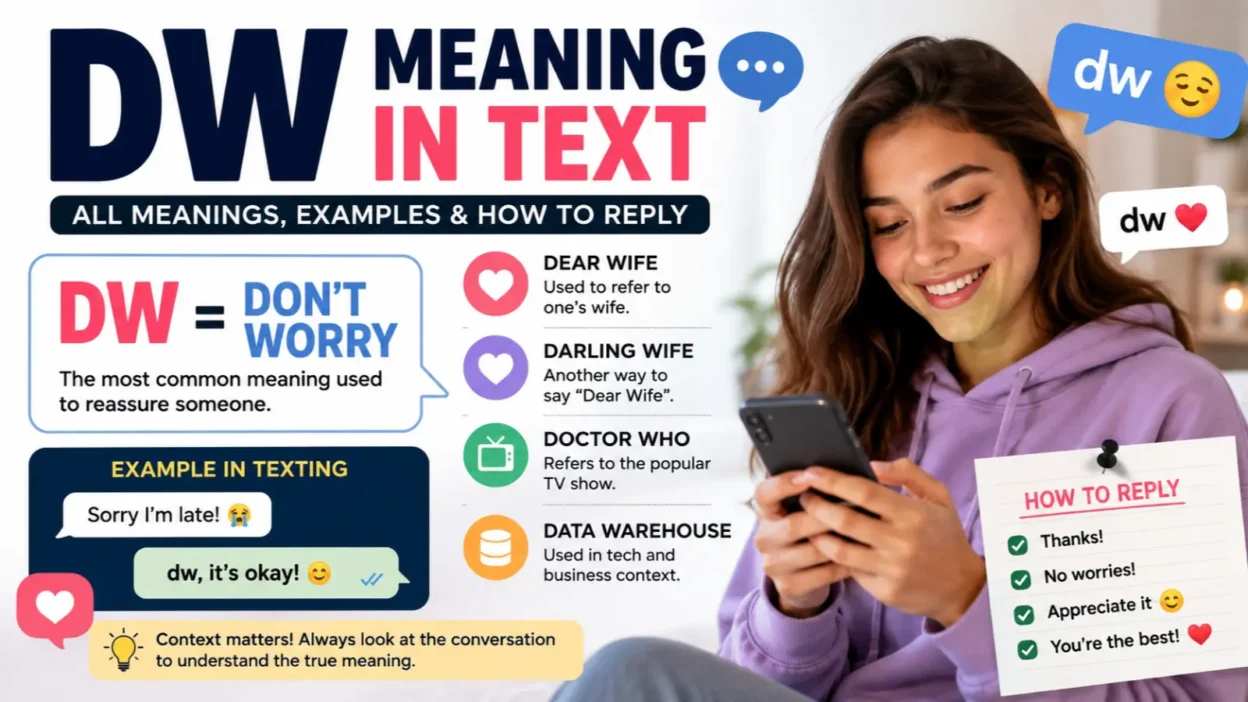
That is exactly why people search for DW meaning in text. In most casual conversations, DW means “Don’t Worry.” But context can change the meaning. It can also stand for “Dear Wife” or “Darling Wife” in relationship and family discussions, while completely different meanings can appear in technical, entertainment, or fandom contexts.
A simple example:
A: “Sorry, I forgot to send the file 😭”
B: “dw, send it whenever you can.”
Here, DW = Don’t Worry. The sender is trying to lower the emotional pressure and tell the other person that the mistake is not a big deal.
Quick Definition & Meanings
DW most commonly means “Don’t Worry” in texting, DMs, comments, and casual online conversations. It works as a quick reassurance, especially when someone is apologizing, stressing, or feeling guilty.
However, DW has more than one meaning, so you should always look at the surrounding conversation.
1. DW = Don’t Worry
This is by far the most relevant meaning in everyday texting.
People use it to reassure someone, reduce anxiety, accept an apology, or communicate that a situation is under control.
Example:
“Sorry I’m running late.”
“dw, I’m still getting ready.”
Here, the emotional message is essentially: “It’s okay. You don’t need to stress about it.”
Similar expressions include:
- Don’t stress
- No worries
- It’s okay
- You’re good
- No problem
- It’s all good
- Nothing to worry about
- Don’t sweat it
2. DW = Dear Wife
In relationship, family, forum, or marriage-related conversations, DW can mean “Dear Wife” or “Darling Wife.” This use is much less common in ordinary texting than “Don’t Worry.” Oxford also lists “darling wife/dear wife” as an informal meaning used in texts and social media.
Example:
“My DW made an amazing dinner tonight.”
Here, DW clearly refers to the writer’s wife, not “Don’t Worry.”
The context gives it away because “my DW” is describing a person.
3. DW = Darling Wife
Some people use DW as a variation of Dear Wife, particularly in older online communities, family discussions, or relationship forums.
Example:
“My DW and I are planning a vacation.”
Again, the surrounding words make the meaning obvious.
This meaning is relatively niche compared with “Don’t Worry.”
4. DW = Doctor Who
In entertainment or fandom conversations, DW can refer to the British science-fiction franchise Doctor Who.
For example:
“Are you watching DW tonight?”
If the conversation is about TV shows, the person probably isn’t telling you not to worry.
This is why acronyms should never be decoded in isolation.
5. DW = Data Warehouse
In technology, analytics, databases, and business conversations, DW can mean data warehouse.
For example:
“The data has already been moved into the DW.”
Here, the abbreviation has nothing to do with texting slang.
This illustrates an important rule: meaning comes from context, not just the letters themselves.
How DW Works in Texting & Messaging
The interesting thing about DW isn’t simply what the letters stand for. It’s what the abbreviation does socially.
When someone writes:
“dw”
They’re often trying to make the conversation lighter.
Instead of typing:
“Please don’t worry about this. It’s completely fine, and you don’t need to feel bad.”
they can type:
“dw”
Two letters accomplish the same basic emotional function with much less effort.
That efficiency is one reason abbreviations work so well in digital communication. Research into internet slang has shown that online communication creates social and linguistic patterns that differ from conventional written language
DW in Private Texts
Between friends, DW often feels relaxed and familiar.
“I might be 20 mins late.”
“dw 😂”
The emoji matters.
1 “dw 😂” can feel warm and playful.
2 “DW.” can feel more neutral.
3 “dw…” might even feel slightly uncomfortable depending on what happened before it.
DW in Group Chats
Group chats create another layer.
Someone might say:
“Sorry everyone, I completely messed that up.”
Another person replies:
“dw lol”
The short response can signal that the group isn’t interested in making the mistake a bigger issue.
DW With Read Receipts and Response Timing
Digital communication has another psychological layer: timing.
If someone normally sends detailed messages but suddenly responds with only:
“dw”
you may interpret it differently.
The abbreviation itself hasn’t changed. Your perception has.
A short message after a long emotional conversation can feel dismissive. A short message during an ordinary casual exchange can feel perfectly friendly.
That is why DW is not automatically warm or cold. The relationship, timing, punctuation, previous messages, and emotional situation all contribute to the interpretation.
Origin, Evolution & Social Media Spread
“Don’t worry” is obviously much older than texting. What changed with digital communication was the ability to compress familiar phrases into short abbreviations.
As texting, instant messaging, forums, and social platforms became everyday communication spaces, users developed increasingly efficient ways to express common ideas.
Abbreviations such as:
- DW — Don’t Worry
- IDK — I Don’t Know
- TBH — To Be Honest
- BTW — By The Way
- IMO — In My Opinion
- NVM — Never Mind
- FYI — For Your Information
became part of informal online communication.
The spread of social media accelerated this process because users constantly encounter expressions outside their own friend groups. A phrase that starts in one online community can quickly become recognizable elsewhere.
Academic research on internet slang has found that social networks and other digital environments have helped slang develop distinctive patterns and spread across online communities.
But there is an important misconception: not every internet abbreviation belongs to one specific generation, platform, or subculture.
People borrow language.
They adapt to it.
They shorten it.
And sometimes they stop using it.
That’s how digital slang evolves.
Real-Life Conversations
WhatsApp / iMessage Chat
Person A:
“Sorry I didn’t reply earlier. My phone died.”
Person B:
“dw, you’re fine.”
What it means:
The second person is reassuring the first person that they don’t need to apologize.
Another Example
A:
“I think I sent the wrong screenshot 😭”
B:
“DW 😂 nobody noticed.”
Here, DW reduces embarrassment while the laughing emoji makes the response playful.
Instagram DM
A:
“I thought you were mad at me.”
B:
“dw 😭 I was just busy.”
The abbreviation softens the conversation before the sender explains what actually happened.
TikTok Comment
Commenter:
“Sorry but I totally misunderstood the video.”
Reply:
“dw lol”
Here, DW functions almost like “No worries.”
Public Thread
User 1:
“Wait, I completely missed that detail.”
User 2:
“dw, I didn’t notice it either 😂”
The response creates a sense of shared understanding rather than judgment.
Why Choose DW Instead of “Don’t Worry”?
Because digital language is not only about saving characters.
It also communicates social energy.
“Don’t worry” sounds complete and deliberate.
“DW” sounds faster, lighter, and more casual.
That’s why abbreviations can sometimes feel more natural among people who already share the same communication style.
Psychological & Emotional Dynamics of DW
A tiny abbreviation can carry surprisingly different emotional signals.
Reassurance
The most straightforward function is emotional reassurance.
“dw, everything’s okay.”
The sender is reducing perceived threat or pressure.
Emotional Softening
DW can make potentially uncomfortable conversations feel less formal.
Compare:
“Don’t worry about it.”
with:
“dw lol”
The second feels more conversational and digitally native.
Social Belonging
Using common internet abbreviations can also signal familiarity with a particular communication style.
Someone who understands:
“dw, you’re good”
doesn’t need the abbreviation explained.
That shared understanding creates a small sense of social belonging.
Emotional Distance
There is another side.
Sometimes DW can feel dismissive.
Imagine someone says:
“I’m really worried about what happened.”
and receives:
“dw.”
The person might feel unheard.
The sender may intend reassurance, but the receiver may interpret the message as “Stop worrying” rather than “I understand why you’re worried.”
That’s an important distinction.
Reassurance addresses emotion. Dismissiveness shuts emotion down.
The same two letters can accidentally do either.
Contextual Usage Guidelines
Social Media vs. Private Texts
On TikTok, Instagram, Snapchat, Reddit, or casual messaging, DW generally fits informal communication.
It’s especially natural when the surrounding conversation is already casual.
Close Friends
With close friends, you can usually use:
“dw 😂”
or
“dw you’re good”
without much risk of sounding strange.
Shared communication habits make short expressions easier to interpret.
Casual Acquaintances
With someone you barely know, consider using:
“No worries!”
instead of only:
“dw”
A complete phrase can sound warmer and more universally understandable.
Professional Environments
Avoid relying on DW in formal emails, job applications, reports, client communication, or important workplace messages.
Instead of:
“DW, I’ll handle it.”
write:
“No worries, I’ll take care of it.”
The second version is clearer and more professional.
Match the Energy
One of the simplest rules for internet communication is:
Match the emotional energy of the conversation.
If someone is joking, DW can be playful.
If someone is genuinely distressed, DW may need an explanation attached.
For example:
“dw, I understand why you’re stressed. We’ll figure it out.”
That is much more emotionally supportive than simply:
“dw.”
When NOT to Use DW & Common Misconceptions
Don’t Use It to Shut Down Serious Feelings
If someone is discussing grief, conflict, anxiety, or a major personal problem, a two-letter response may feel insensitive.
Try:
“I understand. Take your time.”
or:
“You’re okay. I’m here if you want to talk.”
Don’t Assume DW Always Means “Don’t Worry”
If someone writes:
“My DW is picking us up.”
they probably mean Dear/Darling Wife.
Context matters.
Don’t Assume It Is Always Friendly
“DW” usually has a reassuring intention, but short digital messages can sound blunt.
Compare:
“dw ❤️”
“dw haha”
These can produce noticeably different emotional impressions.
Don’t Treat It as a Formal Abbreviation
DW belongs primarily to informal communication when it means “Don’t Worry.” It isn’t appropriate for every audience or setting.
DW vs. Similar Expressions
| Expression | Primary Meaning | Tone | Best Usage Context |
| DW | Don’t worry | Casual, quick | Texts, DMs, group chats |
| NWS / NW | No worries | Casual, reassuring | Friends and informal messages |
| NP | No problem | Casual, neutral | Replies to apologies or requests |
| It’s okay | Reassurance/acceptance | Warm, direct | Personal conversations |
| Don’t stress | Stop worrying | Friendly, encouraging | Casual supportive chats |
The distinctions are subtle. DW is particularly compact, while “it’s okay” sounds more emotionally explicit. “No problem” often responds to an apology or request, while “don’t stress” directly addresses someone’s anxiety.
Variations, Derivatives & Ways to Respond
You may see DW written in several styles:
- dw
- DW
- dw lol
- dw 😂
- dw you’re good
- dw about it
- dw, it’s fine
- dww — playful stretching of the abbreviation
- dwai — sometimes used as shorthand for “don’t worry about it”
The exact form depends on someone’s personal texting style.
Casual Replies
If someone sends you:
“dw, it’s fine”
you can reply:
- “Okayyy 😂”
- “Appreciate you”
- “Thanks 😭”
- “Good looks”
- “You’re the best”
- “Haha okay”
Funny or Sarcastic Replies
For a playful conversation:
“DW, I got this.”
You could respond:
- “Famous last words 😂”
- “That sounds suspicious 😭”
- “You better”
- “I’m choosing to believe you 💀”
Mature or Direct Replies
When the situation is more serious:
- “Thanks, I appreciate that.”
- “I really appreciate your understanding.”
- “Thank you. I was overthinking it.”
- “That actually makes me feel better.”
And if you want to use DW yourself:
“dw, you don’t need to apologize.”
That’s probably the most natural everyday use.
Generational & Regional Perspectives
People don’t all interpret internet slang in exactly the same way.
Gen Z
Younger internet users are generally more accustomed to compressed digital language, although even within Gen Z, usage varies significantly by friend group, platform, country, and personal style.
Some people use dw constantly.
Others understand it perfectly but rarely type it.
Millennials
Millennials who grew up with texting, instant messaging, forums, and early social media may recognize DW easily, particularly in informal conversations.
However, usage varies widely.
Older Audiences
Someone who doesn’t regularly use texting abbreviations may understand “don’t worry” immediately but pause at “dw.”
That doesn’t mean the expression is universally new. It simply means digital shorthand isn’t equally familiar to every generation.
Interestingly, community discussions show significant variation even among native English speakers: some people describe DW as extremely common in informal texting, while others rarely encounter it.
Global Internet Culture
English-language internet slang travels far beyond English-speaking countries.
Non-native English speakers often encounter abbreviations through TikTok, Instagram, gaming, YouTube comments, Discord, and international messaging.
This can create an interesting language-learning effect: users learn digital English alongside traditional English.
Someone may understand:
“dw, you’re good”
long before they encounter the same phrase in a formal English lesson.
FAQs About DW Meaning in Text
What does DW mean in text?
DW most commonly means “Don’t Worry.” People use it to reassure someone, reduce stress, or respond casually to an apology or concern.
What does DW mean from a girl or guy?
Usually, DW means “Don’t Worry” regardless of who sends it. The sender’s gender doesn’t automatically change its meaning. Context determines whether it is reassuring, casual, playful, or potentially dismissive.
Is DW rude?
Not usually. DW is generally casual and reassuring, but replying only “dw” to someone discussing a serious emotional issue can feel dismissive because the response is extremely brief.
What does DW mean on TikTok?
On TikTok and similar social platforms, DW generally means “Don’t Worry” when it appears in comments, captions, replies, or casual conversations. Other meanings are possible depending on the topic.
What does DW mean in a relationship?
In ordinary relationship texting, DW usually means “Don’t Worry.” In marriage or family-related discussions, it can also mean “Dear Wife” or “Darling Wife.”
How do you reply to DW in text?
You can respond casually with “thanks,” “okay,” “appreciate you,” or “you’re good too.” If the conversation is emotional, a more direct response such as “Thanks, I really appreciate that” works better.
Final Takeaway: What Does DW Really Mean?
When you’re trying to understand DW meaning in text, start with the simplest interpretation: DW usually means “Don’t Worry.”
It is a compact way to reassure someone, accept an apology, lower tension, or keep a conversation moving without making the exchange feel overly formal.
But DW has other meanings, especially “Dear Wife” or “Darling Wife,” and context can also turn the abbreviation into a reference to entertainment, technology, or another specialized subject.
The bigger lesson is that internet slang isn’t just about abbreviations. It’s about social signals.
1 “DW ❤ ️” can feel comforting.
2 “dw lol” can feel playful.
3 “DW.” can feel abrupt.
And “Don’t worry, I understand” can feel deeply supportive.
The letters stay the same. The relationship, timing, punctuation, and emotional context change the meaning.
That is what makes modern digital language so interesting: sometimes two letters aren’t just saving time—they’re carrying an entire tone of voice.

I am Maxwell Ford, the creator of meaningosho.com, where I explore the origins and clear definitions of everyday words. I built this platform to help readers easily decode complex vocabulary and deepen their understanding of language. Through my articles, I love sharing simple, engaging insights that make learning new words both fun and useful.