You check your phone after a terrible morning. Your alarm failed, you missed the bus, your coffee spilled on your shirt, and then your boss moved an important meeting to the exact time you had planned to leave.
Your friend asks, “How’s your day going?”
You reply:
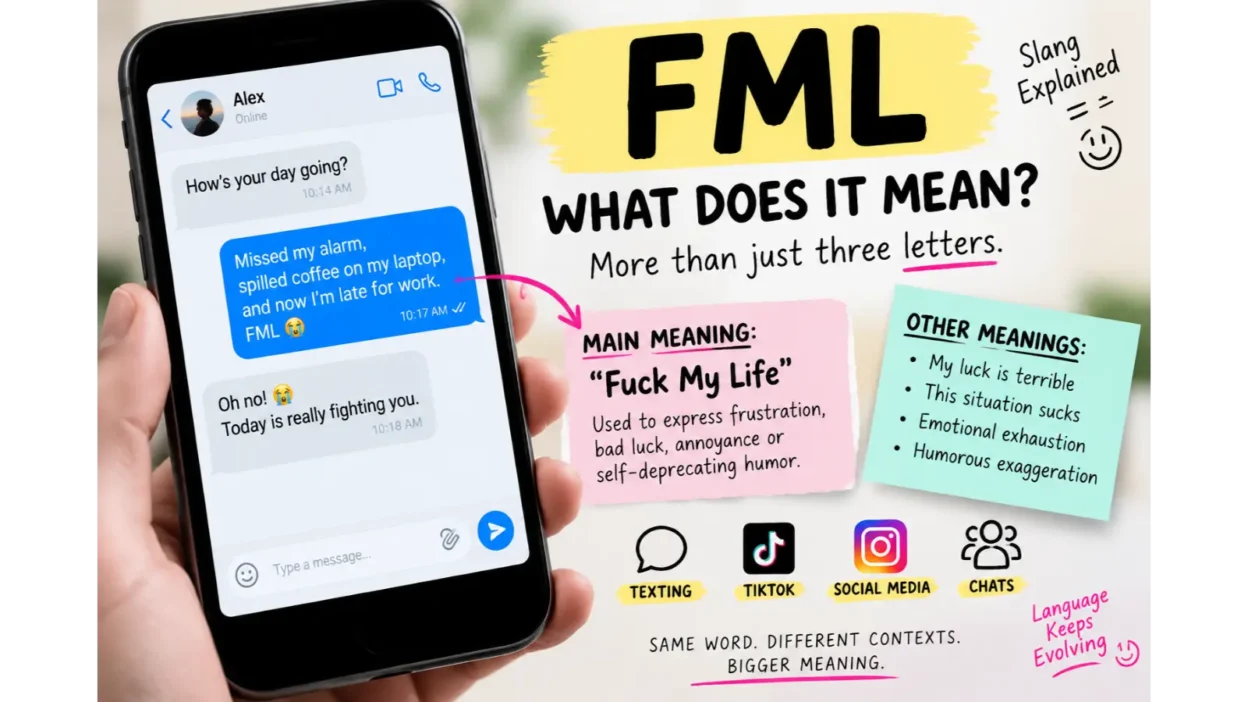
You: Missed my alarm, spilled coffee on my laptop, and now I’m late for work. FML 😭
Friend: Nahhh 😭 today is fighting you.
That tiny three-letter response can communicate an entire emotional paragraph. FML meaning in text is most commonly “fuck my life,” a vulgar internet expression used to show frustration, annoyance, disappointment, bad luck, or humorous self-pity.
Cambridge Dictionary and Merriam-Webster both identify “fuck my life” as the standard slang meaning, while noting that it is informal or offensive.
But FML is not always a serious statement about someone’s life. In modern online communication, people often use it playfully after minor disasters, awkward moments, inconvenient timing, embarrassing mistakes, or an unlucky sequence of events.
That distinction matters.
Someone typing “FML” after failing a difficult exam may genuinely be upset. Someone wrote “Forgot my headphones at home. FML” may simply be joking about a small inconvenience.
The letters stay the same. The emotional meaning changes with context.
Quick Definition & Meanings
1. FML Means “Fuck My Life”
This is the dominant slang meaning of FML in texting and social media.
People use it as an emotional reaction when something goes badly or when they feel frustrated by an unfortunate situation.
Example:
“My phone died right before I was about to order my Uber. FML.”
The speaker is basically saying, “This is so frustrating” or “I cannot believe this happened to me.”
Cambridge describes FML as an offensive written abbreviation used when something bad or unlucky happens.

2. FML Can Mean “My Luck Is Terrible”
In casual conversation, FML often functions less like a literal sentence and more like an exaggerated way of saying:
“Why does this always happen to me?”
“I have terrible luck.”
“Of course this would happen today.”
For example:
“The one day I forget my umbrella is the day it rains. FML.”
The speaker is not necessarily making a profound statement about life. They are dramatizing their bad luck for comic effect.
3. FML Can Express Frustration
Sometimes the term focuses on irritation rather than bad luck.
“I spent three hours fixing the file and accidentally deleted the final version. FML.”
Here, FML communicates immediate frustration and disbelief.
A longer version might sound like:
“I cannot believe I just did that.”
FML simply compresses the emotional reaction into three letters.
4. FML Can Be Used Humorously
One of the most important modern nuances is humor.
Internet users often exaggerate ordinary problems and add FML as a punchline.
“My pizza delivery was five minutes late. FML.”
Clearly, the situation is probably not life-changing. The expression is intentionally dramatic.
This kind of exaggeration is part of internet humor: a small inconvenience gets treated like a cinematic tragedy.
5. FML Can Show Self-Deprecating Humor
People sometimes use FML when they are laughing at their own mistakes.
“I walked into the wrong classroom and sat there for ten minutes. FML.”
The speaker is embarrassed, but the slang makes the story lighter.
Instead of saying:
“I feel embarrassed about what just happened.”
They use a culturally familiar shorthand that says:
“That was painfully stupid, and I know it.”
6. FML Can Signal Emotional Exhaustion
The expression can carry more weight when the surrounding situation involves several problems.
“Lost my job, my car broke down, and my landlord just called. FML.”
In this context, FML can suggest genuine emotional overwhelm rather than casual joking.
This is why reading the surrounding conversation matters. Three letters do not tell you how serious the situation is by themselves.
7. FML Can Be a Sarcastic Punchline
FML is also useful for sarcasm.
“Finally cleaned my room and immediately spilled coffee everywhere. FML.”
The speaker may be annoyed, but the phrasing is deliberately theatrical.
The humor comes from recognizing the absurdity of the situation.
8. FML Can Mean “This Situation Is Awful”
Sometimes the focus is not literally the person’s entire life.
“Four assignments due tomorrow. FML.”
In everyday texting, the expression usually means:
“This situation sucks.”
It is an emotional shortcut rather than a precise philosophical statement.
9. FML Can Refer to FMyLife
There is another important cultural connection: FMyLife.com, a website built around user-submitted stories about everyday misfortunes.
The site’s own FAQ says its concept began in France with an IRC channel and later developed into a microblog in January 2008; the English-language FMyLife site followed in 2009. User-submitted stories traditionally begin with “Today…” and end with “FML.”
So when someone references “an FML” in a historical internet-culture context, they may be talking about the website or the site’s style of sharing unfortunate stories.
10. Other Expansions Exist, but They Are Not the Normal Texting Meaning
FML appears in other contexts as an acronym, abbreviation, song title, organization name, technical term, and other proper names.
You may occasionally encounter playful reinterpretations such as “fix my life” or other euphemistic expansions. Wiktionary records euphemistic variants including “fix my life,” “funk my life,” and “forget my life.” These are adaptations rather than the dominant slang definition.
Likewise, “Family and Medical Leave” belongs primarily to workplace/legal terminology associated with the Family and Medical Leave Act (FMLA) in the United States. FMLA is the standard legal abbreviation, not the normal meaning of FML in a casual text.
So if a friend texts:
“Missed my flight. FML.”
They almost certainly are not discussing employment law.
FML Meaning in Texting & Messaging
In private messages, FML works as what linguists might describe as a highly compressed emotional signal. Instead of explaining an entire reaction, the sender gives the recipient a recognizable emotional label.
Compare:
“I am really frustrated because everything seems to be going wrong today.”
with:
“FML.”
The second message requires more shared cultural knowledge, but it communicates the mood much faster.
FML After a Bad Event
This is probably the most familiar pattern.
“Just got a parking ticket. FML.”
The event comes first. FML provides the reaction.
FML at the End of a Longer Story
A sender may describe a sequence of unfortunate events:
“Went to the store, forgot my wallet, came back, then realized I left my keys inside. FML.”
Here, FML acts like the final punchline.
FML as a Standalone Message
Sometimes the recipient already knows what happened.
You: FML
Friend: What happened now? 💀
In that exchange, FML creates curiosity without explaining the story.
The recipient understands that something went wrong and asks for the details.
FML in Group Chats
Group chats often make the expression more playful.
Alex: I have three deadlines tomorrow.
Sam: Four.
Jordan: Five.
Alex: FML 😭
The acronym becomes a shared reaction.
Everyone understands the emotional shorthand without needing a formal explanation.
FML and Read Receipts
Texting culture is not only about vocabulary. Timing matters too.
A rapid:
“FML 😭😭😭”
can communicate immediate emotional distress or exaggerated frustration.
A delayed:
“fml lol”
may feel more reflective, ironic, or casually humorous.
Capitalization can also influence the vibe.
FML can look emphatic.
film often feels softer or more casual.
FML 😭 feels emotionally expressive.
fml 💀 often signals humor.
These aren’t strict rules. They are social cues that users interpret together with the surrounding conversation.
The Origin, Evolution & Social Media Spread of FML
FML belongs to the broader family of internet abbreviations created to express complicated emotions quickly.
Dictionary.com records a May 13, 2005 Urban Dictionary entry as an early known instance of FML meaning “fuck my life,” while noting that the origin of the expression itself is uncertain. The phrase became more visible in popular culture during the late 2000s, including a use in the 2007 film Superbad.
Then came a major cultural accelerator: FMyLife.
According to the site’s own history, the concept began in France as VDM, short for Vie de merde, roughly “life of shit.” The project developed from an IRC community into a microblog in early 2008 and later became FMyLife.com.
Know Your Meme similarly traces the popularization of FML through the FMyLife format and notes the acronym’s rapid spread online during the late 2000s.
This format was almost perfectly designed for early social media:
Today, something went wrong.
Here is the embarrassing or unlucky story.
FML.
1 It was short.
2 It was anonymous.
3 It was relatable.
4 It was easy to share.
And most importantly, readers could recognize themselves in someone else’s minor disaster.
From Blogs to Social Platforms
Internet slang rarely stays inside one community.
An expression can move from a website to forums, from forums to social media, from social media to messaging apps, and eventually into everyday informal speech.
FML followed this wider pattern.
By the early 2010s, it appeared in meme culture and other social-media spaces. Later generations inherited the term and adapted its tone. The expression became increasingly flexible, appearing not only after genuinely frustrating experiences but also after trivial inconveniences used for comic exaggeration.
That flexibility helps explain why FML has remained recognizable even as platforms and online habits have changed.
Real-Life Conversations
WhatsApp / iMessage Chat
Example 1: Missing an Appointment
Maya: I left the house early for my appointment.
Nina: Nice.
Maya: Forgot my wallet and had to turn around.
Nina: 😭
Maya: Now I’m 20 minutes late. FML.
Here, FML means “This could not have gone worse.”
Example 2: Tech Disaster
Leo: I finally finished my presentation.
Chris: Let’s gooo.
Leo: My laptop restarted before I saved it.
Chris: NOOOO.
Leo: FML 💀
The skull emoji pushes the message toward dark humor rather than serious despair.
Instagram DM
A: Your flight okay?
B: Delayed six hours.
A: Seriously??
B: Yep. FML.
The sender does not need to explain that they are frustrated. The emotional context is already obvious.
TikTok Comment
Imagine a TikTok showing someone spending an hour getting ready only to discover the event was canceled.
A viewer might comment:
“Got ready for nothing 😭 FML.”
This is partly empathy and partly comedy.
The commenter is borrowing the video’s situation and giving it an exaggerated emotional reaction.
Public Thread
“Studied all night for the test and the teacher postponed it five minutes before class. FML.”
In a public thread, the phrase creates instant emotional identification. Other readers who have experienced similar situations can respond with jokes, sympathy, or their own stories.
Why People Choose FML Instead of Formal Language
Slang works because it is socially efficient.
A formal sentence explains an emotion.
A slang expression performs that emotion.
“FML” can sound funnier, more spontaneous, more dramatic, and more culturally familiar than “I am experiencing considerable frustration.”
That is especially useful in online environments where people communicate through short messages, reactions, emojis, GIFs, memes, and fragments.
The acronym also creates emotional distance.
Someone can admit:
“Today is going terribly.”
without writing a serious emotional paragraph.
That combination of honesty and humor is one reason internet slang can feel psychologically comfortable.
Psychological & Emotional Dynamics Behind FML
FML is not just vocabulary. It can function as a tiny piece of emotional theater.
Humor as Emotional Armor
People frequently turn frustration into a joke because humor can make an uncomfortable experience easier to share.
Saying:
“I ruined dinner. FML 😂”
can communicate both disappointment and self-awareness.
The humor does not necessarily erase the frustration. It changes how the frustration is presented.
Self-Awareness
Using FML can signal:
“I know this is ridiculous.”
That matters because exaggerated complaints can otherwise sound overly dramatic.
The acronym often tells the reader that the speaker understands the exaggeration.
Group Belonging
Shared slang creates a sense of social membership.
When friends use phrases like FML, LOL, WTF, BRB, or IDK naturally with each other, those expressions become part of the group’s communication style.
Someone who understands the shorthand immediately feels included in the conversation.
Emotional Compression
Digital communication rewards compression.
FML can replace:
“I am annoyed, disappointed, overwhelmed, and slightly amused by how badly this situation turned out.”
with:
“FML 😭”
That is an extraordinary amount of emotional information packed into three letters.
Boundary Setting
Slang can also signal informality.
Using FML with a close friend says:
“I am speaking casually with you.”
Using it in a formal work email may communicate the opposite of what you intended.
The vocabulary itself helps define the relationship.
How FML Changes Across Different Contexts
Social Media vs. Private Texts
On social media, FML often becomes performative.
A user might exaggerate an ordinary inconvenience because they want the post to be funny or relatable.
In private texts, FML can be more emotionally direct.
“My dog ate my homework. FML lol”
feels different from:
“My relationship ended today. FML.”
The same abbreviation can carry radically different emotional weight.
Close Friends vs. Casual Acquaintances
With close friends, profanity may feel completely normal.
With a new acquaintance, however, FML can sound more aggressive or overly familiar.
Consider the difference between:
“FML 😂”
sent to your best friend
and:
“FML 😂”
sent to someone you met yesterday.
The words have not changed, but the relationship has.
Professional or Formal Environments
FML is generally unsuitable for professional communication.
A workplace message such as:
“The client moved the deadline again. FML.”
may feel inappropriate, even if your colleagues understand the joke.
A safer alternative would be:
“The deadline moved again. That is frustrating.”
Or:
“This creates a significant scheduling challenge.”
The principle is simple: match the language to the audience.
When NOT to Use FML
Serious Emotional Situations
If someone is telling you about grief, trauma, abuse, or a major crisis, responding with “FML” may trivialize their experience.
It can be better to respond directly:
“That sounds incredibly difficult.”
Workplace Communication
Avoid it in formal emails, reports, client messages, applications, and professional documentation.
The profanity makes the expression deliberately informal.
Sensitive Arguments
If someone is angry with you, replying:
“FML.”
can come across as dismissive.
It may sound as though you are making their problem about yourself.
Older or Less Internet-Savvy Audiences
Not everyone interprets internet abbreviations in the same way.
Even if someone understands the letters, they may not appreciate the profanity.
Public Communication With Mixed Audiences
Remember that social media audiences are often broader than personal friend groups.
A phrase that feels harmless among friends can look crude when detached from that context.
Common Misconceptions About FML
“FML Always Means Someone Hates Their Life”
No.
Most casual uses are much less serious.
Someone can say:
“My fries fell out of the bag. FML.”
They probably do not literally hate their life.
“FML Always Means Something Extremely Serious”
Also no.
The phrase is often used for minor inconveniences precisely because exaggeration makes the joke work.
“FML Means Family and Medical Leave”
Not normally in casual texting.
The U.S. legal/workplace terminology is FMLA, the Family and Medical Leave Act.
“FML Is Always Rude”
It contains profanity, so it is definitely informal and potentially offensive. Cambridge explicitly labels the slang usage as offensive.
But whether it feels rude depends heavily on the relationship, audience, and situation.
“FML Means Something Romantic”
Not in ordinary internet slang.
Unless a specific community establishes another meaning, the default texting interpretation is “fuck my life.”
FML and Similar Expressions: Semantic Comparison
| Expression | Primary Meaning | Tone | Best Usage Context |
| FML | “Fuck my life” | Frustrated, dramatic, humorous | Casual texts, memes, social media |
| SMH | “Shaking my head” | Disappointed, amused, disapproving | Reactions to mistakes or absurd behavior |
| WTF | “What the fuck” | Shocked, confused, angry | Unexpected or ridiculous situations |
| Ugh | Frustration or annoyance | Softer, emotional | Everyday casual conversation |
| This sucks | Something is unpleasant | Direct, informal | Complaints and casual conversation |
These expressions overlap, but they are not interchangeable.
FML focuses on the speaker’s unfortunate situation.
SMH often focuses on someone’s behavior or an absurd outcome.
WTF emphasizes surprise or disbelief.
Ugh communicates irritation without the same level of profanity.
This sucks and directly labels the experience as unpleasant.
Understanding those distinctions makes your texting sound more natural.
Similar Meanings and Related Expressions
When someone says FML, they may effectively be communicating one of several related ideas:
“This is terrible.”
“What are the odds?”
“Why me?”
“I cannot catch a break.”
“Today is not my day.”
“Everything is going wrong.”
“This situation sucks.”
“My luck is awful.”
“I cannot believe this happened.”
“Well, that went badly.”
“You have got to be kidding me.”
The exact substitution depends on tone.
A professional version of FML might be:
“This is extremely frustrating.”
A softer casual version might be:
“Ugh, not my day.”
A humorous version might be:
“Of course this happens to me 😂.”
A dramatic version might be:
“Why is the universe personally attacking me?”
Variations, Derivatives & Playful Forms
Lowercase “fml”
“missed the bus again fml”
Lowercase often feels especially casual and conversational.
Uppercase “FML”
“FML. I just locked myself out.”
Capital letters can create stronger emphasis.
“FML 😭”
The crying emoji typically adds exaggerated emotional intensity.
“FML 💀”
The skull emoji often signals that the situation is so ridiculous that the speaker is laughing rather than literally suffering.
“FML lol”
Adding “lol” can soften the phrase.
It can imply:
“This is annoying, but I know it is kind of funny.”
Euphemistic Forms
Some people avoid the profanity and use playful substitutes such as:
“Fix my life.”
“Forget my life.”
These versions are understandable from context but are not the primary dictionary meaning of FML.
Meme-Style FML
Internet users may stretch the expression for comic emphasis:
“FMLLLLL 😭”
The additional letters do not create a new definition. They simply intensify the emotion.
How to Respond to “FML”
Your response should match the sender’s emotional energy.
Casual Replies
“LMAO what happened?”
“Oh no 😭”
“You cannot catch a break.”
“That is rough.”
“Classic bad-luck behavior.”
Funny or Sarcastic Replies
“At this point, the universe has beef with you.”
“Your character development is getting intense 💀”
“And somehow tomorrow will be worse 😂”
“Life really said ‘not today.’”
“FML season finale just dropped.”
Mature or Direct Replies
“That sounds really frustrating. Are you okay?”
“That is a lot to deal with at once.”
“I am sorry. What happened?”
“Want to talk about it?”
When the situation sounds genuinely serious, a supportive response is usually better than matching the joke.
FML in Different Generations
Gen Z
Younger internet users generally encounter FML alongside a massive vocabulary of abbreviations, memes, emojis, reaction images, and ironic humor.
For many Gen Z users, FML can be highly flexible.
It may describe:
“I have an exam tomorrow.”
or:
“I opened the front camera accidentally.”
The second example is deliberately exaggerated.
Millennials
Millennials encountered many forms of internet slang during the growth of blogs, forums, SMS messaging, early social networking, Tumblr, Twitter, and websites such as FMyLife.
Because FML became culturally visible during the late 2000s, many Millennials recognize it as classic internet slang rather than a newly invented expression.
Older Demographics
Older users may recognize FML but use it less frequently, especially in formal or mixed-age communication.
They may also be more likely to interpret the profanity literally rather than as a humorous internet convention.
Of course, generational tendencies are not rules. Individual familiarity with online culture matters much more than age alone.
Global Internet Culture and FML
FML is English-language slang, but internet culture regularly moves expressions across national and linguistic boundaries.
People who speak English as a second language may encounter FML through TikTok comments, Instagram posts, gaming communities, Reddit, memes, music, television, or English-language conversations.
The expression also has cultural relatives in other languages.
The FMyLife concept itself has roots in the French expression VDM, short for Vie de merde, reflecting the idea of sharing an unfortunate everyday experience in a humorous way.
This illustrates something important about internet slang: languages develop their own emotional shorthand, but online communities constantly exchange those shortcuts.
Is FML Appropriate in Social Media Comments?
Usually, it depends on the audience and topic.
For a funny video about someone missing the bus:
“FML 😭”
fits naturally.
For a serious post about someone’s bereavement:
“FML”
could sound insensitive.
The platform does not automatically determine appropriateness. Context does.
Is FML Rude?
FML can be considered rude or offensive because the full phrase contains profanity. Cambridge Dictionary explicitly categorizes the slang expression as offensive.
Among close friends, however, it may sound completely normal.
The key question is not simply “Is FML rude?”
A better question is:
“Would this audience be comfortable with casual profanity?”
FML Meaning in TikTok Comments
On TikTok and similar social platforms, FML generally means “fuck my life” and communicates frustration, bad luck, embarrassment, or humorous exaggeration.
For example:
“Me realizing the exam was today: FML 😭”
The comment does not necessarily indicate serious distress.
It is often a compact reaction to a relatable situation.
What Does FML Mean From a Friend?
If a friend texts:
“FML”
they are usually signaling that something went wrong.
The safest response is to ask:
“What happened?”
That lets the friend decide whether they want to joke about it or explain something genuinely upsetting.
How Do You Reply to FML?
A natural reply depends on the situation.
For a minor problem:
“Lol what happened?”
For bad luck:
“You seriously cannot catch a break 😭”
For something serious:
“I’m sorry. What happened?”
The best response matches the emotional temperature rather than mechanically mirroring the slang.
Can FML Be Used in a Positive Way?
Not normally in its standard slang meaning.
However, the expression can appear in ironic situations where something unexpectedly good happens after a frustrating buildup.
For example:
“Though I missed the concert, they moved the show to tomorrow. FML 😂”
Here, the surrounding context may turn the phrase into playful irony.
That is a reminder that online slang is highly dependent on context.
Why Does FML Feel So Powerful When It Is Only Three Letters?
Because it is not functioning like an ordinary three-letter word.
It acts as an emotional shortcut.
When a person writes FML, the reader usually reconstructs a larger emotional message:
Something went wrong.
1 I am annoyed.
2 I recognize how ridiculous this is.
3 I probably do not want to write a whole paragraph about it.
Here is the entire mood in three letters.
That efficiency is a major feature of digital communication.
The Difference Between FML, SMH, WTF, and “I’m Done”
These expressions may appear together, but their emotional jobs differ.
FML says: “My situation is awful.”
SMH says: “I cannot believe this behavior or situation.”
WTF says: “What is happening?”
I’m done saying: “I have had enough.”
For example:
“My roommate ate my leftovers again. FML.”
Focus: personal frustration.
“My roommate ate my leftovers again. SMH.”
Focus: disapproval.
“My roommate ate my leftovers again. WTF?”
Focus: disbelief.
“My roommate ate my leftovers again. I’m done.”
Focus: emotional limit or finality.
Those subtle distinctions are exactly why internet slang is more expressive than a basic dictionary definition suggests.
Final Thought:
The most common FML meaning in text is “fuck my life.” People use it to react to frustration, bad luck, embarrassment, disappointment, inconvenience, or an absurd series of unfortunate events. Major English dictionaries recognize this as the standard slang definition.
But modern usage is more flexible than the literal words suggest.
FML can mean:
“This sucks.”
“Why me?”
“I cannot catch a break.”
“I cannot believe this happened.”
“Today is officially terrible.”
Or, with the right emoji and context:
“This is so ridiculous that I have to laugh.”
Its internet history also explains why the expression feels so familiar. Early online uses appeared by the mid-2000s, while FMyLife helped popularize the format of turning everyday misfortune into short, shareable stories in the late 2000s.
The important lesson is that FML does not have one emotional volume.
A person can use it for a spilled coffee, a failed exam, a broken phone, an awkward mistake, or a genuinely overwhelming day.
The letters are identical.
The context supplies the meaning.
And that is the fascinating part of digital language: sometimes three letters can carry an entire story, an emotion, and a joke at the same time.

I am Maxwell Ford, the creator of meaningosho.com, where I explore the origins and clear definitions of everyday words. I built this platform to help readers easily decode complex vocabulary and deepen their understanding of language. Through my articles, I love sharing simple, engaging insights that make learning new words both fun and useful.