You’re in a group chat, someone asks you a question, and you suddenly need to step away. Instead of typing, “I’m leaving my computer for a few minutes,” you might simply send: “AFK for a bit.” So, what does AFK meaning in text actually refer to?
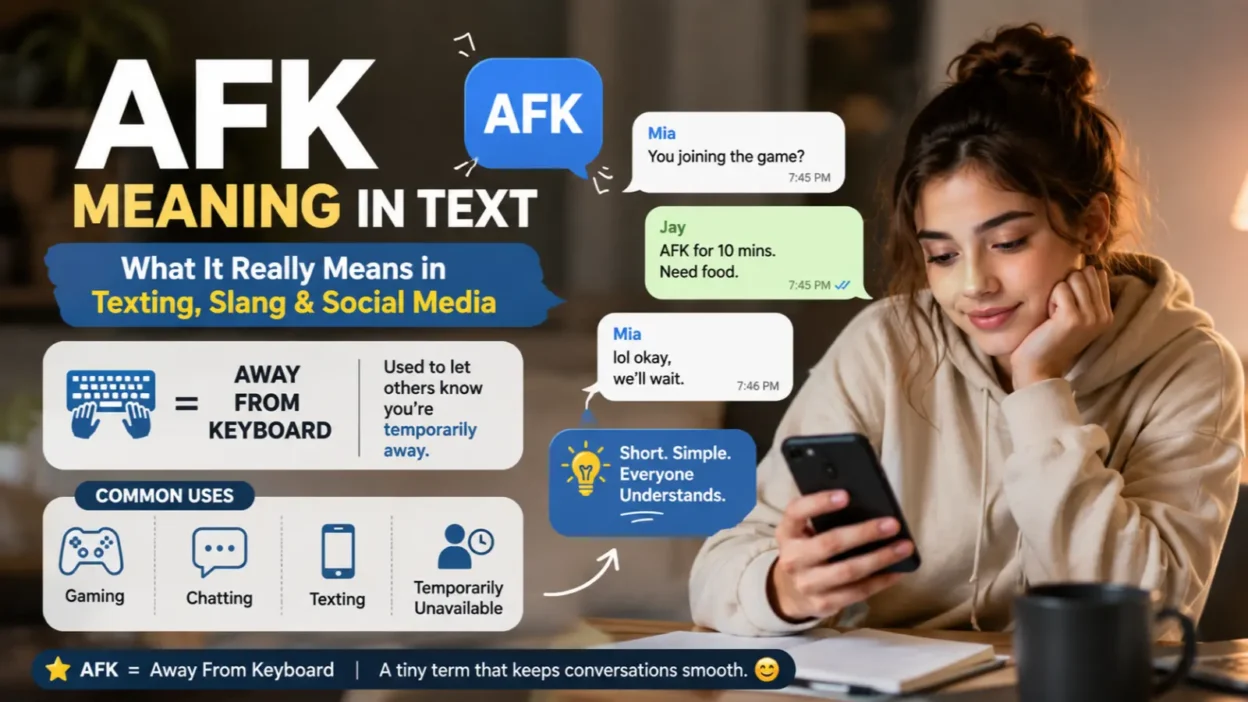
AFK stands for “away from keyboard.” In everyday digital communication, it tells people that you are temporarily unavailable, not actively participating, or stepping away from a game, chat, computer, or online activity.
Cambridge Dictionary defines AFK as a written abbreviation for “away from keyboard” used when someone temporarily stops taking part in a chat, while Merriam-Webster gives the same core definition.
A simple conversation might look like this:
Mia: Are you joining the game?
Jay: AFK for 10 mins. I need food.
Mia: lol okay, we’ll wait.
The interesting part is that AFK has grown beyond its literal keyboard meaning. People now use it to explain temporary absence, delayed replies, inactivity in games, and even a playful feeling of being mentally checked out.
Quick Definition & Meanings
At its core, AFK means “away from keyboard.” But the exact social meaning depends on where and how someone uses it.
1. AFK Means Temporarily Away
This is the most literal and common use.
Someone says “AFK” when they are stepping away from their device and may not respond immediately.
Example:
“AFK for five minutes. Be right back.”
The message sets an expectation: don’t assume the person is ignoring you. They are simply unavailable for a short period.
2. AFK Means Not Currently Active
In gaming and chat environments, AFK can describe someone who is still technically connected but is not participating.
Example:
“He’s AFK, so don’t start the match yet.”
Here, AFK focuses less on the physical keyboard and more on the person’s lack of activity.
3. AFK Means Temporarily Unresponsive
You may also see AFK when someone has stopped responding.
Example:
“Sorry, I was AFK when you sent that.”
This use is especially common in fast-moving chats where people want to explain a delayed response without writing a long explanation.
4. AFK Means Stepping Away From a Game
Gaming remains one of the strongest contexts for the term.
Example:
“I’m AFK. Cover my character for a minute.”
In competitive games, telling teammates that you are AFK can be important because your absence may affect the entire team.
5. AFK Can Mean Mentally Checked Out
Online culture often stretches old slang into metaphorical territory. Someone might jokingly say:
“My brain is AFK today.”
Here, the person is not literally away from a keyboard. They are saying they feel distracted, exhausted, disconnected, or mentally unavailable.
That playful extension is part of how internet slang changes. A term can keep its original definition while gaining new emotional uses.
What Does AFK Meaning in Text & Messaging?
In texting, AFK functions as a tiny status update.
Instead of explaining:
“I need to leave my phone for a few minutes, so I probably won’t answer.”
Someone can simply write:
“AFK.”
That three-letter abbreviation communicates several things at once: presence, temporary absence, and an expectation of delayed communication.
In private messages, AFK can sound casual and practical:
“AFK, calling my mom.”
In a group chat, it may help people understand why someone suddenly disappears:
“AFK guys, dinner.”
In gaming chats, it can be even more functional:
“AFK 2 mins.”
The underlying message is often, “I’m not ignoring you. I’m temporarily unavailable.”
That distinction matters emotionally. Digital communication has trained people to notice response times, read receipts, typing indicators, online status, and last-seen activity. When someone suddenly stops responding, silence can feel more meaningful than it really is.
AFK acts as a small piece of social reassurance.
It gives silence a reason.
AFK and Read Receipts
Imagine you send someone a message and they read it but do not reply.
If they later say:
“Sorry, AFK.”
the abbreviation reframes the situation. Their silence was probably about availability rather than attitude.
Of course, AFK does not automatically prove why someone disappeared. Context still matters. Slang communicates intent, but it cannot eliminate ambiguity.
AFK in Group Chats
Group chats move quickly, so AFK becomes useful shorthand.
“AFK for a while, catch up later.”
This tells everyone that the person has temporarily left the conversation without creating a dramatic announcement.
It is especially natural in communities where abbreviations such as BRB, TTYL, BBL, and GTG are already familiar.
AFK Origin, Evolution & Social Media Spread
AFK comes from older internet and gaming communication. The phrase “away from keyboard” was particularly useful in environments where people communicated through text and needed a quick way to tell others that they were temporarily absent. Cambridge and Dictionary.com both identify AFK with this meaning and connect its use to online chat and gaming communities.
Slang references commonly trace its wider adoption to early online chat and multiplayer gaming communities, including IRC-style communication and later massively multiplayer online games. Slang.net, for example, notes that AFK was used in early online communication before becoming especially common in gaming during the 1990s.
The technology changed, but the phrase survived.
That is one of the fascinating things about internet language. A term created around a keyboard can remain useful even when people communicate through phones, consoles, tablets, voice chat, and social platforms.
Today, saying “I’m AFK” does not necessarily mean a person has physically moved away from a keyboard. It usually means:
“I’m temporarily unavailable or not actively participating.”
That broader interpretation allows old internet vocabulary to survive in new communication environments.
Why Did AFK Spread So Easily?
AFK works because it is efficient.
Internet communities naturally reward language that communicates a lot with very few characters. AFK became especially useful in environments where timing matters, such as games and live chats.
Then digital communities began overlapping.
Gamers joined social platforms. Social-media users entered Discord servers. Workplace communities adopted chat-based communication. Internet slang moved with the people who used it.
Social platforms further exposed users to vocabulary from different online subcultures. A phrase that once felt specifically “gamer” could become ordinary internet language after enough people encountered it repeatedly.
This is how slang often travels: community to community, context to context, meaning to meaning.
Real-Life Conversations
WhatsApp / iMessage Chat
Sam: Are you free right now?
Alex: AFK for like 20 mins.
Sam: No worries.
What’s happening here?
AFK serves as a polite timing signal. Alex is not rejecting Sam. They are simply saying, “I’m temporarily unavailable.”
Instagram DM
Lena: Did you see the pics I sent?
Noah: Not yet 😭 AFK rn
Lena: Haha okay
The lowercase “afk” makes the message feel even more casual. In informal texting, capitalization often matters less than emotional context.
TikTok Comment
“I’ve been AFK from TikTok all week. What did I miss?”
Here, AFK is being used metaphorically. The speaker is not necessarily away from a physical keyboard. They mean they have been absent from the platform.
Gaming Chat
Player 1: Ready?
Player 2: AFK 2 mins, grabbing water.
Player 1: Got you.
In this context, AFK has a practical function. It communicates availability and helps teammates coordinate.
Work Chat
“AFK for lunch. Back at 1.”
This use shows how gaming terminology can move into ordinary digital communication. In a workplace, however, whether it sounds appropriate depends heavily on company culture.
Why Do People Say AFK Instead of “I’m Away”?
There is a social reason internet slang feels so natural.
It compresses communication.
Instead of:
“I’m going to step away from my computer for a few minutes.”
AFK provides the same basic status information instantly.
But there is another layer: shared language creates familiarity.
When two people both understand AFK, they do not need to explain it. The abbreviation quietly signals, “We speak the same internet language.”
That can create a sense of belonging.
Slang often works this way. It is not merely about saving time. It can also establish identity, community, humor, and tone.
Psychological & Emotional Dynamics of AFK
AFK looks simple, but short online expressions can carry surprisingly subtle social signals.
AFK Can Create a Boundary
Saying:
“AFK right now.”
can function as a digital boundary.
The speaker is communicating:
“I’m not available at this moment.”
That boundary is especially valuable in a culture where people often feel pressure to respond immediately.
AFK gives someone permission to pause without writing a defensive explanation.
AFK Can Reduce Social Misunderstanding
Silence online can be interpreted emotionally.
“No reply” might become:
- They are angry.
- They are ignoring me.
- They are busy.
- They forgot.
- They lost internet access.
AFK removes some of that uncertainty by attaching a simple explanation to the absence.
AFK Can Be Humorous
People also exaggerate the term for comedic effect:
“AFK from adulthood.”
“My brain has gone AFK.”
“Social battery = AFK.”
These uses turn a technical gaming phrase into a humorous description of everyday exhaustion or disconnection.
AFK Can Signal Internet Fluency
Among people familiar with gaming or online culture, AFK feels effortless.
Among people unfamiliar with internet abbreviations, however, it may sound cryptic.
That difference is important: slang creates connection when it is shared, but confusion when it is not.
Contextual Usage Guidelines
Social Media vs. Private Texts
On social media, AFK is often playful or metaphorical.
“AFK from Instagram lately.”
In private texts, it is more likely to mean literal temporary unavailability.
“AFK for dinner.”
The same abbreviation can therefore carry different levels of seriousness.
Close Friends vs. Casual Acquaintances
With close friends, AFK can be extremely casual:
“afk lol”
With someone you barely know, a slightly clearer message may be better:
“AFK for a bit. I’ll reply later.”
The extra context reduces ambiguity.
Professional or Formal Environments
Professional use depends on the workplace.
In a gaming company, Discord-based team, or highly informal tech environment, AFK may be completely normal.
In a formal business email, however, writing “AFK” can feel too casual or unclear.
Instead, use:
“I’m away from my desk and will respond shortly.”
The strongest communication habit is not knowing slang. It is knowing when slang fits.
AFK vs. Similar Expressions
| Expression | Primary Meaning | Tone | Best Usage Context |
| AFK | Away from keyboard; temporarily unavailable | Casual, internet-native | Gaming, chats, DMs, online communities |
| BRB | Be right back | Casual, friendly | Texting, chats, gaming |
| BBL | Be back later | Casual | Longer temporary absence |
| TTYL | Talk to you later | Friendly, conversational | Ending a conversation |
| Offline | Not currently connected or available | Neutral | Apps, social platforms, general digital use |
The distinctions are small but useful. AFK emphasizes being temporarily away or inactive. BRB suggests a relatively quick return. BBL often implies a longer absence. TTYL focuses more on ending the current conversation, while offline describes connection or availability more generally.
AFK Variations, Derivatives & Playful Forms
Internet users rarely treat abbreviations as rigid vocabulary.
You may see:
“AFK” – standard form
“afk” – lowercase casual form
“going AFK” – announcing that you are about to leave
“was AFK” – explaining previous inactivity
“AFK rn” – away from the keyboard right now
“AFK for a sec” – very short absence
“AFK mode” – playful description of being unavailable
“brain AFK” – joking about mental exhaustion or distraction
You may also see people turn AFK into a verb-like expression:
“I’m gonna AFK for a minute.”
Technically, the original phrase is an abbreviation, but internet language frequently turns abbreviations into flexible parts of speech.
How to Respond to AFK
Casual Replies
“Okay, no rush.”
“Got you.”
“All good!”
“Catch you later.”
Funny or Sarcastic Replies
“Bro entered AFK mode 😂”
“Wake up when civilization returns.”
“We’ll pretend you’re still here.”
Mature and Direct Replies
“No problem. Message me when you’re back.”
“Understood. I’ll follow up later.”
These responses work because they match the low-pressure nature of AFK. There is usually no reason to turn a temporary absence into a serious social event.
When NOT to Use AFK
AFK is widely understood online, but it is not universally appropriate.
Avoid relying on the term when the audience may not know internet slang.
For example, writing:
“AFK, will reply later.”
to a formal client may leave the message sounding overly casual.
It can also be risky during serious conversations.
Imagine someone is discussing an urgent personal issue and you respond:
“AFK.”
Although technically understandable, it may sound abrupt or dismissive.
In emotionally sensitive situations, clear language often works better:
“I need to step away for a little while. I’ll respond when I can.”
Common Misconception: AFK Means You Are Completely Offline
Not necessarily.
Someone can be AFK while still technically connected to the internet or logged into an application.
The key idea is temporary absence or inactivity, not necessarily loss of connection.
Common Misconception: AFK Is Only for Gamers
Gaming played a major role in popularizing the term, but AFK now appears in broader internet communication. Dictionaries such as Cambridge, Collins, and Dictionary.com recognize its wider use in chat and messaging.
Common Misconception: AFK Means “I Don’t Want to Talk”
Usually, no.
AFK generally describes availability, not emotional rejection.
Someone saying they are AFK normally means they cannot actively respond at that moment.
The surrounding conversation still determines the emotional meaning.
Gen Z, Millennials & Older Internet Users
Different generations may encounter AFK through different online environments.
Gen Z
Younger users may recognize AFK as part of a much larger vocabulary of gaming, Discord, meme, and social-media language.
They may also use it creatively:
“I’m mentally AFK.”
For this group, the term can function as both literal shorthand and playful metaphor.
Millennials
Many Millennials encountered AFK through early gaming, forums, chatrooms, MMORPGs, or online messaging.
For them, the term can carry a slightly nostalgic internet feel while remaining completely understandable.
Older Audiences
Older users who did not grow up around gaming and online chat may know AFK, especially if they work around technology, but others may find it unfamiliar.
That is why audience awareness matters.
A good communicator does not use slang simply because it exists. They use it because the audience will understand the intended tone.
AFK in Global Internet Culture
Internet slang spreads across national borders surprisingly easily.
A user in Pakistan might see AFK in a gaming stream. Someone in Brazil may encounter it through English-language memes. A user in Japan might see the abbreviation in an international gaming community.
The phrase remains recognizable because it is short, visually distinctive, and strongly connected to global digital culture.
For non-native English speakers, abbreviations like AFK can initially feel confusing because the literal words are not always obvious. But repeated exposure makes them easier to recognize.
This is one reason online slang can become an informal shared language across cultures.
Is AFK Still Relevant Today?
Yes.
Its literal reference to a keyboard is older than many of the devices people now use for online communication, but its underlying social purpose remains highly relevant.
People still need ways to communicate:
“I’m temporarily unavailable.”
AFK simply packages that message in a form that internet communities instantly recognize.
Its continued use is less about keyboards and more about the digital habit of announcing availability.
FAQs:
What does AFK mean in text?
AFK means “away from keyboard.” In texting, chats, and gaming, it usually tells someone that you are temporarily away or unavailable.
Is AFK rude?
Usually, no. AFK is generally a neutral or casual way to explain that you are temporarily unavailable. However, sending only “AFK” during a serious conversation can feel abrupt depending on the context.
What does AFK mean in gaming?
In gaming, AFK means that a player is temporarily away or inactive and may not be controlling their character or participating normally.
What does AFK mean on social media?
On social media, AFK can mean temporarily absent from the platform. It is also used humorously to describe being mentally distracted or disconnected.
What is the difference between AFK and BRB?
AFK means you are away or inactive, while BRB means “be right back,” which more directly suggests that you expect to return shortly.
How do you reply when someone says AFK?
You can respond casually with “No worries,” “Okay,” “Got you,” or “Message me when you’re back.” A playful reply can also work among close friends.
Final Thoughts:
Understanding AFK meaning in text is really about understanding a small but useful piece of internet culture.
At its foundation, AFK means “away from keyboard.” It tells people that someone is temporarily unavailable, inactive, or stepping away from a chat or game.
Dictionaries continue to define the term around that core meaning, while modern online usage has expanded it into broader expressions for digital absence and even mental distraction.
The most interesting thing about AFK is not the acronym itself. It is what the acronym does socially.
It manages expectations.
It protects against unnecessary assumptions.
It lets people step away without turning absence into an explanation.
And online, where silence can be interpreted in dozens of emotional ways, that tiny clarification can make a surprising difference.
So when someone texts “AFK,” they usually are not sending a hidden message. They are simply saying, in the language of internet culture:
“I’m not available right now. I’ll be back when I can.”
Sometimes three letters really are enough to keep a conversation moving.

I am Maxwell Ford, the creator of meaningosho.com, where I explore the origins and clear definitions of everyday words. I built this platform to help readers easily decode complex vocabulary and deepen their understanding of language. Through my articles, I love sharing simple, engaging insights that make learning new words both fun and useful.